I am Lloyd Stellar, an electro producer from Hilversum
Lloyd Stellar
Erik Griffioen. Electro producer and software developer from Hilversum, The Netherlands. Owner of LDI Records and co-owner of Control Data Institute. Also known as Warriors of Kagh.
Who I am
My name is Erik Griffioen and I make electro as Lloyd Stellar. I live in Hilversum, in the Netherlands, and I work alone in my home studio. My contacts are spread over the whole world, and most of them I only know through the internet.
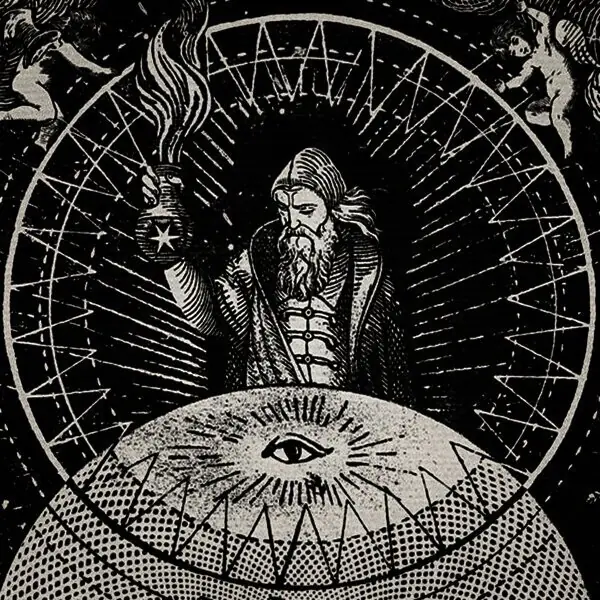
My logo, the one you see here and on every platform where my music is, is an alchemist. He prepares the drink that his followers take. That drink is my music. I try to lure people into it, into that world. The tracks are built on machine-like beats, floaty pads and vocoder voices. They are about the future, about strange cults and other occult things, about greed, and about people and machines.
I have releases on 20/20 Vision, Brokntoys, Science Cult, Hilltown Disco and Exploited Records. Since 2021 I run my own label, LDI Records, and with Francois Dillinger from Detroit I run a second one, Control Data Institute. More about both further down. All my own releases are on the releases page.
Where the name comes from
In the early 2000s I wanted to write a science fiction book. The main character was called Lloyd Stellar. I have always been fascinated by the name Lloyd, because it starts with two L's, and that is strange. Stellar fits science fiction, but what I liked was the double L in the middle. I also know someone with the surname Staller, and I thought that name would be better with the vowels swapped. The book never got written. The name stayed.
The first machines
In the first half of the 1990s I spent a lot of time at my father's Amiga 500 with ProTracker. We had a sampler too. My mother worked for the radio and had professional gear at home: a microphone and a portable high-end cassette recorder. I could plug those into the Amiga. I never made anything good in those years, but I had fun messing with sounds.
At the end of the 1990s I bought my first synthesizer, a Korg MS-20. I had seen it in the booklet of Moon Safari by Air and I fell in love with how it looked. I understood very little of how it worked, and there were no YouTube videos to explain it. After about a year I sold it and bought a good sound card, headphones and FruityLoops. That is when I started making drum and bass.
Years later I started buying hardware again. I took out a loan for a Nord Modular G2. The manual that came with it taught me how synthesizers actually work. The G2 was sold long ago, but that manual is where my understanding started.
How I found electro
In the 1990s I heard electro now and then, but I had no idea what the genre was called, so I could not look for more of it. In 2001 I lived in The Hague and went out a lot, among other places at De Blauwe Aanslag. They played electro there sometimes, and through the internet I finally learned the name. The Hague produced a lot of electro in those years, and I got pulled into that rabbit hole. I was still making drum and bass, but it slowly turned into electro.
What electro is to me
To me, electro is a form of techno, but an elementary one. Techno usually turns around the kick drum. Electro hangs its rhythm on the snare. What I love about it are the pure synthesizer sounds. Techno is wide and goes in every direction. Electro is a niche and mostly underground. Many of the people who make it or listen to it like the same things I like: vintage hardware, science fiction, underground music and the scene around it.
Bosch, cults and science fiction
I have an odd fascination for medieval music and art, especially the folk mysticism in it. I love the paintings of Hieronymus Bosch. The enormous dark fantasy he puts into his work inspires me more than anything. The alchemist in my logo comes from that world.
I also love science fiction. In the 1990s I bought the complete Meulenhoff series of science fiction pocket books, more than a hundred classic novels, and read most of them. I grew up with the Commodore 64 and the Amiga 500, and those were my happiest years with computers. That is where the retro computers on this website come from.
A lot of electro producers use science fiction, and I find that a bit of a shame, because it quickly becomes a cliché. So I also write tracks about strange cults and other occult subjects. But I cannot stop writing about science fiction either.
Vocoders, and a confession
I have a strange fascination for voices with effects on them. The vocoder is my favourite. But I secretly also like exaggerated autotune, the kind used in more commercial music for the last 25 years. I know many people in the underground hate it. I cannot help that it does something for me.
I also do not have a good singing voice, so vocoders are great for me, even though a vocoder in electro can be as much a cliché as science fiction. My favourite vocoder lives in an old Nord Micro Modular. It is the only thing I use that machine for.
How a track gets made
Most of the time I start by messing with a beat. These days that means sitting down at my Roland TR-1000 and working on a pattern until I have something I like. Then I add layers. I go with the flow and I never know in advance where a track is going. I fiddle with sequencers, turn some knobs, play some keys, and before I know it three hours have passed and a track is done.
I use a lot of hardware, but I record and mix in Ableton Live, so most of the effects are plugins. I often add samples too. I am not a synthesizer purist at all. I use what I have. One time it is a riff from my self-patched Eurorack, the next time it is a sample from Splice that I chop up. There is no "this is allowed and this is not". I do not care where a sound comes from, as long as it works in my music.
I make music when I feel the urge to make music. The urge has to be there. For a while it was gone, and then I made twelve tracks in two weeks. That is how it goes. It comes in waves, and I never know when.
The studio
My favourite synthesizer is the Korg Prologue 16. Its sounds touch something deep in me. It is not the most practical synth to use, but in the end it is about the sound.
I also have a Roland SH-101. Together with the TR-808, the SH-101 has always been the foundation of electro. I owned the Behringer 808 clone for a while, but since the Roland TR-1000 arrived, with its analogue 808 circuits on board, I have sold my other drum machines. Both the SH-101 and the 808 spin as wireframes in the Holo Archive on the home page.
What is in the studio
Recording and mixing in Ableton Live. Samples are welcome too.
Who plays my records
Dave Clarke plays my music regularly on his radio show White Noise. When I have a new release I send it to him, and it usually ends up in the show. During the pandemic there was an ADE special on BBC Radio, and he closed his set with one of my remixes.
Helena Hauff played a remix of mine on BBC Radio 1. She plays vinyl only, so now and then I hear an LDI Records track in one of her mixes on SoundCloud or YouTube. That is an honour, because I think she is the best electro DJ of recent years.
With The Droid I released Rise Of The Machines on 20/20 Vision in 2022, the label of Ralph Lawson, and he played my tracks for a while too.
A favourite of my own
That is a hard one. The EP I find most interesting is Esoteric Enterprise, released by Gated in 2021 as a limited white label 12 inch. I made those tracks a long time ago. I was not very skilled yet and they did not sound great. Then the label had them mastered, and suddenly they sounded fantastic. The naivety in that music is what makes it special to me now. They are odd tracks, and I could not make them like that anymore. I think that is why it has become my favourite.
Corporate Electro, and why my music is free
My latest EP is Corporate Electro, with tracks like Destroy Data Centers and Ban The Algorithm. The titles are not irony, and they are not aimed at AI. I see the dangers of AI, but I also see a lot of good in it. The titles are aimed at social media and American big tech.
I think social media is one of the biggest dangers to humanity right now. Walk into any public space and everyone is glued to a phone, caught in algorithms that keep the dopamine flowing as long as you keep watching, like sitting at a slot machine. I am a real social media hater. If it stopped existing today, the people who have turned into Borg drones could rejoin society.
As an artist I am not free of it myself. I have been fighting for years to use it as little as possible, but if I do not share my new music anywhere, nobody will find it. So I am part of the problem too.
Over the years I started to dislike sending my music to labels, until I thought: forget it, I will release it myself. Giving music away for free gives me the same feeling I liked about the internet of the 1990s. Almost everything was free then, with no logins and no tracking. I like that hippie idea. As a system administrator I have always loved open source software. My music is not open source, but releasing it this way feels right. And although it is free to download on Bandcamp, about a quarter of the people who download it pay something anyway. You give something away, and people still want to hand you some money. That is a good feeling.
Mastering
Mastering started with my own music. At first I was no good at it, but slowly I got better, until friends and small labels I knew asked me to master their music. I did that for free, and that is how I learned the trade. After a long time I had enough confidence to see if I could earn money with it. I did that for a while, but it did not bring in much. Now that my software company takes up more of my time, I have stopped offering mastering as a service. I still master my own music, sometimes a friend's, and the digital releases on LDI Records.
Two labels
LDI Records
LDI Records (Lloyd's Dark Imperium) is a passion project. I started it in 2021 because I love vinyl and wanted my own vinyl label. Of course I hoped to earn a little money with it too. It has cost a lot of effort, time and money, and a while ago I decided to continue as a digital label for now. If times get better for vinyl, I may press records again.
Nothing about vinyl is easy. It is expensive and it takes long to get made. Then you have to work hard on marketing to sell the records. My distribution goes through Clone in Rotterdam, but that does not mean the records sell themselves. If you are lucky you break even on a release. Most of my vinyl releases cost me far more than they brought in. If you want to make money, do not press underground music on vinyl.
The label has released music by T/Error, Francois Dillinger, Versalife, Terrestrial Access Network, Cliff Dalton, Human Rebellion, Dirk Wiertz, Robodroid and others.
What I look for in a demo is something unique, something that hits me right away. I usually hear within ten seconds whether a track is special. I start somewhere halfway, and it has to grab me immediately. If it passes that test, I listen to all the tracks a few times, calmly. Demos can go through the contact form.
LDI Records on Bandcamp
Control Data Institute
Control Data Institute (CDI) is a label I run with Francois Dillinger from Detroit. Ben, as he is called in daily life, and I met online. We liked each other's music and started chatting about music and about life. A friendship grew out of that. We made an EP together for LDI Records, LDI003, and the collaboration went so well that we started CDI.
We split the roles. Ben is good at reaching artists and at the marketing and visual side of the project. For almost two years we had a video call every two weeks. Our first release was a USB stick with a compilation of electro artists, plus extras you could only get on the stick: an EP by Lloyd Stellar and Francois Dillinger together, sample packs and DJ tools (long, simple electro loops). Ben designed the stick. The price was fair for all of that, and the 100 sticks sold out on Bandcamp within 24 hours. Digital downloads are still available in the CDI store.
Visit the CDI store
Warriors of Kagh
Warriors of Kagh is my side project for calm music, somewhere between dark ambient and liminal music. It is a kind of music therapy. When I am going through a difficult period, messing around with quiet music can be healing. I do not listen to much ambient myself, because I cannot keep my attention on it, but making it relaxes me.
I do not remember exactly where the name came from. Warriors, more or less because of the struggle. Kagh just sounded good to me, a bit Klingon. Klingons are warriors too. Warriors of Kagh sounds like the descendants of a Klingon called Kagh.
The latest album is Music for Liminal Spaces (June 2026), eight instrumental pieces for those in-between places that feel frozen between past and present.
Warriors of Kagh on Bandcamp
What I listen to
My taste is wide, as long as the music is authentic or original. Sufjan Stevens is one of my favourite artists. Aphex Twin is brilliant. Neutral Milk Hotel, Joy Division, Antony and the Johnsons. David Bowie, mostly his work from the 1970s and the 1990s. I love old Americana from the Appalachian mountains, and sometimes I listen to medieval music. I like hip hop with old soul samples, the way The Alchemist makes beats for Armand Hammer and Earl Sweatshirt, but trap beats are not for me. Minimal piano music when it is warm and dreamy, like Joep Beving. And Kraftwerk, above all Computer World. That album is a big source of inspiration, and you can probably hear it in this website too.
Beyond music
I am a software developer. The tools and games on this site are mine: the online TR-808, the More Lasers plugin, Lloyd's Sample Maker for Ableton, Spin Doctor, the Bowie Lyrics Cutter and the arcade. I also run Gryffi, a tool that helps companies communicate information better to neurodivergent people. And there is Lloyd's Shirt Lab on Etsy, with shirts for Lloyd Stellar, LDI Records and Control Data Institute, and a few designs with vintage synthesizers.
Why this page exists
I hope people who like the same things I like will poke around on this website, try a tool or a game, and have a good time on the internet for a while because of it. If you want to say hello, use the contact form.