Lloyd's Future Arcade is a set of five free retro browser games, playable on desktop and phone without a download, an account or ads. There is a 2048 puzzle played against a rogue AI, a Tetris-style block stacker set in a synth rack, a Suika-style merge game in space, Space Invaders as it ran on the first IBM PC, and a rhythm game built on a real TR-808 drum machine. Every game has a worldwide hall of fame.
5 games
0 downloads
0 accounts
5 halls of fame
Updated
I am Lloyd Stellar, an electro producer from Hilversum. I build these games the way I build tracks: in the evenings, in the studio, with a lot of vintage hardware around. That is why the games are full of drum machines, synth modules and CRT screens. Pick one below, or jump straight to the game you came for.
Which game are you looking for?
If you searched for a classic, this table tells you which game in the arcade plays like it.
Played on a real TR-808 pattern, fire on the quarter note
The five games
2048 Override Play 2048 online against a rogue AI
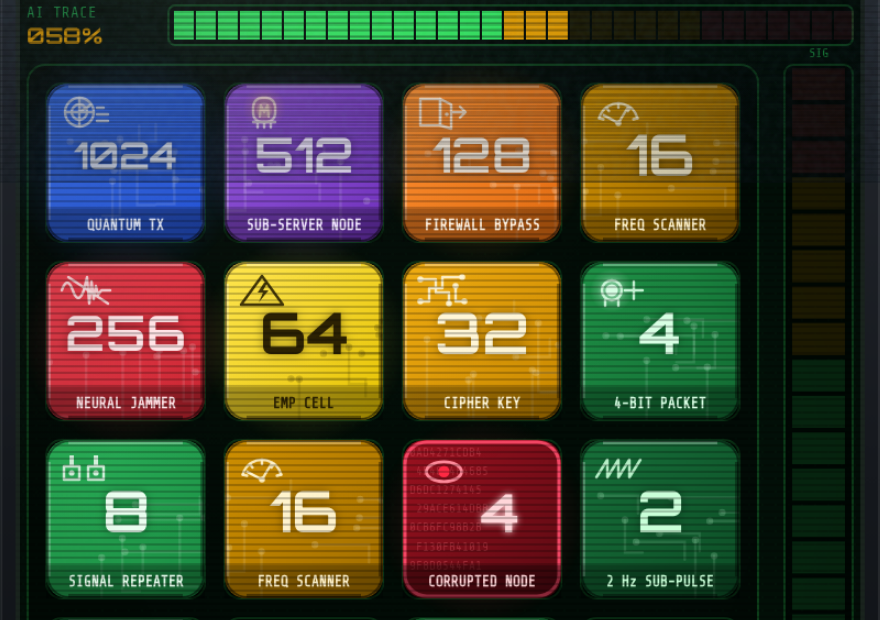
2048 Override is the 2048 puzzle played on a hacked military CRT in the year 2048. Slide the tiles, fuse two equal signals into one of double strength, and build a pulse of exactly 2048 bit to overload the processing core of the AI NEXUS-9. The sliding and merging rules are the original ones, so if you know 2048 you can start right away.
What the original does not have: an AI trace meter that rises with every move that does not fuse anything and locks a cell when it hits 100%, red corrupted nodes that only an equal tile or a 64 EMP cell can remove, a generated electro soundtrack that speeds up as your highest tile grows, an endless mode to 4096 and 8192, and lore files and phosphor colours you unlock along the way.
Controls arrow keys or WASD, swipe on a phone
Score frequency in Hz, every fusion adds the new tile's value
Based on the open-source 2048 by Gabriele Cirulli (MIT)
Patch Bay A Tetris-style block stacking game in a Eurorack rack
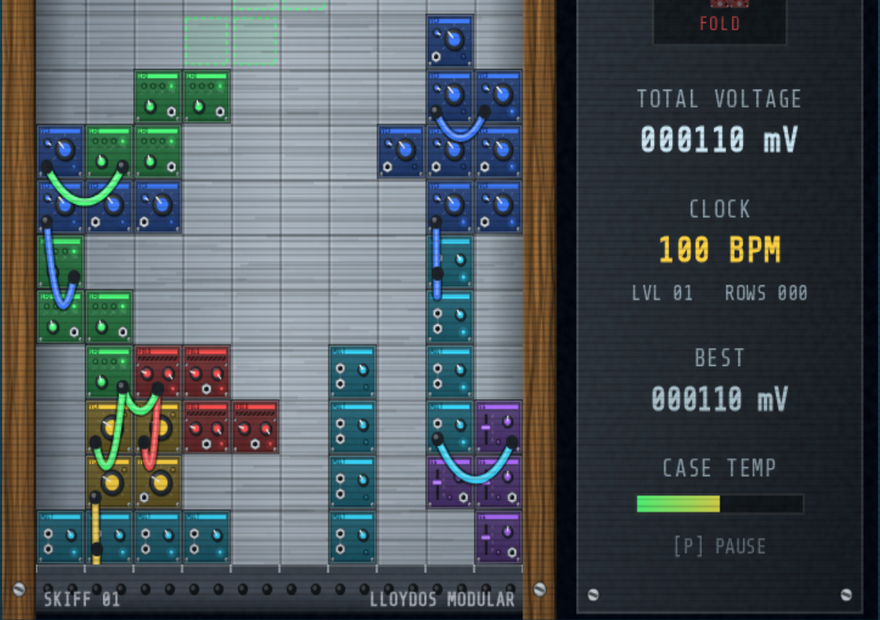
Patch Bay is a falling-block game with the classic rules: seven shapes made of four squares, a well of ten by twenty, and a full row disappears. Here the well is a Eurorack skiff and the shapes are synth modules, each with its own panel, knob, jack and blinking LED. A runaway master clock keeps shipping them in; your job is to mount them and close the signal paths before the rack short-circuits.
Every module you mount gets patched to its neighbours with a cable, so a full case turns into cable spaghetti. There is a ghost outline, a hard drop, a buffer to park a module and a queue of the next three. Your voltage adds up across games and unlocks case skins, cable styles and soundbanks, including the 808 samples from this site's drum machine.
Controls arrows move, up rotates, space drops, C buffers; swipe or buttons on a phone
Score total voltage in mV: 10 per module, 100 to 800 per cleared rows
Based on Jake Gordon's open-source JavaScript Tetris (MIT)
Stellar Singularity A Suika-style merge game, from stardust to black hole
Stellar Singularity is a merge game in the spirit of Suika Game, the watermelon game: drop a body into the well and two equal bodies that touch fuse into the next one up. Instead of cherries and melons you build from stardust to meteoroid, asteroid, comet, moon, planet, gas giant, ringed giant, star and red giant, until two red giants collapse into a black hole.
The physics are real circle physics with squash and chain reactions, the backdrop is the Milky Way, and two black holes that meet vanish in a gravitational wave for a bonus. Keep the pile below the event-horizon line, or the containment fails.
Controls move with the pointer or arrow keys, drop with a click, tap or space
Score every fusion scores, black holes score most
Tiers 11 celestial bodies, the five smallest can be dropped
Stellar Invaders Space Invaders as it ran on the 1982 IBM PC
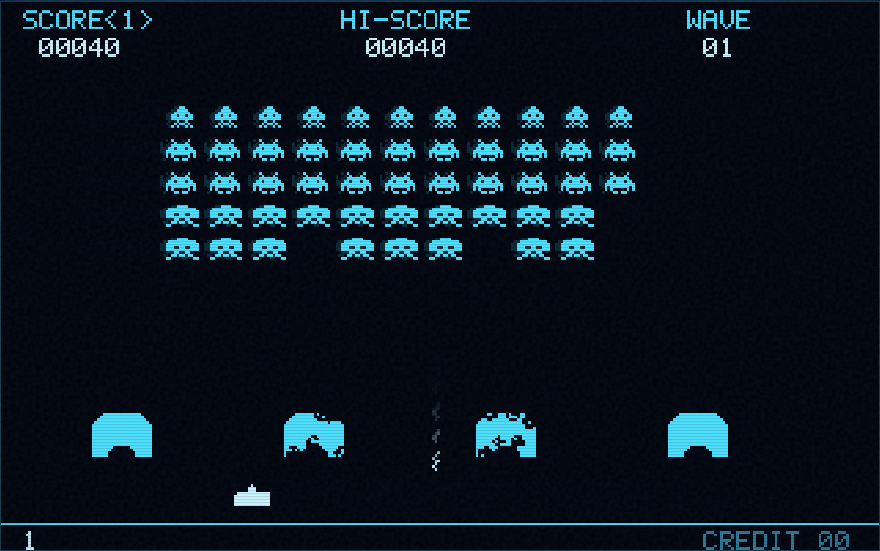
Stellar Invaders is Space Invaders the way the first IBM PC owners played it in 1982: 55 invaders in eleven columns, four bunkers, one cannon, a 320 by 200 screen and a single-voice PC speaker for the sound. The phosphor afterglow of a monochrome monitor is part of the picture.
Seven skill levels change the speed of the invaders and the number of shots in the air, you get an extra life every 1000 points, and the mystery ship still crosses the top of the screen when you least expect it.
Controls arrow keys to move, space to fire; touch buttons on a phone
Score 10, 20 or 30 per invader depending on the row, more for the mystery ship
808 Defender A rhythm game played on a real TR-808 drum machine
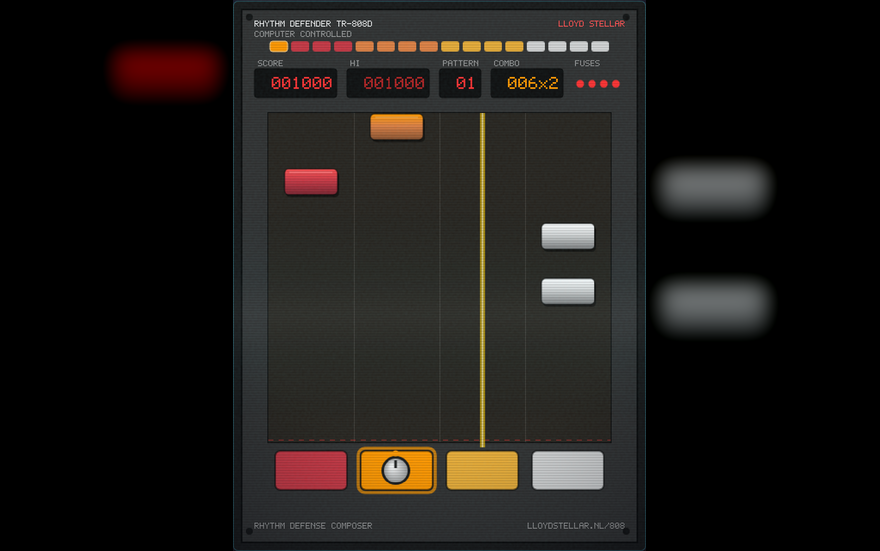
808 Defender is a rhythm game built on top of the online TR-808 on this site. Rogue step buttons march down four lanes on the beat of a real 808 pattern, and you may only fire on the quarter note. Hit on the beat and the groove opens up, miss and the drums fall silent.
Every level is the next pattern of a nine-artist setlist from the drum machine, T/Error, Nachtwald, Anthony Rother, Carl Finlow, Cliff Dalton, The Exaltics, Legowelt, The Droid and Lloyd Stellar, each at the tempo the artist programmed it, with the artist's photo and bio when the level starts. The buttons spawn from the hits in the pattern, so each level marches to its own groove. Armoured and fast buttons arrive from level 2 and 3, and after the full set it all runs again 8 percent faster.
Controls arrow keys or 1 to 4 for the lanes, space fires; tap a lane on a phone
Score on-beat hits and combos, plus 250 and 500 times the level for clearing it without a blown fuse
The arcade runs on plain HTML, CSS and JavaScript, no frameworks, no app store. A game page is a few hundred kilobytes and loads in a second on a phone. Here is what you can expect from every game.
Free, and staying free
No price, no premium tier, no ads, no newsletter popup. The arcade is here because I like making it, and because some of you might like my music afterwards.
No account
You do not log in. Mute settings, your best score and your unlocks live in your own browser. The only thing that leaves your device is a hall of fame entry, and only if you type a name.
Worldwide hall of fame
Each game keeps a public top 10 of all visitors. Make the list and you can sign it with up to 25 characters. The top score of every game is shown live on this page.
Desktop and phone
Keyboard on a desktop, swipes and buttons on a phone, and a fullscreen button on every game. The name field stays visible above the phone keyboard when you sign the hall of fame.
Sound starts when you do
All sound is synthesized or sampled in the browser and only starts after you press a key or tap. Every game has a mute key, so your own records can keep playing.
Open-source roots
2048 Override and Patch Bay are built on MIT-licensed code by Gabriele Cirulli and Jake Gordon. The credits stay in the code and on the game pages.
Why there is an arcade on a music site
This website started as a toolbox for electro producers: a free VST plugin, an online drum machine, a vinyl video maker. The games grew out of the same habit. I spend my days with sequencers, synth modules and old computers, and sooner or later you want to play with them instead of working with them. Stellar Invaders came first, because the IBM PC version of Space Invaders was the first game I ever played. 808 Defender turned the drum machine into a game. Patch Bay and Stellar Singularity put the studio and the night sky into two classic puzzles, and 2048 Override gave the oldest number puzzle on the web a story and a soundtrack.
The whole site is themed as LLOYDOS, a fictional retro operating system with a cyan phosphor CRT look, so the games fit in: scanlines, terminal text, vector wireframes. If the sound of the arcade appeals to you, the real thing is on Bandcamp and Spotify, and the releases page has the players. My latest EP, Corporate Electro, is free.
Frequently asked questions
Are the games in Lloyd's Future Arcade free?
Yes. All five games are free to play in the browser, with no download, no account, no ads and no in-app purchases. Scores you submit to a hall of fame are stored under the name you type, nothing else.
Can I play the games on my phone?
Yes. Every game has touch controls (swipes or on-screen buttons) and a fullscreen mode. Stellar Invaders plays best with the phone held sideways; the other four are built for portrait.
Is 2048 Override the same as the original 2048?
The sliding and merging rules and the 90/10 spawn of 2s and 4s are exactly Gabriele Cirulli's 2048, so anyone who knows 2048 can play it straight away. On top of that it adds an AI trace meter that locks cells, red corrupted nodes that only an equal tile or a 64 can remove, a soundtrack that speeds up with your highest tile and an endless mode to 4096 and 8192.
Is Patch Bay a Tetris game?
Patch Bay uses the classic falling-block rules that Tetris made famous: seven four-square shapes, a 10 by 20 well, full rows disappear. It is not an official Tetris product. The pieces are synth modules dropping into a Eurorack case, and there are patch cables, a buffer, hard drop and unlockable case skins and soundbanks.
Is Stellar Singularity like Suika Game?
Yes, it is a merge game in the spirit of Suika Game, also known as the watermelon game: drop a body into the well, and two equal bodies that touch fuse into the next one. Instead of fruit you build from stardust to meteoroid, asteroid, comet, moon, planet, gas giant, ringed giant, star, red giant and black hole, and two black holes vanish in a gravitational wave for a bonus.
How do the high scores work?
Each game keeps a worldwide top 10 of all visitors. When your score makes the top 10 at the end of a game, you can type a name of up to 25 characters and it appears on that game's hall of fame page. Nothing else is stored.