The Brazen Head: A Talking Oracle from 1594
A head of brass stands in a vault at night. It will answer one question, but only if somebody is awake when it speaks, and it does not wait. This is the scene Robert Greene put on the stage around 1590: Friar Bacon has watched his head for sixty days and has fallen asleep, and you are Miles, his servant, with a bell. Every answer is a quotation from a book written between 1125 and 1834; the head never makes anything up. Wake the friar in time and a drawer in the pedestal turns the head into a vocoder you can play. Free, no account, and nothing you type leaves your browser.
No. III A head of brass on an oak pedestal, after Friar Bacon. It speaks three times. Stay awake.

A note on the table
Miles, I have watched this head for threescore days and can keep my eyes open no longer. Watch it for me. The moment it speaks, ring the bell and wake me. Do not wait.Bacon
You are Miles. Light the candle, give the head a question if you like, and keep watch. When its eyes light up you have a few seconds to ring the bell: click it, or press the space bar or Enter.
The plate is being engraved
With sound. Every word is also written down.
This vault is drawn by your graphics card with WebGL 2, which this browser does not offer or has switched off. The picture shows what you would see. Everything below the vault still applies.
The plate cracked: the graphics card restarted. Light it again.
How to keep watch
Light the candle first. Until then the vault is dark and silent, and the click on the candle is also what allows the page to make sound. The head speaks with the voice of S.A.M., a speech program from 1982, pushed through three resonators that open and close with its jaw. Everything it says is written on a scroll as well, so you can play with the sound off.
Then write a question on the strip of parchment and feed it to the head, or keep watch without one. The hourglass is turned. Before the sand has run out, the eyes light up and the head says Time is.
From that moment you have three and a half seconds to ring the bell: click it, or press the space bar or Enter. Ring in time and Friar Bacon wakes, and the head answers your question.
The vault does its best to make you ring too early. The jaw clicks, the friar talks in his sleep, the candle nearly goes out. Ring for nothing and Bacon wakes up for nothing, and he lets you know. Miss the moment and the head falls silent; the next time it says Time was
and you have two seconds. The third time it says Time is past
, you get one second, and after that the play takes its course.
A broken head stays broken, also when you come back tomorrow, until you cast a new one: work the bellows three times. Every new head carries a seam where the last one broke. Ask the same question within the same hour and you get the same answer. The button at the top right of the vault, or the F key, makes it fill the screen.
Four heads of brass and the books they come from
For five hundred years Europe told the same story about learned men and talking heads. The page is built on the last and best known of them, but the head knows all four.
Gerbert of Aurillac William of Malmesbury, around 1125
Gerbert, the scholar who became Pope Sylvester II in 999, is said to have cast the head of a statue that spoke only when spoken to, and then only yes or no. Asked whether he would be pope, it said yes. Asked whether he would die before he had sung mass in Jerusalem, it said no. He never went to the Holy Land. But in Rome there is a church called Jerusalem where the pope sings mass on three Sundays of the year, and on one of those days Gerbert fell ill as he prepared for mass, and died.
Robert Grosseteste John Gower, 1390
In Confessio Amantis the bishop of Lincoln spends seven years forging a head of brass that will tell of things to come, and loses all of it because he is half a minute late. Gower tells it as a warning to lovers who hesitate.
Albertus Magnus William Godwin, 1834
Albertus is said to have built a whole man of brass, over thirty years, that answered every question and served him as a domestic, until it talked so much that his pupil Thomas Aquinas picked up a hammer and beat it to pieces. Leave an awake head alone long enough and you will understand him.
Roger Bacon Robert Greene, printed 1594
The version most people know is Greene's play Frier Bacon and Frier Bongay, written around 1589. Bacon has made a head of brass that is to tell him how to put a wall of brass around England. After sixty days of watching he falls asleep and leaves his servant Miles on guard with a bill in his hand. The head says Time is.
Miles decides that is not worth waking anybody for.
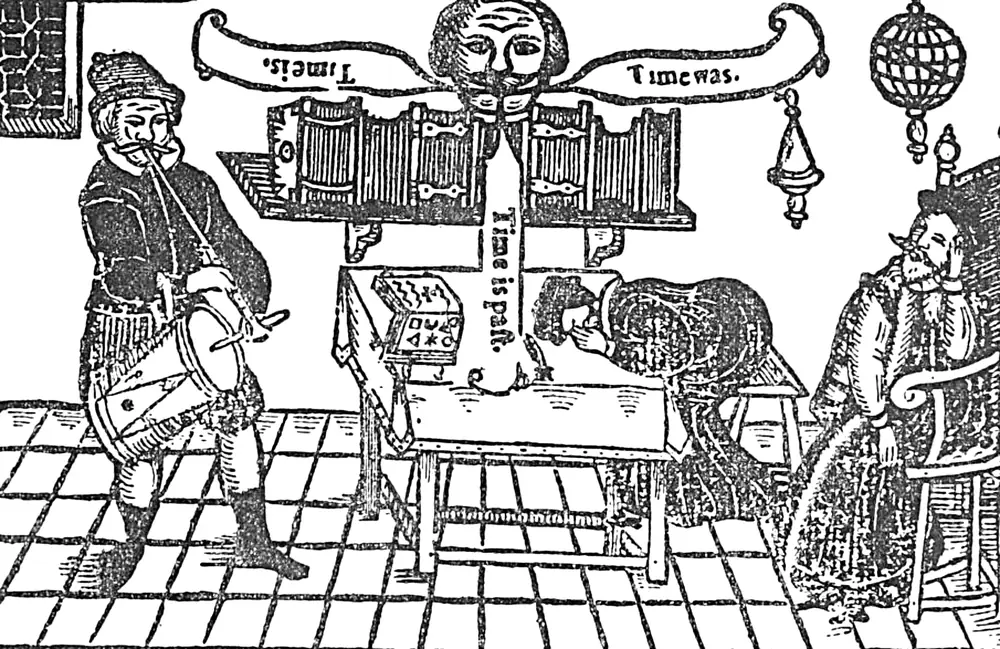
What the head says 189 quotations, each checked against its source
The head never invents anything. Every answer is a quotation in the spelling of the book it comes from, with the source written under it on the scroll. Questions that start with will, shall, is, can and the like get a yes or a no, the way Gerbert's head answered, sometimes with a proverb as a sting in the tail. A few questions it recognises. Everything else is drawn by lot from these books:
- Robert Greene, The Honorable Historie of frier Bacon, and frier Bongay (London, 1594), with four lines from the edition of 1630. The head's own words, and those of Bacon and Miles.
- Nostradamus, The True Prophecies or Prognostications of Michael Nostradamus, translated by Theophilus de Garencières (London, 1672). For most questions.
- The Prophesie of Mother Shipton (London, 1641). When nobody asks anything.
- John Heywood, A dialogue conteinyng the nomber in effect of all the prouerbes in the englishe tongue (London, 1546). The sting after a yes or a no, and the chatter of a head left alone.
- Meric Casaubon, A True & Faithful Relation of What passed for many Yeers Between Dr. John Dee and Some Spirits (London, 1659), and Dee's private diary, edited by J. O. Halliwell (1842). What the angels told John Dee and Edward Kelley.
- Reginald Scot, The Discoverie of Witchcraft (1584), in Brinsley Nicholson's reprint of 1886. After midnight.
- William of Malmesbury, Chronicle of the Kings of England (around 1125, translated by John Sharpe and J. A. Giles, 1847), John Gower, Confessio Amantis (1390, edited by G. C. Macaulay, 1901), and William Godwin, Lives of the Necromancers (1834). The head's own history.
The texts of 1546 to 1659 come from the transcriptions of the Text Creation Partnership (Early English Books Online), the rest from Project Gutenberg. Long s is printed as s; everything else, u for v and all, is as it was printed.
From brass heads to the vocoder
People have tried to make metal talk for as long as they have told stories about it. In 1791 Wolfgang von Kempelen published a book about the speaking machine he had built from a bellows, a reed and a leather mouth. In the late 1930s Homer Dudley at Bell Labs built the vocoder, which splits a voice into bands and lays them over another sound. In 1981 Kraftwerk released Computer World, full of voices that are half machine, and in 1982 a program called S.A.M. let home computers speak.
Electro never let go of that sound, and neither did I. My Nord Micro Modular has one job in my studio: it is my vocoder. So once you have woken the friar, a drawer slides out of the pedestal and the head becomes an instrument. Type a line, hold a key or a chord, and the head sings it. S.A.M. speaks the words, twenty filters measure the speech band by band, and the same twenty bands are cut from one of three carriers: a raw sawtooth (I, S.A.M. Vintage), a minor triad of detuned voices on every key (II, Monks Choral) or a low electro bass (III, Sub-Brass). The jaw moves with what you play.
The upper manual can be tuned a quarter tone above the lower one, as on the two-manual quarter-tone pianos of the 1920s. On a computer keyboard the keys are laid out as in a tracker: Z S X D C V G B H N J M for the lower manual, Q 2 W 3 E R 5 T 6 Y 7 U for the upper. On a phone, turn on Hold keys to build a chord one finger at a time.
Record a take and save it as a WAV: 24-bit, 44.1 kHz, with or without the vault around it, and nothing spoken at the end. The file is called Brazen_Head_Vocoder_1594_LloydStellar.wav and you can use it in your own tracks. If you want to hear where this kind of sound ends up, my records are on Bandcamp, free to stream.
Questions
Is the head an AI?
No. It cannot write a sentence. Every answer is a quotation from a book written between 1125 and 1834, chosen by a few simple rules: yes-or-no questions get Gerbert's yes or no, some words lead to a fitting passage, and the rest is drawn by lot from the books, the same draw for the same question within the same hour.
Is my question stored or sent anywhere?
No. The question stays in your browser. It is not sent to a server and not stored. Google Analytics counts that someone asked, kept watch or broke a head, never what was asked. The only thing the page remembers, in your own browser, is the state of the head: whether it is broken, and how many seams it has.
Why does the head break?
Because Robert Greene wrote it that way. The stage direction in the edition of 1594 reads: Heere the Head speakes and a lightning flasheth forth, and a hand appeares that breaketh down the Head with a hammer.
Can I use the vocoder recordings in my own music?
Yes, without asking. The WAV is 24-bit at 44.1 kHz with nothing spoken at the end. Credit is welcome but not required; it is already in the metadata of the file.
Why do I hear nothing?
Sound starts when you light the candle, because browsers only allow sound after a click. Check the sound button at the top of the vault, and on an iPhone the switch for silent mode: it also silences web pages.
Does it work on a phone?
Yes. Turn on full screen for the biggest view. The vault is drawn by the graphics chip of your phone, and on an older phone the first picture can take a few seconds.
Is it different at night?
Between midnight and three in the morning, your time, it is what Hamlet called the very witching time of night. The head is not quite itself then.
Credits and the rest of the cabinet
Built by Lloyd Stellar, electro producer and software developer from Hilversum. The vault, the head and the friar are not photographs or bought models: they are shapes described in code, drawn by your graphics card and engraved line by line by a shader, so the candle can move their shadows. The voice is S.A.M. (Software Automatic Mouth, Don't Ask Software, 1982) in Christian Schiffler's JavaScript port SamJs. Type: IM Fell English by Igino Marini and EB Garamond, both under the SIL Open Font License.
More in Lloyd's Wunderkammer: Lloyd's Scriptorium, where any answer of the head can be written out in Theban, Enochian or Elvish, and The Book Nobody Can Read, an investigation of the Voynich manuscript. For the sound of all this: my music is on Bandcamp and Spotify.
Finis