Hold the candle to a shelf and its tag turns up. Each piece opens in a room of its own.
Tap a piece on the shelves, or a brass plate, to open it.
Lloyd's Wunderkammer:An Online Cabinet of Curiosities
Wunderkammer [ˈvʊndɐˌkamɐ]noun, German for "room of wonders"; plural Wunderkammern. A room or cabinet in which a collector of the 16th and 17th centuries kept rare and strange things side by side: shells, fossils and a stuffed crocodile, coins and paintings, clocks and instruments, and a unicorn horn that was really the tusk of a narwhal. Also called a cabinet of curiosities or a Kunstkammer, in Dutch a rariteitenkabinet. Several of these collections became the first public museums.
Lloyd's Wunderkammer is a free cabinet of curiosities on this website, set around 1650 and lit by a candle. It holds four pieces you can use in your browser, each built on a real piece of history with its sources on the page: a writing desk with forgotten alphabets, the Voynich manuscript put through statistics, a talking head of brass from a play of 1594, and a narwhal tusk that tunes a ghost radio. It is free, and nothing you type leaves your browser.
4 curiosities
Free, no account
Desktop and phone
Catalogued
I am Lloyd Stellar, an electro producer from Hilversum. I like strange things from bygone times, the better documented the better, and this room is where I keep them.
Every serious collector printed a catalogue; Ole Worm's, the Museum Wormianum of 1655, is the one with the famous picture. This one is shorter. If you came here looking for something specific, it is the quickest way in.
Tune a ghost radio through 28 stations, from whistling lightning to the Wow! signal
Radio and astronomy 1876 to 1977, wax cylinders of 1888 to 1890
The four pieces
Each piece stands in a room of its own, with the history written out underneath and the sources named. They work on a desktop and on a phone. Sound only starts when you ask for it.
No. I. Lloyd's Scriptorium Forgotten alphabets, sigils and ciphers
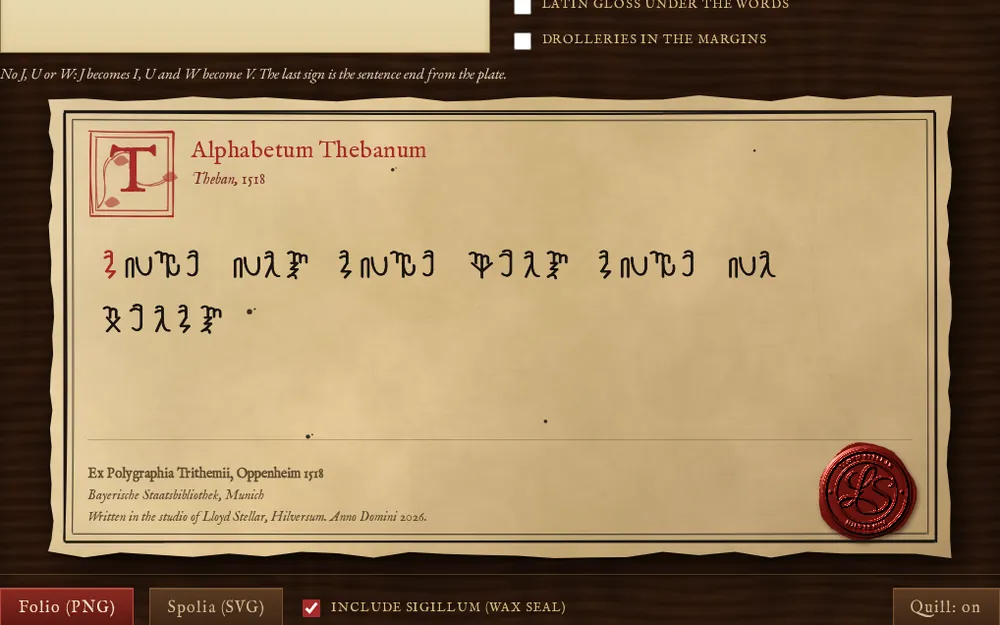
A writing desk of 1530 with ten alphabets in its drawer. Type a sentence and a quill writes it out, stroke by stroke, in Theban, which Johannes Trithemius printed in 1518 and which became "the witches' alphabet", in the Celestial, Malachim or Passing the River scripts from Agrippa's Three Books of Occult Philosophy (1533), in the secret letters of Hildegard von Bingen, in John Dee's Enochian, in Elder Futhark runes, in Ogham or in Voynichese. Tolkien's Tengwar has a drawer of its own, marked as invented.
The other drawers hold a sigil maker that traces a sentence on the witches' wheel or the Golden Dawn's Rose Cross, Agrippa's seven planetary magic squares to trace a name on, and three ciphers (the Alberti disc, the table of Trithemius and the Vigenère square) that seal a message in a link. When the receiver opens it, the wax seal cracks. The sheet saves as a PNG or an SVG.
Scripts
Ten, from Theban (1518) to Tengwar
Also
Sigils, planetary squares, three Renaissance ciphers, sealed letters
No. II. The Book Nobody Can Read The Voynich manuscript, measured
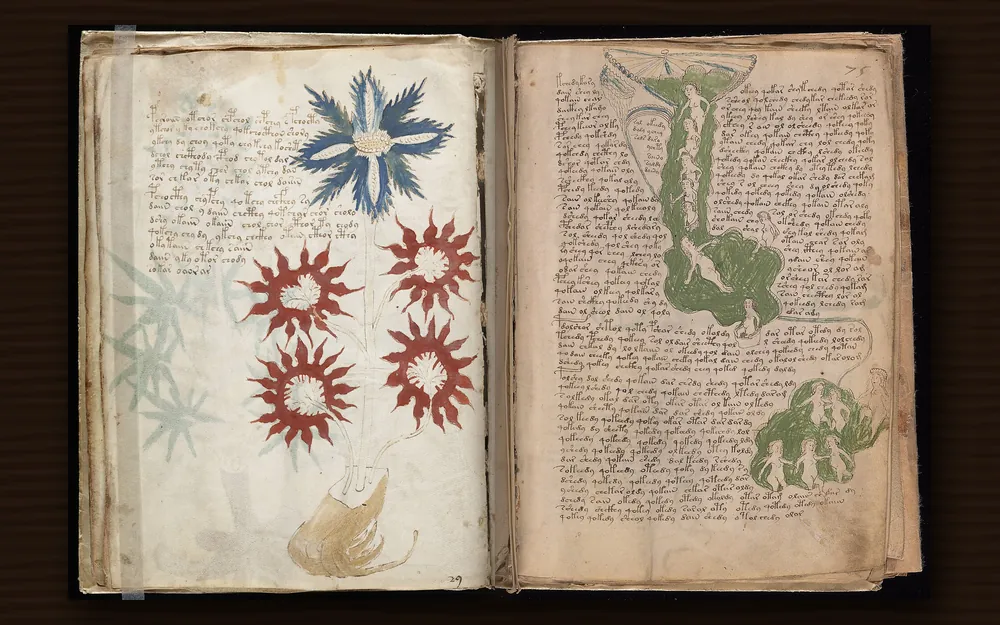
The Voynich manuscript, Beinecke MS 408 at Yale, is a book of plants nobody can name, zodiac wheels, women bathing in green pools and some 200 pages of a script nobody can read. People have claimed to crack it for a hundred years. I spent decades fascinated by it, and then put its text through a statistical lie detector: entropy, the information hidden in the order of the words, repetition per page, and comparisons with seven medieval texts.
The article tells what the numbers confessed, in plain language with charts, and ends with a generator that writes Voynichese convincing enough to pass the same tests. The full technical paper is a free PDF of 15 pages. The generator also lives in the Scriptorium, so you can write a page of the book yourself.
Format
Illustrated article and a technical paper (PDF)
Images
Beinecke Rare Book and Manuscript Library, Yale (public domain)
No. III. The Brazen Head A talking oracle of 1594, and a vocoder
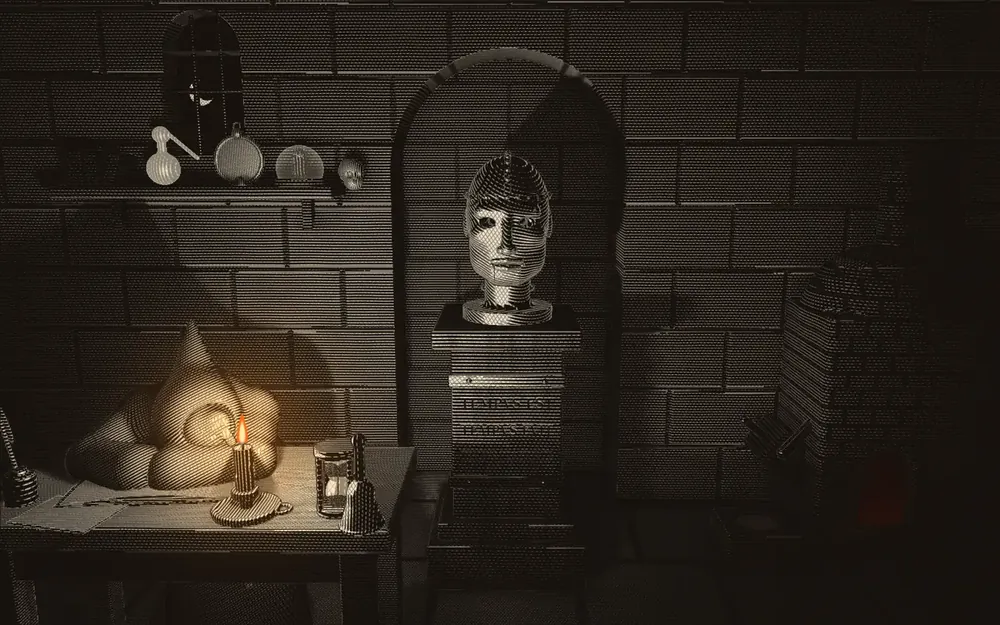
In Robert Greene's play Frier Bacon and Frier Bongay (1594), Friar Bacon has watched his head of brass for sixty days, waiting for it to speak. When he falls asleep, he leaves his servant Miles on guard. The head says "Time is", then "Time was", then "Time is past", and Miles never wakes his master. Here you are Miles: light the candle, write a question on a strip of parchment, and keep watch in an engraved vault.
Ring the bell at the right moment and Bacon wakes, and the head answers with one of 184 real quotations, from Nostradamus and Mother Shipton to John Dee's angels. Ring too late and lightning and a hammer break it; it stays broken until you recast it in the furnace. Once it is awake, a drawer opens with a vocoder of 20 bands that you play from the keyboard and record as a WAV file.
Answers
184 quotations, each with its source
Vocoder
20 bands, three carriers, quarter tones, WAV export
No. IV. The Alicorn Wireless A narwhal tusk wired to a ghost radio
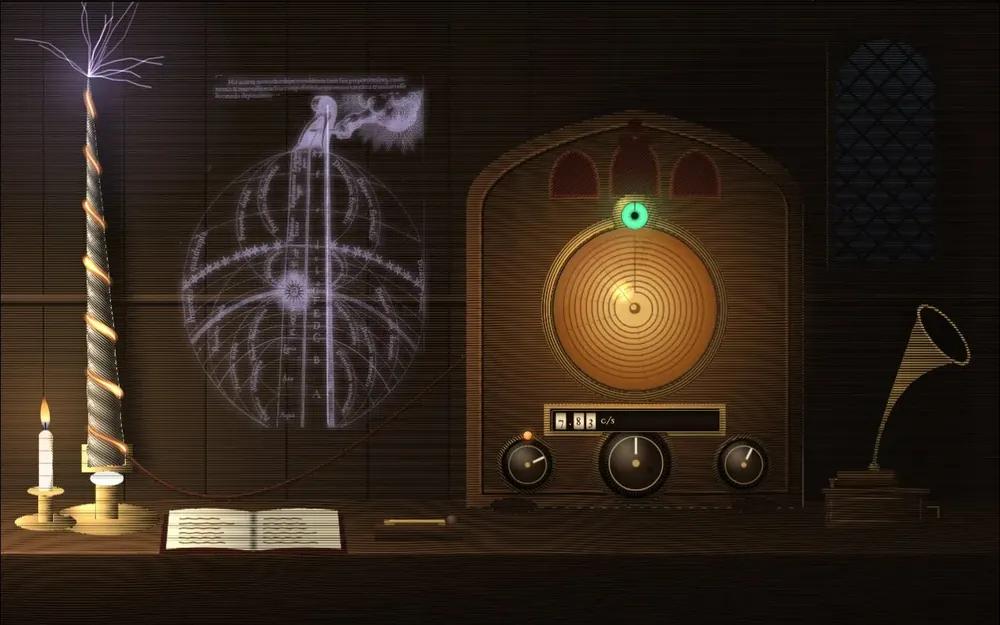
Cabinets of curiosities kept narwhal tusks and called them unicorn horns. This one is wound with copper wire and connected to a valve radio with one big tuning knob. Twenty-eight stations sit where their stories happened: the Schumann resonance at 7.83 cycles a second, lightning that whistles, Marconi's first signal across the Atlantic, Friedrich Jürgenson's voices of the dead at 1485 kHz, the numbers stations, Sputnik, the first pulsar and the Wow! signal at 1420.4556 MHz.
You tune by ear. A carrier whistles until you are exactly on it, a voice slides from chipmunk to human. Some stations keep hours: the dawn chorus, the Sun by day, Jupiter when its moon Io is in place, all from your own clock. Below the dial, a phonograph plays five real wax cylinders from 1888 to 1890, among them Florence Nightingale. Anything you hear can be saved as a 24-bit WAV.
A Wunderkammer is a collection of rare and strange things kept together in one room or one piece of furniture, the way princes, scholars and apothecaries did in Europe from the middle of the 16th century to the early 18th. The word is German: Wunder means wonder and Kammer means chamber, so a room of wonders. You say it roughly VOON-der-kah-mer, and the plural is Wunderkammern. The earliest known use is in the Zimmern Chronicle, written between 1564 and 1566, which mentions a weapon melted by lightning that was kept "in der wundercammer" of the counts of Zimmern.
German had a second word for the same thing. A Kunstkammer is a room of art, a Wunderkammer a room of wonders, and collectors used the two side by side; since Julius von Schlosser's book of 1908, historians write Kunst- und Wunderkammer. English says cabinet of curiosities. The cabinet was a room before it was a piece of furniture: in French a cabinet was a small private room next to a larger one (the word is recorded in 1491), and by 1542 a room where precious things were kept. Italians spoke of a studiolo or a museo, the Dutch of a rariteitenkabinet.
What was in it
Anything rare, strange or beautiful enough to make a visitor stop. The title of Ole Worm's catalogue of 1655 puts it in four words: rerum rariorum, tam naturalium quam artificialium, tam domesticarum quam exoticarum, rare things, natural as well as made by hand, from home as well as from far away. Those four words are on the drawers of the cabinet at the top of this page. Historians now add scientifica for instruments and mirabilia for marvels, but those are modern labels.
In practice that meant shells, corals and minerals, fossils, stuffed birds and crocodiles, turtle shells and antlers, coins and antiquities, carvings in ivory, clocks, globes and mathematical instruments, weapons and clothing from other continents, paintings and prints. Almost every cabinet had a unicorn horn, and nearly all of them were narwhal tusks. They were believed to detect poison and sold for many times their weight in gold. In 1638 Ole Worm gave a public Latin dissertation in Copenhagen, after a dispute among merchants about what they were selling: the unicorn's horn was the tooth of the narwhal.
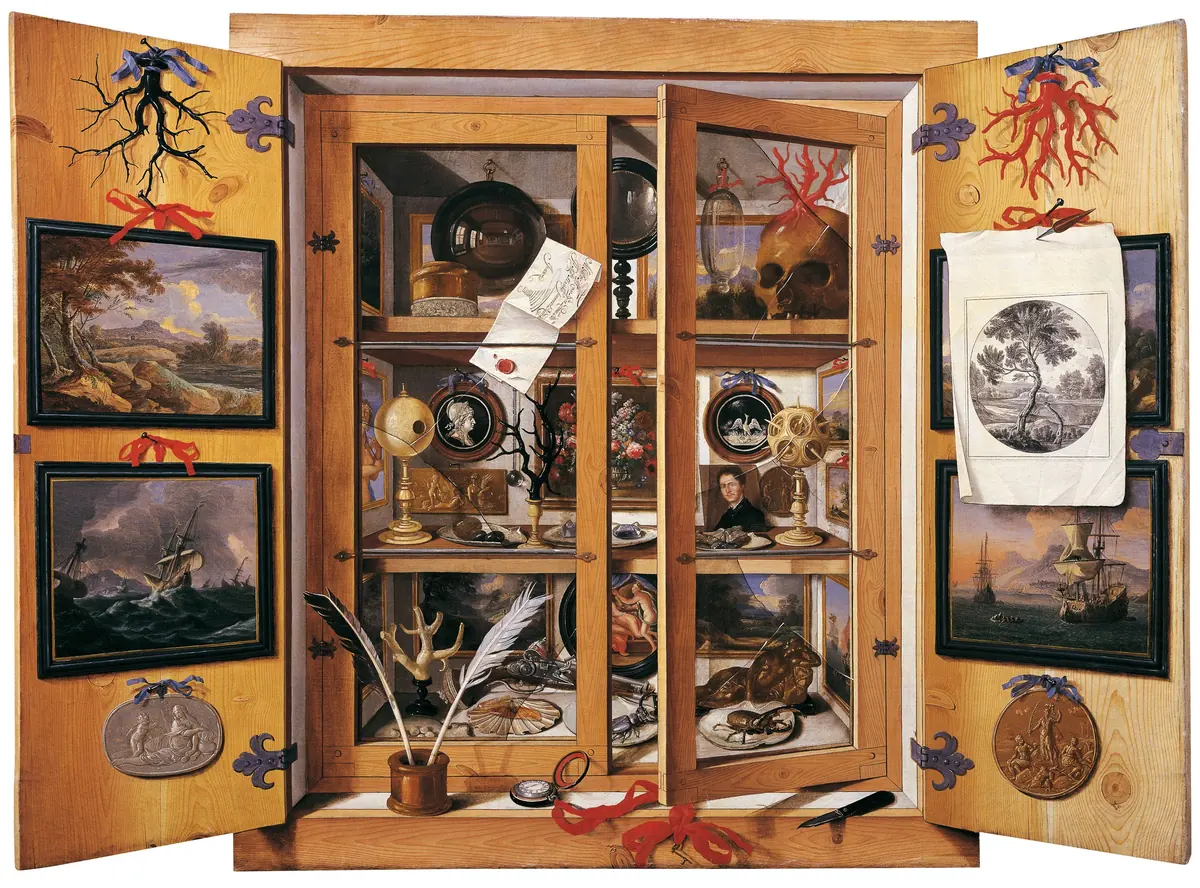
Domenico Remps, Cabinet of Curiosities, around 1690, painted to fool the eye on a canvas cut to the shape of the cabinet. Museo dell'Opificio delle Pietre Dure, Florence. Public domain, via Wikimedia Commons.
A short history of the cabinet of curiosities
The princes
The first great cabinets belonged to rulers. Duke Albrecht V of Bavaria had a building put up for his Kunstkammer in Munich between 1563 and 1567; it still stands as the Alte Münze. In 1565 Samuel Quiccheberg, a physician from Antwerp who bought objects for that collection, published the Inscriptiones vel tituli theatri amplissimi, which the Getty published in English as The First Treatise on Museums. He divided a collection into five classes: the founder and his history, things made by hand, nature, instruments and tools, and paintings and prints.
In the Tyrol, Archduke Ferdinand II had extra buildings put up at Ambras Castle near Innsbruck in 1570 and 1571 to house his collections. They are still there, and Ambras calls itself "the oldest museum in the world" and "the only Renaissance Kunstkammer of its kind to have been preserved at its original location". Emperor Rudolf II built perhaps the most spectacular cabinet of all in Prague at the end of the 16th century. Swedish troops carried it off when they took the city in 1648: 470 paintings, several thousand coins and medals, more than 300 mathematical instruments and 403 "Indian curiosa", among much else.
A cabinet could also be a single piece of furniture. The Augsburg agent Philipp Hainhofer had whole Kunstkammern built into single cabinets; about two dozen craftsmen worked on the one for the Duke of Pomerania from 1611 to 1617. The city of Augsburg gave another to King Gustavus Adolphus of Sweden in 1632. It has been at Uppsala University since 1694 and, with its thousand objects, is the only one of its kind kept with its contents intact.
An apothecary in Naples
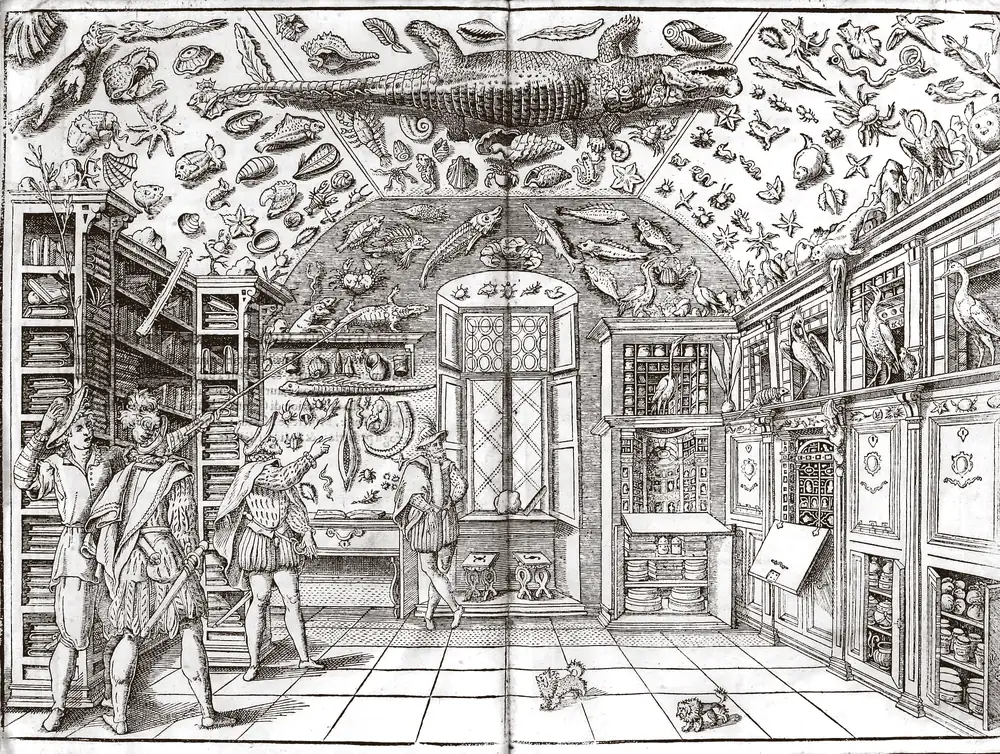
You did not have to be a prince. Ferrante Imperato was an apothecary in Naples, born around 1525, who kept his museum in a room of his house. His Dell'historia naturale of 1599 opens with a double-page woodcut of that room: the ceiling covered in fish, shells and starfish with a crocodile in the middle, cupboards full of jars and specimens, and gentlemen pointing at it all. The historian Paula Findlen calls it the first image of a natural history museum. The crocodile on the ceiling of this website comes from a later copy of that woodcut, in the Venice edition of 1672.
The museum of Ferrante Imperato in Naples, the woodcut in his Dell'historia naturale (1599). Public domain, Smithsonian Libraries via the Biodiversity Heritage Library.
Ole Worm's museum
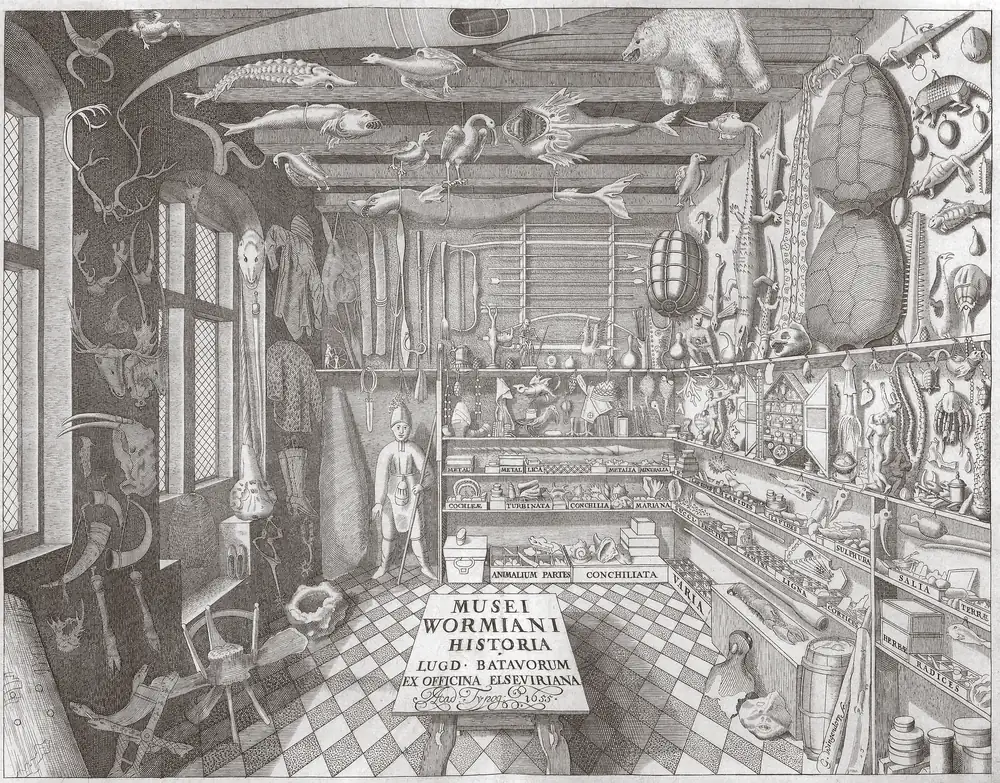
Ole Worm (1588 to 1654) was a physician and professor in Copenhagen. A year after his death his son Willum had the collection published by the Elzevier press: the Museum Wormianum of 1655. Its frontispiece, engraved by G. Wingendorp, shows the room: a polar bear and turtle shells under the beams, antlers and weapons on the walls, and boxes labelled by kind. King Frederik III bought the collection for the royal Danish Kunstkammer. The faint room on the walls of this website, on a wide screen, is the same engraving.
The frontispiece of the Museum Wormianum (Leiden, Elzevier, 1655), engraved by G. Wingendorp. Public domain, Smithsonian Libraries via the Biodiversity Heritage Library.
From cabinet to public museum
In London, John Tradescant and his son showed their collection, called the Ark, in their house in Lambeth for sixpence, and printed its catalogue, the Musaeum Tradescantianum, in 1656. The collection passed to Elias Ashmole, who gave it to the University of Oxford. The Ashmolean opened in 1683 as, in its own words, "Britain's first public museum, and the world's first university museum". When the physician Hans Sloane died in 1753, an Act of Parliament bought his more than 71,000 objects for £20,000 and founded the British Museum, which opened in 1759.
The Dutch cabinets
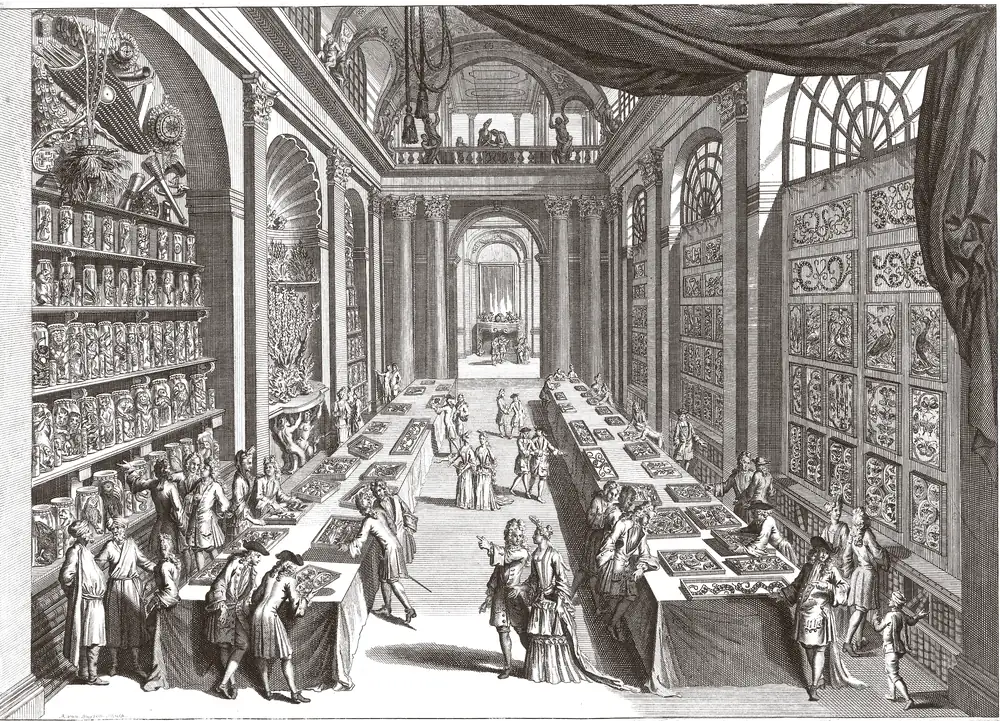
Holland had its own collectors. Bernardus Paludanus, the town physician of Enkhuizen, kept an album in which his visitors signed their names, and in 1651 his heirs sold the collection to the Duke of Holstein-Gottorp. The silk merchant Levinus Vincent filled eight cabinets with 600 jars of animals in spirits, 288 boxes of insects and drawers of shells, minerals and fossils, first in Amsterdam and later in Haarlem, and published them as the Wondertooneel der Nature, the wonder theatre of nature (1706 and 1715). Peter the Great came to look.
Peter bought as well. In 1716 he acquired the first collection of the Amsterdam apothecary Albertus Seba, and in 1717 the anatomical preparations of Frederik Ruysch for 30,000 guilders, for the Kunstkamera he had founded in St Petersburg, which first opened to visitors in 1719. Seba started collecting again, and his new cabinet fills the four volumes of his Thesaurus (1734 to 1765).
Visitors in the cabinet of Levinus Vincent in Haarlem, etched by Andries van Buysen for the second part of the Wondertooneel der Nature (1715). Rijksmuseum, Amsterdam, public domain.
Why the cabinets disappeared
In the 18th century the wonder went out of wonders. Natural philosophers began to see rarities as misleading exceptions to the order of nature; Lorraine Daston and Katharine Park tell that story in Wonders and the Order of Nature (1998). In 1735 Carl Linnaeus published the first Systema naturae in Leiden, eleven large pages that sorted stones, plants and animals into one system, and the Kunst- und Naturalienkammer of the Francke Foundations in Halle became the first museum to order its natural things that way. The great cabinets were split into separate collections of art, natural history, coins and antiquities. The Danish royal Kunstkammer, with Ole Worm's things in it, was dissolved in 1825 and its nearly 10,000 objects went to new specialist museums.
And now
The idea never quite went away. In 1988 David and Diana Wilson opened the Museum of Jurassic Technology in Los Angeles, a modern cabinet of curiosities, and Lawrence Weschler's book about it, Mr. Wilson's Cabinet of Wonder (1995), was a finalist for the Pulitzer Prize. Lloyd's Wunderkammer tries the same thing on a screen, with the sources on the page.
Where you can still see a cabinet of curiosities
A few cabinets survive where they were made, and the big museums show what is left of the others. These can be visited.
Ambras Castle, Innsbruck. Archduke Ferdinand II's Kunst- und Wunderkammer, in the building he had made for it in the 1570s. Closed in November.
Kunstkammer Wien, Kunsthistorisches Museum, Vienna. About 2,200 objects of the Habsburg collections in 20 rooms, with things from Ambras and from Rudolf II's Prague. The Habsburgs' unicorn horn, a narwhal tusk of 243 cm, is in the Imperial Treasury in the Hofburg.
Residenzschloss, Dresden. The Green Vault, the treasury of Augustus the Strong, and the exhibition Weltsicht und Wissen um 1600 with the instruments and tools of the Saxon Kunstkammer.
Francke Foundations, Halle. The Kunst- und Naturalienkammer, founded in 1698 and arranged from 1736 to 1741 in painted Baroque cabinets, with a Nile crocodile hanging from the ceiling. In the foundation's words, "the only completely preserved Baroque cabinet of curiosities in Germany".
Gustavianum, Uppsala. The Augsburg art cabinet of Gustavus Adolphus, with its thousand objects.
Teylers Museum, Haarlem. Not a Wunderkammer but the step after it: the oldest museum in the Netherlands, open since 1784. Its Oval Room has barely changed since the day it opened.
How this cabinet works
The cabinet is part of Lloyd Stellar's Homepage, which runs on a few rules from the old web. They hold for every piece on the shelves.
Free, no account
Nothing to sign up for and nothing to pay. The Brazen Head remembers its scars and the radio keeps a logbook, but only in your own browser.
Sources on every page
Each piece names the books, plates and recordings it is built on, and says plainly where I made something up.
Desktop and phone
All four work on a phone. The desk and the radio are at their best on a big screen, and the head wants sound.
Silent until you ask
The room makes no sound. The head and the radio only start after you light the candle or switch them on.
Drawn in code
The cabinet, the head and the radio are drawn by the browser and engraved line by line. The old plates come from public domain scans.
No magic
Everything here is history, told as history. Nothing on these shelves claims to work, which is half the fun.
Why a Wunderkammer on a music site
My logo is an alchemist. He prepares a drink for his followers, and that drink is my music. He comes from the world this room comes from: the paintings of Hieronymus Bosch, medieval folk mysticism, old books in letters nobody uses any more. My tracks are about the future, strange cults, greed, and people and machines, built on machine beats, floaty pads and vocoder voices. A head of brass that talks is one of the oldest dreams of a talking machine, and a radio full of voices in the noise sits right next to it.
The rest of this website is LLOYDOS, a computer that never existed, with tools and games. This is the room next to it. The rules are the same as on the old web: everything is free and nobody asks for your name. The alchemist hangs on the wall of the cabinet as its keeper. If you like the mood in here, his drink is on Bandcamp and Spotify.
Questions
What is a Wunderkammer?
A Wunderkammer, German for "room of wonders", is a collection of rare and strange things from nature and art kept together in one room or one cabinet, the way princes, scholars and apothecaries did in Europe from the middle of the 16th century to the early 18th. In English it is called a cabinet of curiosities; Kunstkammer means much the same.
What does Wunderkammer mean in English, and how do you say it?
Room of wonders, or chamber of wonders: Wunder is wonder and Kammer is chamber. In German it sounds like [ˈvʊndɐˌkamɐ], roughly VOON-der-kah-mer. The plural is Wunderkammern.
What is the difference between a Wunderkammer and a Kunstkammer?
Hardly any. Kunstkammer means room of art and Wunderkammer room of wonders, but collectors used the two words side by side, and since Julius von Schlosser's book of 1908 historians write Kunst- und Wunderkammer. Cabinet of curiosities is the usual English name for both.
What was kept in a cabinet of curiosities?
Things from nature, such as shells, corals, minerals, fossils, stuffed animals and narwhal tusks sold as unicorn horns, and things made by hand, such as coins, antiquities, ivory carvings, clocks, globes and instruments, paintings, and weapons and clothing from far away. The title of Ole Worm's catalogue of 1655 sums it up: rare things, natural and artificial, domestic and exotic.
What was the first cabinet of curiosities?
There is no single first one, but there are some firsts. The earliest known use of the word Wunderkammer is in the Zimmern Chronicle (1564 to 1566). Samuel Quiccheberg's Inscriptiones (Munich, 1565) is called the first treatise on museums. Ambras Castle near Innsbruck, built for Archduke Ferdinand II's collections in the 1570s, calls itself the oldest museum in the world. And Ferrante Imperato's book of 1599 has the first picture of a natural history museum.
Why is it called a cabinet?
Because a cabinet was a room before it was a piece of furniture. In French the word meant a small private room next to a larger one, and by 1542 a room where precious things were kept. Later it also came to mean the cupboard with doors and drawers.
Why did cabinets of curiosities disappear?
In the 18th century rarities came to be seen as exceptions that hid the order of nature, Linnaeus' Systema naturae (1735) sorted nature into one system, and the great collections were split into museums of art, natural history, coins and antiquities. Many cabinets became the start of public museums, among them the Ashmolean in Oxford (1683) and the British Museum (1753).
Where can I see a real Wunderkammer today?
At Ambras Castle in Innsbruck, in the Kunstkammer of the Kunsthistorisches Museum in Vienna, in the Residenzschloss in Dresden, at the Francke Foundations in Halle and in the Gustavianum in Uppsala. Teylers Museum in Haarlem, open since 1784, shows the step after the cabinet.
Is Lloyd's Wunderkammer free?
Yes. All four pieces are free to use, with no account and no advertising. What you make or type stays in your own browser.
Does it work on a phone?
Yes. The cabinet, the Scriptorium, the Brazen Head, the Alicorn Wireless and the Voynich article all work on a phone. The writing desk and the radio are at their best on a larger screen, and the head and the radio want sound.
Who made Lloyd's Wunderkammer?
Lloyd Stellar, the artist name of Erik Griffioen, an electro producer from Hilversum in the Netherlands. The cabinet is part of Lloyd Stellar's Homepage, next to his free music tools and games.
Is any of it real magic?
No. Everything in the cabinet is history, told as history, with the sources on the page. Where a piece adds something of its own, such as a frequency for a station that history did not record, the page says so.
Sources and credits
The history on this page comes from these sources. Each piece in the cabinet has its own list on its own page.
Overviews: Wolfram Koeppe, Collecting for the Kunstkammer (The Metropolitan Museum of Art, 2002); Gabriele Beßler, Chambers of Art and Wonders (European History Online, 2015); Lorraine Daston and Katharine Park, Wonders and the Order of Nature, 1150-1750 (Zone Books, 1998).
The plates: Imperato's woodcut and Worm's frontispiece from copies in the Smithsonian Libraries via the Biodiversity Heritage Library, Levinus Vincent's hall from the Rijksmuseum, Remps' painting via Wikimedia Commons, all in the public domain. The cabinet at the top of the page is drawn in code and engraved line by line in the style of the other pieces. The keeper in the oval frame is the alchemist of Lloyd Stellar's logo; the open book on the shelf shows a plant and the green bath of the Voynich manuscript (Beinecke Library, Yale, public domain). Type: IM Fell English by Igino Marini and EB Garamond, both under the SIL Open Font License.