The Garden of Earthly Delights: Walk into Bosch's Painting
Hieronymus Bosch painted his triptych around 1500 for a palace in Brussels. Today it hangs in the Prado in Madrid, and this page holds the museum's own photograph of it: 30,000 pixels wide, sharp enough to see the cracks in the paint. Open the wings, zoom in, and tap any of the 90 scenes we have described: the owl in the fountain, the couple in the mussel, the Tree Man, the music written on a sinner's backside. Every explanation names the writer it comes from. Free, no account, and the photograph is in the public domain.
No. VI. Triptych of The Garden of Earthly Delights, Jheronimus Bosch, 's-Hertogenbosch, about 1490 to 1500. Oil and grisaille on oak. Madrid, Museo del Prado, P02823. The photograph: Prado and Google Earth, 2009.
The wings are closed: the world on the third day of Creation. Press Open the wings.
How to look
- Drag
- move across the painting
- Scroll, pinch
- zoom in and out; double-click or double-tap zooms in
- Click a detail
- opens the story behind it; zoom in for the small ones
- Map
- bottom left: the rectangle is what you see; click to jump
- ← → ↑ ↓
- move (in a tour, left and right step)
- + - 0
- zoom in, out, the whole triptych
- N P
- next and previous scene
- T S
- tour, surprise me
- F W Esc
- full screen, fill the window, close
Bigger is better
The painting is two metres tall and four wide. It works best with more room: more of the triptych in view, finer detail, less scrolling. Two ways to get it:
How to look
The wings are closed when you arrive, the way the painting was kept in the sixteenth century. You can already zoom into the grey outside: God sits small in the top left corner. Press Open the wings and the two grey shutters swing aside. Then drag to move, scroll or pinch to zoom, and click on anything that catches your eye: a paper card tells you what you are looking at, what the art historians have made of it, and where you are. Nothing is marked on the painting itself, so you can simply look. The closer you zoom, the smaller the details you can click, down to things that few visitors to the Prado ever see. The map in the bottom corner keeps track of where you are.
If you would rather be led, press Take a tour: the camera flies from scene to scene in the order of the story, from the closed wings to the bottom of Hell, or along a theme such as the owls or the music. Surprise me jumps to a scene at random. Find the owls turns the painting into a game. Share this view copies a link that opens the painting at the exact spot you are looking at.
On a phone the triptych runs full screen; the card slides up from the bottom and can be dragged taller. The text of every scene is also printed below the viewer, for reading at leisure.
The painting in a few lines
The Garden of Earthly Delights is a triptych by Hieronymus Bosch: three oak panels painted in oil, hinged so that the two outer wings can close over the middle. Open, it shows Paradise on the left, a garden of naked people, giant fruit and strange buildings in the centre, and Hell on the right. Closed, it shows the world on the third day of Creation in grey. It was painted in 's-Hertogenbosch, probably in the 1490s, and hangs in the Museo del Prado in Madrid.
| Painter | Jheronimus van Aken, called Hieronymus Bosch (about 1450 to 1516) |
|---|---|
| Date | 1490 to 1500 according to the Prado; about 1495 to 1505 according to the Bosch Research and Conservation Project. The oak of the panels was ready for use from 1460 to 1466. |
| Size | Painted surface 185.8 cm high; the centre panel 172.5 cm wide, each wing 76.5 cm. With the frame about 2 by 4 metres. |
| Technique | Oil on oak panel; the outside of the wings in grisaille, grey on grey |
| Museum | Museo del Prado, Madrid, inventory P02823, on permanent loan from Patrimonio Nacional, the Spanish royal collections |
| First seen | 30 July 1517, in the palace of the Nassau family in Brussels, by the Italian traveller Antonio de Beatis |
| Old names | "The variety of the world, called Del Madroño" (1593), the strawberry painting, La Lujuria (Lust). The modern title is not Bosch's. |
| Signed | No. Bosch signed only seven of the paintings that survive and dated none. |
The Prado writes that the painting has never been doubted as a Bosch. Nothing else about it is certain: not the date, not who paid for it, not what it means.
Sources: the Prado's collection entry (Pilar Silva Maroto, 2016); the Bosch Research and Conservation Project as cited by the Eclectic Light Company; Wikipedia, The Garden of Earthly Delights.
Who was Bosch
Jheronimus van Aken was born around 1450 in 's-Hertogenbosch, a prosperous town in Brabant, now in the south of the Netherlands. His grandfather Jan and his father Anthonius were painters; so were four of his uncles. Nothing by any of them survives. In 1462 his father bought a stone house on the Market square, and the next year a fire burned down thousands of houses in the town. Jheronimus was about thirteen. He later signed his paintings with the name of his town: Bosch.
Around 1481 he married Aleid van de Meervenne, who was a little older and a good deal richer. They lived in a house she had inherited on the same Market square, called In den Salvatoer. In 1486 or 1487 Bosch joined the Brotherhood of Our Lady, a religious society of about forty leading citizens with thousands of outer members across Europe; he became a sworn brother in 1488 and painted for its chapel in the church of Saint John. The brotherhood's accounts record his funeral mass on 9 August 1516.
That is almost all we know. Bosch left no letters and no diary. Only about 25 paintings and 8 drawings are accepted as his. Already in his lifetime his work was collected in the Netherlands, Austria and Spain, and copied everywhere, especially the hells. The Spanish writer Felipe de Guevara called him, around 1560, "the inventor of monsters and chimeras". The Dutch painter and biographer Karel van Mander wrote in 1604 of his "wondrous and strange fantasies", often "less pleasant than gruesome to look at", and admitted he could find out neither when Bosch was born nor when he died.
Sources: Wikipedia, Hieronymus Bosch; the Jheronimus Bosch Art Center ('s-Hertogenbosch), his life and the review of Loes Scholten (2014) on the family's workshop; Karel van Mander, Het Schilder-boeck (1604), on DBNL.
How to read a triptych
A triptych is three panels on hinges. In churches the wings stayed closed on ordinary days and were opened on feast days, so the inside was a surprise. Bosch used the same trick for a painting that almost certainly never stood in a church: the outside is grey and quiet, the inside is colour and crowds.
The three inner panels are one landscape. The horizon runs at the same height across all three, the lake of Paradise is echoed by the lake of the garden, and the same blue rocks stand in the distance. Each panel has water in its middle ground: a pond with a fountain, a pool full of women, a frozen lake. Each has buildings in the background: fountains that look like plants in the first two, a burning city in the third. The figure of Adam, stretched out on the grass, is repeated in the garden and mirrored in Hell. The painting looks chaotic and is anything but.
Infrared photographs, which show the drawing under the paint, tell us that Bosch changed his mind while he worked. On the left wing he first drew the Creation of Eve from Adam's rib, the usual scene, and then painted God presenting Eve to Adam instead, a scene connected with marriage. The Prado showed the infrared and X-ray images in 2016, with the triptych standing free in the room so that visitors could walk around it and see both sides.
Sources: the Prado's collection entry (2016); Wikipedia; Eric De Bruyn's review of Reindert Falkenburg (2013), on the egg at the centre; the Prado's exhibition page of 2016.
What it means: seven readings
Nobody knows what Bosch meant, and the painting has been read in opposite ways for four hundred years. These are the readings you will meet on the cards, with the people who proposed them.
- A warning against sin (José de Sigüenza, 1605, and most writers since)
- Sigüenza, the librarian of the Escorial, saw the painting there and wrote that it is "a painted satire of the sins and follies of men", about "the vain glory and brief taste of the strawberry, and its faint scent, which is barely noticed before it is gone". He defended Bosch against the charge of heresy: the others paint men as they look from outside, he wrote, Bosch alone dared to paint them as they are inside. The reading has held: Paradise, then a world given over to lust, then its punishment. Ludwig von Baldass (1960), Charles de Tolnay ("the nightmare of humanity"), Dirk Bax, Walter Gibson (a "false paradise") and the Prado's own text follow it.
- A paradise regained (Wilhelm Fraenger, 1947)
- Fraenger turned it upside down. For him the centre panel was a happy world of innocent love, painted for a secret sect, the Adamites or Brethren of the Free Spirit, whose Grand Master was the pointing man in the corner. It was a brilliant book and nearly everything in it was invented: the Grand Master's biography was fiction, and no art historian today takes the sect seriously. The Dutch scholar Dirk Bax called Fraenger a fantasist.
- Proverbs and puns (Dirk Bax, 1956)
- Bax read the painting through the Dutch language of Bosch's time: to pluck fruit, to bird, to swim in the bath of Venus. Many of the jokes on the cards are his. He gave the triptych a blunt Dutch name: the triptych of unchastity.
- The world before the Flood (Ernst Gombrich, 1969)
- Gombrich found old inventories that called a copy of the painting "as it was in the days of Noah". He suggested that the centre panel shows the carefree world before the Flood, with giant fruit because the soil was more fertile then, and the closed wings the world after the waters went down. The Flood reading of the wings has been rejected; the "days of Noah" idea is still discussed.
- A utopia (Hans Belting, 2002)
- Belting saw a humanist picture for a learned court: the world as it would have been if the Fall had never happened, a place without children, old people, work or death. He also proposed that the Tree Man's face is Bosch's self-portrait.
- A test for the viewer (Reindert Falkenburg, 2011)
- Falkenburg's book The Land of Unlikeness argues that the triptych was a conversation piece for young Burgundian nobles. The garden is a false dream sent to lead mankind away from God, Hell is the "land of unlikeness" where man has lost the likeness of his maker, and the painting tests whether you can see through it. The people in the picture point and whisper to each other, just as its viewers did.
- Alchemy and the Grail (Laurinda Dixon, 1981; Paul Vandenbroeck, 1989)
- Dixon read the glass tubes and eggs as alchemical equipment and the four panels as the four stages of the Great Work; reviewers find the match thin. Vandenbroeck sees a false paradise of love, the "Grail" of medieval romances, painted the way preachers described it. The Prado's 2016 text sums up the museum's position: a paradise "that deceives the senses, a false Paradise given over to the sin of lust".
Sources: Gibson (1973) and Spanish Wikipedia for Sigüenza; Wikipedia and the Jheronimus Bosch Art Center for Fraenger, Bax, Gombrich, Belting, Dixon and Vandenbroeck; Gombrich's own article (1969); De Bruyn's and Jacobs's reviews of Falkenburg; the Prado's entry.
The painting's travels
The triptych was made for the Nassau family, the most powerful nobles of the Low Countries: for Engelbert II of Nassau, says the Prado, or for his nephew Henry III, say others. It hung in their palace on the Coudenberg hill in Brussels, where De Beatis saw it in 1517 and wrote of "bizarre things", "seas, skies, woods, meadows", "people crawling out of a shell". From Henry it passed to René de Chalon and then to William of Orange, the leader of the Dutch revolt against Spain.
In 1568 the Duke of Alba, sent by Philip II to crush the revolt, seized William's possessions, the painting among them. It went to Alba's son Fernando de Toledo, and after his death Philip II bought it at the sale of 1591. On 8 July 1593 it arrived at the monastery palace of the Escorial as "a painting in oils, with two wings, of the variety of the world, illustrated with grotesqueries by Hieronymus Bosch, known as Del Madroño", the strawberry tree. It stayed there for more than three hundred years.
In the 1930s it was taken to the Prado in Madrid; the museum's register says 1933, the Civil War deposit of 1936 and a decree of 1943 made the loan permanent, and in 2015 the royal collections and the museum agreed in writing that it stays. In 2016, five hundred years after Bosch's death, the Prado's Bosch exhibition drew about 590,000 visitors, the most in the museum's history, while the Noordbrabants Museum in 's-Hertogenbosch brought seventeen of his paintings home for a few months and counted 421,700.
The painting was famous from the start. A Brussels workshop wove it as a tapestry in gold, silver and silk around 1550 to 1560, now in the Spanish royal collection; painted copies of the wings and the centre exist in Madrid, London and Budapest; and Pieter Bruegel the Elder took the right wing into his Dulle Griet and his Triumph of Death.
Sources: the Prado's provenance line; Wikipedia; Gombrich (1967) on De Beatis; Patrimonio Nacional, the Escorial leaflet of 2016 and the joint statement of 16 December 2015; Fundación BBVA and NL Times on the visitor numbers of 2016.
The music of Hell
Bosch's Hell is the only one I know with an orchestra. A harp with a man strung on it, a lute the size of a shed, a hurdy-gurdy that will take a nun's head off at the next turn of the crank, a drum with a man inside, a recorder in the wrong place, a trumpet that hurts the ears of everyone near it, a pink bagpipe on the head of the Tree Man. Under the lute lies a man with notes painted on his buttocks, and a choir of the damned sings them.
In 2014 a student in Oklahoma, Amelia Hamrick, wrote the notes out and played them, "the 600-year-old butt song from hell", and the internet loved it. A Spanish early music group had recorded the same notes in 1978, on an LP called Codex Gluteo. The musician Ian Pittaway has since argued that the notes are only painted to look like notes: there is no clef, so no pitch, and Bosch never meant them to be sung. Which does not make the picture less funny.
I make electro: machine beats, vocoders, songs about people and machines. What I see in this panel is instruments that have turned on the people who played them, which is a story anyone who works with machines understands. If you want to hear what my own machines do, the About Me page has the records, and the Corporate Electro EP on Bandcamp is free. Bosch is on my list of inspirations there, with reason.
Sources: Ian Pittaway, Early Music Muse (2021), parts 1 and 2; Lapham's Quarterly on Amelia Hamrick; the NTR interactive documentary (2016); Wikipedia.
The catalogue of scenes
Everything the cards in the viewer say, printed here in order: the closed wings first, then Paradise, the Garden and Hell. Each entry opens the scene in the viewer.
The closed wings
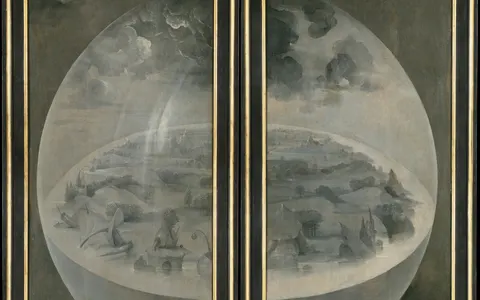
The world on the third day
The exterior (closed wings) · A flat earth inside a glass ball, painted in grey
With the wings closed you see a world in grey. A flat disc of land and water floats inside a transparent sphere; clouds hang under its glass roof, and strange plants and rock shapes grow on the shore. There are no people and no animals yet. Everything outside the sphere is dark.
This is the third day of Creation from the first chapter of Genesis, when God separated the waters from the dry land and the earth brought forth plants. The grey technique is called grisaille. Netherlandish painters often used it for the outside of a triptych, so the colour inside came as a surprise when the wings were opened.
Look closer: Find the sheet of cloud and the beam of light falling through the glass roof. Look closer in the viewer ›
The Prado's text calls it "the Third Day of the Creation of the World, when the waters were separated from the earth and the earthly Paradise (Eden) created". Wikipedia adds that the lack of colour may also show a time before the sun and moon were made. The art historian Ernst Gombrich (1969) read the same scene differently: he saw castles among the plants and argued that this is the earth after the Flood, with the water still going down. Most writers have not followed him on this point.
Sources
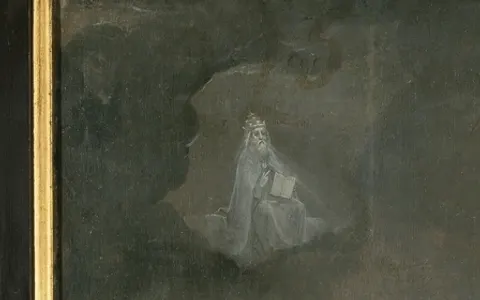
God with a book
The exterior (closed wings) · A tiny figure in the top left corner, creating by word
High in the top left corner, outside the sphere, sits a small old man with a crown and a book on his lap. He does not touch the world. He simply speaks, and it is made. He raises his right hand, which in medieval pictures means that someone is talking.
Bosch painted him from a model. The Prado's research points to a woodcut of God the Father in the Nuremberg Chronicle, a famous illustrated history of the world printed in 1493. That print uses the same line from the Psalms that Bosch wrote above the wings, which also helps to date the painting after 1493.
Wikipedia describes him as "a tiny figure at the upper left" wearing "a crown similar to a papal tiara" and "creating the Earth in a passive manner by divine fiat". James Payne (Great Art Explained, 2021) points out the raised hand as the sign of speech.
Sources
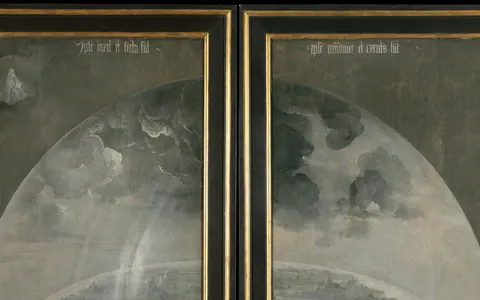
The words from the Psalms
The exterior (closed wings) · Ipse dixit, et facta sunt
Along the top of the two wings runs a line of Latin in Gothic letters. On the left wing: Ipse dixit et facta sunt. On the right: Ipse mandavit et creata sunt. Together: "For he spoke, and it was done; he commanded, and it stood fast." It is Psalm 33, verse 9 (Psalm 32 in the Latin Bible of Bosch's day; the same words also appear in Psalm 148).
The line explains the picture. God does not build the world with his hands. He says a word, and the world appears inside the glass.
The Prado gives the two verses as Psalms 33:9 and 148:5. Gombrich noted that the inscription "fits in well with the accepted view" that the wings show God creating the world.
Sources
The left wing: Paradise
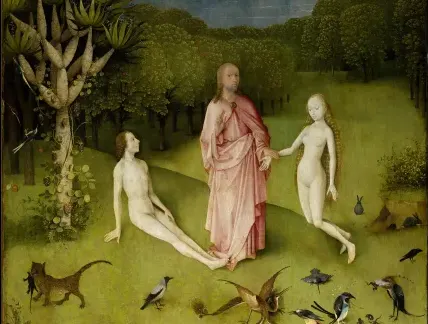
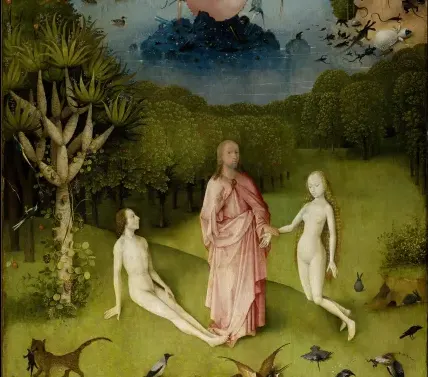
God brings Eve to Adam
Left wing: Paradise · The first marriage, with a young God in red
In the bottom half of the left wing a young, blue-eyed God in a pink robe holds Eve by the wrist and raises his other hand in blessing. Adam has just woken up. He sits on the grass with his eyes wide open and looks at the woman he has never seen before. Eve looks down. God looks straight out of the picture, at you.
This is an unusual scene. Most painters showed the creation of Eve from Adam's rib or the Fall. Bosch chose the moment just after: God presents Eve to Adam and blesses them, the moment the Bible sums up as "Be fruitful and multiply". Infrared photographs show that Bosch first painted the Creation of Eve here and then changed his mind.
Look closer: Look at where Adam's toes are: they touch the foot of God. Wilhelm Fraenger noticed it in 1947. Look closer in the viewer ›
The Prado writes that this "very uncommon subject was associated with the institution of marriage". Walter Gibson (1973) points to Dutch Bibles of the fifteenth century that show the same scene. Gibson also reads Adam's face as showing "not just surprise but also expectation", and the art historian Virginia Tuttle and others have called his gaze lustful: in medieval belief, the first sin after the Fall was carnal lust. Reindert Falkenburg (2011) sees the opposite in the same eyes: an uncorrupted way of seeing before the Fall. He also noticed Adam's crossed feet and read them as an early sign of Christ's feet on the cross. Eric De Bruyn objects that the lute player on Bosch's Haywain has the same feet, so it may just be a habit of the painter.
Sources
- Museo del Prado, collection entry P02823 (Pilar Silva Maroto, 2016)
- Wikipedia: The Garden of Earthly Delights
- Walter S. Gibson, The Garden of Earthly Delights: the iconography of the central panel, NKJ 24 (1973)
- Lynn F. Jacobs, review of Falkenburg, The Land of Unlikeness, HNA Reviews (2012)
- Eric De Bruyn, review of Reindert Falkenburg, The Land of Unlikeness (2011), Oud Holland 126 (2013)
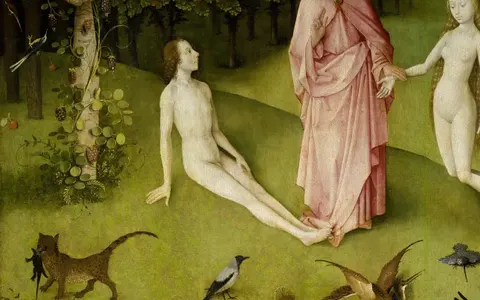
Adam
Left wing: Paradise · Just awake, eyes wide open
Adam sits with his legs stretched out, one foot over the other, one hand on the grass. He is pale and thin, with curly hair. His whole face is turned towards Eve.
Fraenger counted three things in that face: surprise that God is standing there, the discovery that Eve is "of the same nature as himself", and perhaps the first stir of desire. Different writers have read the look as innocent wonder or as the first glimpse of lust. The painting lets you decide.
Charles de Tolnay thought that "through the seductive gaze of Adam, the left panel already shows God's waning influence". Falkenburg reads the "wide-open eyes" as the pure vision of man before the Fall.
Sources
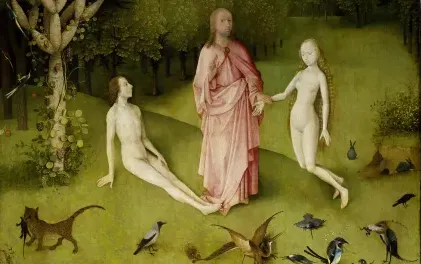
Eve
Left wing: Paradise · Long golden hair, eyes lowered, rabbits at her feet
Eve kneels on the grass with her long fair hair falling to her hips. She avoids Adam's look and keeps her eyes down, while her body is turned fully towards him. Behind her, rabbits sit in the grass.
Rabbits were a sign of fertility, which fits the blessing God is giving the couple. The Spanish writer José de Sigüenza, who saw the painting in the Escorial around 1605, called the whole triptych a painted satire of the sins and follies of men; for him the story that starts here ends badly.
Gibson sees Eve "seductively presenting her body to Adam". The NTR documentary (2016) notes the rabbits "symbolising fertility". The Belgian scholar Paul Vandenbroeck has argued that lust was present in Eden from the very beginning, inside marriage.
Sources
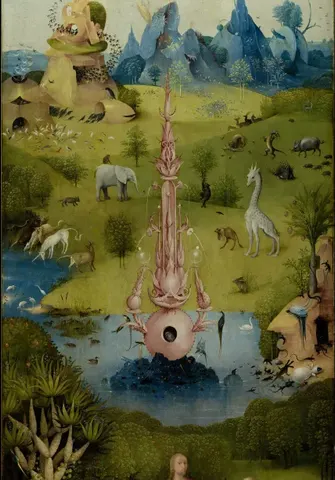
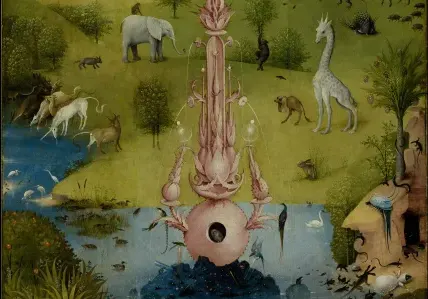
The Fountain of Life
Left wing: Paradise · A pink tower of petals and spikes in the middle of the pond
In the middle of the wing stands a tall pink fountain, like a plant and a piece of coral and a church spire at once. It rises from a dark blue heap of rocks and gems in the pond, and four thin jets of water fall from it. Its round base has a dark hole, and something is looking out of it.
This is the source of all water in Paradise. The four jets recall the four rivers that flowed out of Eden in the Bible. The fountain is on the same vertical line as God's figure and shares the colour of his robe.
Look closer: The dark heap under the fountain is full of pearls, gems and small glass tubes. Zoom in on it. Look closer in the viewer ›
The Prado calls it "the fountain of the Four Rivers". The NTR documentary describes it as "a symbol of life, fertility and reproduction". Gombrich noticed the flesh colour and wondered whether Bosch knew a text by Saint Ambrose about rivers of desire bursting from the flesh "as from a fountain". Falkenburg went further and claims that the tangled shapes just above the base form a grinning monster's face, hidden in plain sight. Eric De Bruyn adds an observation of his own: the owl in the base sits at the exact centre of the panel.
Sources
- Museo del Prado, collection entry P02823 (Pilar Silva Maroto, 2016)
- NTR, Jheronimus Bosch: the Garden of Earthly Delights, interactive documentary (2016)
- E. H. Gombrich, Bosch's Garden of Earthly Delights: a progress report, JWCI 32 (1969)
- Eric De Bruyn, review of Reindert Falkenburg, The Land of Unlikeness (2011), Oud Holland 126 (2013)
- The Eclectic Light Company, Hieronymus Bosch: The Garden of Earthly Delights, part 1 (2016)
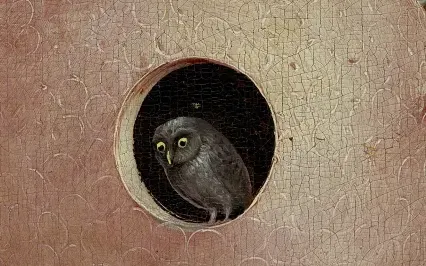
The owl in the fountain
Left wing: Paradise · Two round eyes in a dark hole, at the exact centre of Paradise
Inside the round base of the fountain, in a dark porthole, sits a small owl. It stares straight out at you. It is the first of several owls in the triptych.
Today we think of owls as wise. In Bosch's time the owl was a bird of the night that lured smaller birds and then struck. Writers of the period used it for evil and foolishness. So even in Paradise, before anyone has sinned, something is already watching and waiting.
The NTR documentary explains that the owl was once nicknamed "the Bosch bird" and here stands for "impending evil and doom". The Dutch Wikipedia quotes a refrain from 1524 in which night-owls hiding from the sun are compared to lovers who do not keep to marriage. Vandenbroeck calls the owl a core symbol of the panel's marriage theme. De Bruyn notes that "the owl and the cavity it guards inside the fountain have dark connotations".
Sources
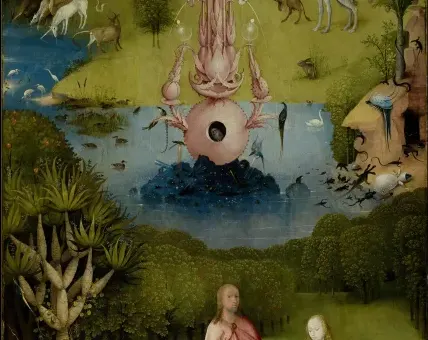
The pond of Paradise
Left wing: Paradise · Ducks, a swan and creatures crawling ashore
The pale blue pond around the fountain is full of life. Ducks swim on the left, a white swan on the right, a dark bird with a long tail stands on the fountain. On the far right, small lizard-like creatures with too many legs crawl out of the water onto the land, and a strange animal with a shell sits on the rock.
This is the water that feeds the garden in the centre panel; the lake there is painted at the same height. It also brings the first ugly things into Eden: the crawling creatures were counted as demonic in Bosch's day.
Look closer: Find the three-headed lizard among the creatures on the right bank. Look closer in the viewer ›
The NTR documentary points out "all manner of reptiles" leaving the water, and among them a creature with three heads, "most likely an invention by Bosch himself". Gombrich wrote that these creeping creatures make it "visually more intelligible" that God later repented of his creation. Payne reads the white swan beside the fountain as a nod to Bosch's own Brotherhood of Our Lady, which served swan at its banquets.
Sources
The dragon tree
Left wing: Paradise · A tree from the Canary Islands, copied from a print
Left of Adam grows a tree that looks like a palm with thick arms and bursts of spiky leaves. A vine with berries climbs up its trunk. It is a dragon tree, a species from North Africa and the Canary Islands that gives a dark red sap, the "dragon's blood".
Bosch never saw one. He copied it, almost line for line, from an engraving of the Flight into Egypt by Martin Schongauer, a German printmaker of the 1470s. The same tree stands in the picture of Eden in the Nuremberg Chronicle of 1493.
Gibson and the NTR documentary read it as the Tree of Life, the tree that gave Adam and Eve immortality. The Dutch Wikipedia says it is "possibly" the Tree of Knowledge instead. Vandenbroeck connects its "burgeoning branches and clinging vine" to the command to be fruitful and multiply.
Sources
The serpent on the palm
Left wing: Paradise · Wrapped around a date palm, waiting
On the right edge of the wing, a date palm grows out of a brown rock. A snake is coiled around its trunk. Nothing has happened yet, but the snake is already in Paradise. A small animal creeps along the rock below it.
The Fall itself is not painted anywhere in the triptych. Bosch only shows the moment before, and lets you know what will come.
The NTR documentary: the snake is "waiting to strike once Adam and Eve are married". Wikipedia reports Fraenger's reading of the snake and the mouse beside it as phallic symbols. Hans Belting (2002) also saw the serpent "curled around a palm tree" as a hint of the Fall.
Sources
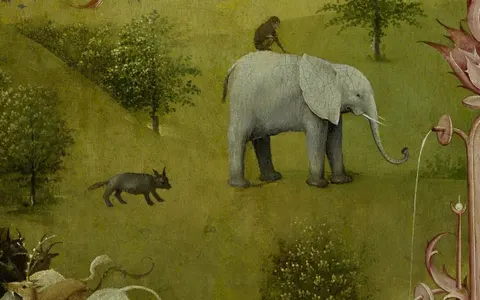
The elephant and the monkey
Left wing: Paradise · An elephant with a monkey on its back
On the meadow walks a grey elephant with a small monkey riding on its back. Nearby a bear climbs a tree. Few people in the Low Countries had ever seen an elephant. Bosch may have seen one at a fair, or in a book.
The animals of Paradise are a mix of the familiar, the exotic and the invented. Together they show the richness of God's creation, which is also something a rich patron liked to see and talk about.
The Dutch Wikipedia reports Jos Koldeweij's view that the elephant and the seal were painted from life. Belting wrote that the exotic animals appeal "to the knowledge of a humanistic and aristocratic readership".
Sources
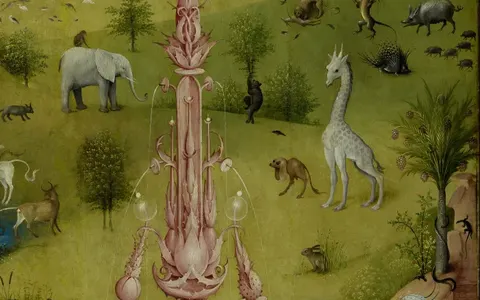
The giraffe
Left wing: Paradise · Copied from a traveller's drawing of the 1430s
A giraffe stands on the hill to the right of the fountain, white and spotted, with small horns and a long thin neck. It looks a little stiff, as if drawn from a picture rather than from life. That is exactly what happened.
The Italian traveller Cyriac of Ancona saw a giraffe in Egypt in the 1430s and drew it. Copies of his drawing went around Europe, and Bosch's giraffe is almost identical to it. For most viewers of the painting this was the first giraffe they ever saw.
Wikipedia (after Belting and Vandenbroeck) says the giraffe "may be drawn from copies of those in Cyriac of Ancona's Egyptian Voyage"; the Dutch Wikipedia calls it "almost identical" to the drawing.
Sources
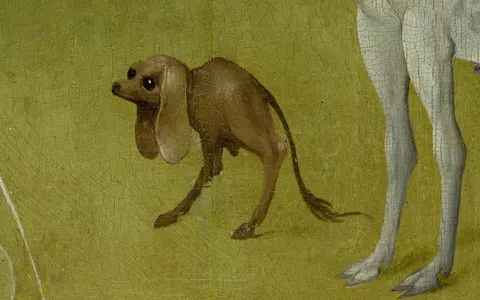
The dog with two legs
Left wing: Paradise · A floppy-eared beast that walks on its hind legs only
Just left of the giraffe walks a small brown animal with long floppy ears, like a hound, and a thin tail with a tuft. It has only two legs. Where its front legs should be, its chest simply ends in a round belly.
Smarthistory calls it "the two-legged dog" and adds that early sixteenth-century viewers may have found it and the giraffe "equally fantastic" or "equally real": they knew such animals only from the same books that told of dragons and unicorns. Fraenger (1947) thought it was no dog at all. In Breydenbach's travel book of 1486, he wrote, Bosch found "lop-eared" goats labelled Caprae de India, Indian goats, drawn with four legs, and gave his own one only two, to make it even more "Indian", since India was the land of strange mixed creatures. The woodcut exists and shows those goats. But Belting (2002) notes that the giraffe, once also traced to Breydenbach, was copied from Cyriac of Ancona instead, so treat Fraenger's idea as a guess.
Sources
- Asa Simon Mittman, Hieronymus Bosch, The Garden of Earthly Delights, Smarthistory
- Wilhelm Fraenger, Hieronymus Bosch: Das tausendjährige Reich (1947), pp. 57 and 124 (archive.org)
- Erhard Reuwich, animals seen on the journey, woodcut in Breydenbach, Peregrinatio in terram sanctam (Mainz 1486) (Wikimedia Commons)
- Hans Belting, Hieronymus Bosch: Garten der Lüste (2002), p. 26 (archive.org)
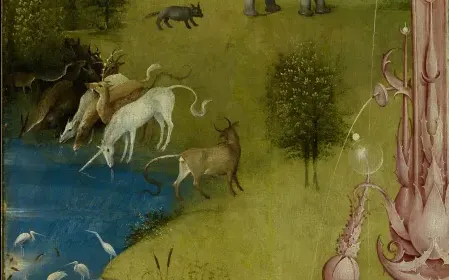
The unicorn at the water
Left wing: Paradise · A white unicorn drinks beside a deer and a boar
At the left edge of the wing, animals have come down to a second pool to drink: a white unicorn, a deer, a boar, a horse. The unicorn was a real animal to most people of the time. It stood for purity.
Remember these animals. In the centre panel the same kinds of animals, unicorns, horses, boars and camels, carry naked men around a pool full of women.
The NTR documentary says that by painting familiar, exotic and fabled animals together, "Bosch pays homage to the miraculous and diverse quality of God's creation". Payne (2021) notes that the animals drinking here "are going to reappear in the second panel".
Sources
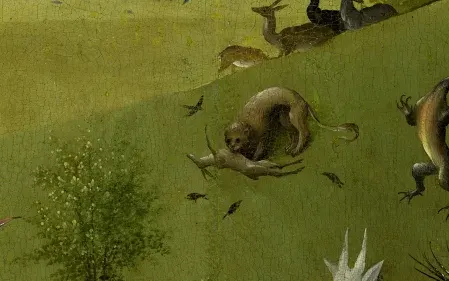
A lion eats a deer
Left wing: Paradise · Killing in Paradise
Behind the giraffe, in the grass, a lion has brought down a deer and is eating it. It is easy to miss. Further back, other animals fight. Paradise is not peaceful even before the Fall.
This surprised some modern writers, but it did not surprise people in Bosch's time. It was commonly believed that the animals were already corrupt before man sinned.
Gibson (1973) writes that animals devouring each other in this landscape "should not disturb us as it does De Tolnay; it was generally agreed that the animals were corrupt even before the Fall of Man". Gombrich put it shortly: "In Bosch's Paradise, corruption has already set in." The NTR documentary asks whether "the animal kingdom, as opposed to the kingdom of man, was never without sin".
Sources
- Walter S. Gibson, The Garden of Earthly Delights: the iconography of the central panel, NKJ 24 (1973)
- E. H. Gombrich, Bosch's Garden of Earthly Delights: a progress report, JWCI 32 (1969)
- NTR, Jheronimus Bosch: the Garden of Earthly Delights, interactive documentary (2016)
- Wikipedia: The Garden of Earthly Delights
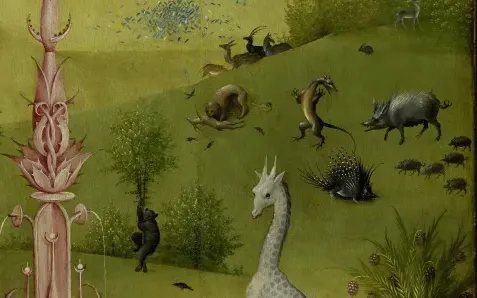
Strange beasts on the hill
Left wing: Paradise · A porcupine, a dragon-lizard and a boar with its young
On the hill to the right there is a crowd of animals that do not quite exist: a lizard standing on two legs with a long tail, a porcupine with spines like white needles, a grey boar followed by its young. Some are real animals seen through books, some are Bosch's own.
Bosch took many of his animals from bestiaries, the medieval books of beasts, and from the drolleries in the margins of manuscripts. He also had a store of his own images that he used again in other paintings.
The Eclectic Light Company describes "composite" creatures among the animals of the wing. Vandenbroeck reads the swarming animals as "a rampant propagation of multiform Evil".
Sources
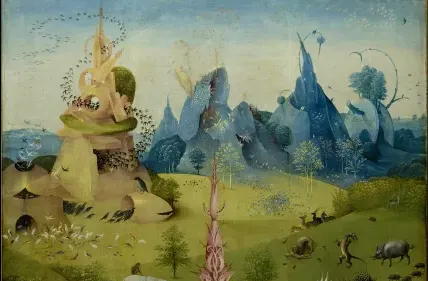
The rock with the birds
Left wing: Paradise · A flock pours into a dark hole in a rock shaped like a face
In the top left corner of the wing stands a tall yellow rock with holes in it. A long flock of white birds flies into one opening and a flock of dark birds flies out on the other side and swirls up into the sky. The rock looks a bit like a hut, and a bit like a head.
These bird-rocks appear again in the centre panel, which shares the same skyline. Salvador Dalí knew this corner well: his painting The Great Masturbator of 1929 echoes a rock on the right side of this wing that looks like a face with a long nose.
Gombrich wrote that "the swarm of black birds which spiral through and around them augurs nothing good". Falkenburg, as reported by De Bruyn, sees in the distant blue mountains "late-medieval war machines" attacking Paradise, and a "disturbing rock face" to the right of the fountain. Payne (2021) reads the weeping rock face as Golgotha, the "place of the skull", after the medieval belief that Adam's skull was buried under the cross. That is his own reading.
Sources
- Wikipedia: The Garden of Earthly Delights
- E. H. Gombrich, Bosch's Garden of Earthly Delights: a progress report, JWCI 32 (1969)
- Eric De Bruyn, review of Reindert Falkenburg, The Land of Unlikeness (2011), Oud Holland 126 (2013)
- James Payne, Great Art Explained: The Garden of Earthly Delights (video, 2021)
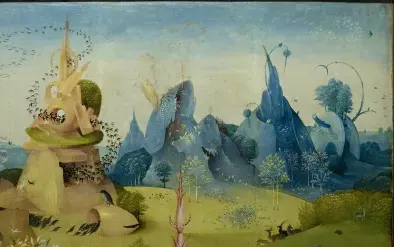
The blue mountains
Left wing: Paradise · Rock spires on the horizon, shared with the centre panel
On the horizon rise pale blue rocks with holes, spikes and ledges. They are the same colour as the distant mountains in the centre panel, and the horizon continues at the same height across both. The painter wanted you to read Paradise and the garden as one landscape.
The Prado speaks of "a single, continuous landscape with a high horizon line". De Bruyn reports Falkenburg's idea that some of these mountains "look like the wide-opened jaw of an animal or like forges from Hell".
Sources
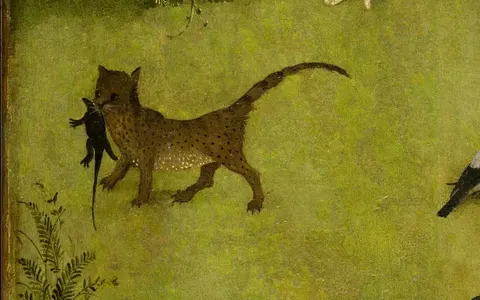
The cat with its prey
Left wing: Paradise · A spotted cat carries a lizard in its mouth
At the bottom left, close to Adam, a spotted cat walks away with a small animal hanging from its mouth. Writers cannot agree whether it is a cat or a panther, and whether the prey is a lizard, a mouse or a rat. What they agree on is the meaning: a creature is being killed in the garden of God.
Wikipedia: "a cat holds a small lizard-like creature in its jaws". De Bruyn asks of Falkenburg's "panther": "but do panthers catch mice (or rats)?" Dutch scholars (Koldeweij, Vandenbroeck, Vermet) see either a sign that animals are sinful by nature or a hint of the coming Fall.
Sources
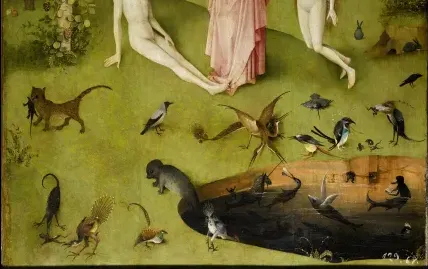
The dark pool and the reader
Left wing: Paradise · A hooded creature with a duck's bill reads a book
At the very bottom of the wing a dark hole opens in the ground, full of black water. Winged fish, a platypus-like animal and small monsters climb out of it. Near the right end of the pool a creature in a short hooded jacket rises from the water, with the bill of a duck and the tail of a fish, holding an open book as if it is reading.
It is one of the strangest details of Paradise and nobody knows for certain what it means. It is also the kind of detail that made the painting a talking point at the court where it hung.
Look closer: The reader with the book is in the water at the right end of the pool. Look closer in the viewer ›
Wikipedia, after Belting: "Behind a fish, a person clothed in a short-sleeved hooded jacket and with a duck's beak holds an open book as if reading." The Eclectic Light Company counts "about thirty" creatures in the lower lake. Gombrich wrote that these creatures make it clear "that the Lord repented of the Creation".
Sources
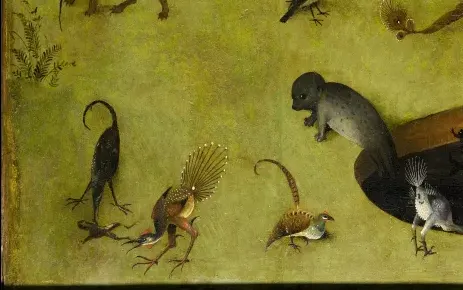
Monsters at the edge
Left wing: Paradise · A curled tail, a fan of feathers and a seal-like beast
In the bottom left corner, small monsters walk and crawl: a black creature with a curled tail on bird's legs, a bird with a tail like a fan, a seal-like animal. They are the kind of hybrid that Bosch became famous for, half one animal and half another, drawn with the same care as the real giraffe above them.
The Eclectic Light Company notes that few of the lower lake's creatures "resemble earthly species". Vandenbroeck counts such monsters as "diabolical".
Sources
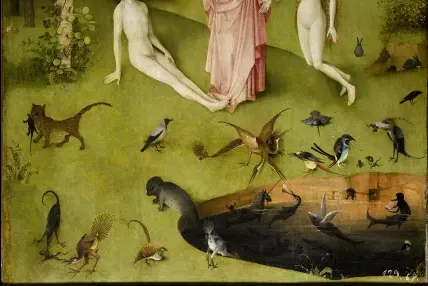
Birds on the meadow
Left wing: Paradise · A kingfisher, a crow, a jay and birds that never existed
Between Adam and the dark pool a row of birds walks and flies over the grass: a crow, a jay, a kingfisher-like bird, a long-legged bird with a fan on its head, and a few that Bosch made up. Some are drawn so exactly that you can name the species; others are composites.
The NTR documentary says the wing "is teeming with animals" and birds. Wikipedia, after Belting, describes birds and winged animals emerging from the hole "some of which are realistic, some fantastic".
Sources
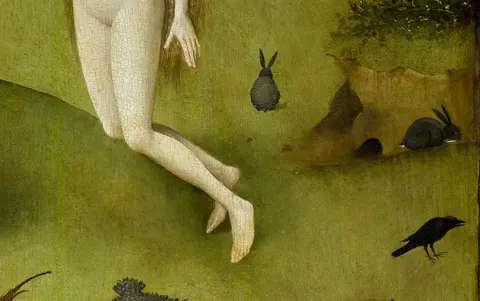
The rabbits
Left wing: Paradise · Fertility, right behind Eve
Behind Eve, two rabbits sit in the grass at the foot of a brown rock, and a black bird walks past. Rabbits were an easy symbol for everyone: they stood for fertility. Bosch placed them next to the woman who has just been blessed with the words "Be fruitful and multiply".
Wikipedia (Gibson): "Behind Eve, rabbits, symbolizing fecundity, play in the grass."
Sources
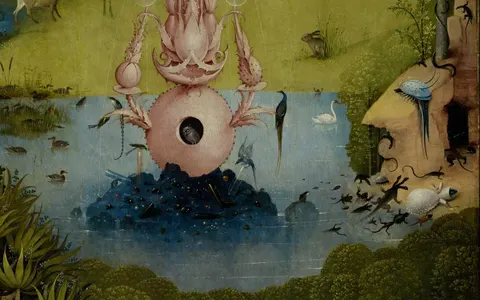
The rock with the cave
Left wing: Paradise · A brown rock on the right bank with creatures on it
On the right bank of the pond stands a brown rock with a dark cave. A blue spiked creature sits on its ledge, lizards crawl at its foot and a round shelled animal rests on the shore. The rock has the shape of a face in profile, which has fascinated modern painters.
Wikipedia notes that Dalí's The Great Masturbator "is similar to an image on the right side of the left panel of Bosch's Garden, composed of rocks, bushes and little animals resembling a face with a prominent nose and long eyelashes". Jacobs, reviewing Falkenburg, mentions "an anthropomorphic rock formation in the right middle ground".
Sources

The centre panel: the Garden
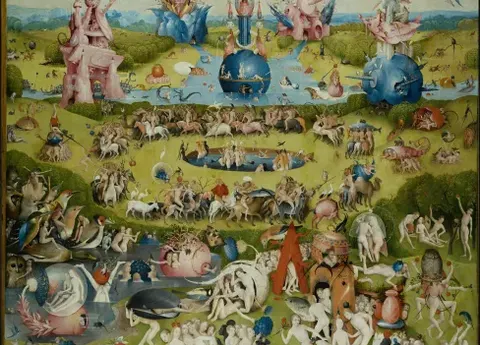
The cavalcade around the pool
Centre: the Garden · Naked men ride in a circle around a pool of women
In the middle of the garden a crowd of naked men rides in a wide circle, anticlockwise, around a round pool. They sit on horses, camels, unicorns, boars, donkeys and animals that do not exist. Some do acrobatics on their mounts. Many carry fruit, eggs or birds, like gifts. In the pool stand the women, with birds and fruit on their heads, and the men ride around and around them.
This is the engine of the whole panel. Everything else in the garden seems to start here: the men want the women, and the women know it.
Look closer: Find the man standing on his head on top of a giant bird. Look closer in the viewer ›
Gibson (1973) reads it as "the sexual attraction of men and women", placed in the centre of the garden "as the source and initial stage of the activity elsewhere". He compares it to Psalm 11:9 in the Latin Bible, "The wicked walk around in a circle", and to prints of the Morris dance, in which men dance around one woman. The Prado says the riders "have been associated with different Cardinal Sins", and the NTR documentary says their mounts "represent vice and deadly sins such as lust, gluttony and pride". The Dutch Wikipedia adds that the ride comes from moral literature, where such circles meant sin and addiction to lust, and that men riding animals show people led by animal urges.
Sources
- Walter S. Gibson, The Garden of Earthly Delights: the iconography of the central panel, NKJ 24 (1973)
- Museo del Prado, collection entry P02823 (Pilar Silva Maroto, 2016)
- NTR, Jheronimus Bosch: the Garden of Earthly Delights, interactive documentary (2016)
- Wikipedia (Dutch): De tuin der lusten
- Wikipedia: The Garden of Earthly Delights
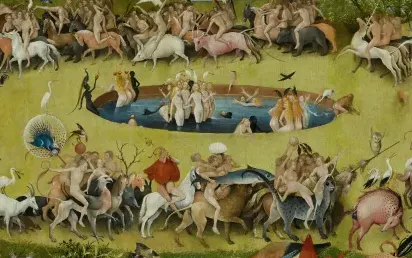
The pool of women
Centre: the Garden · Three groups of bathers with fruit and birds on their heads
The women stand in the water up to their waists, in three groups. On the left they wear red fruit on their heads, in the middle white birds, on the right black ones. On the left bank a black woman balances a peacock on her head and holds up a red fruit, and a heron stands beside her. One woman is already climbing out of the water towards the riders.
Around 1500 people said that someone in love was "swimming in the bath of Venus". Here the whole garden swims in it.
Dirk Bax (1956) explained the pool with that Dutch expression. Gibson adds that "as the medieval moralists constantly complained, it was woman who took the initiative in leading man into lechery". The Dutch Wikipedia names the birds: spoonbills in the middle, jackdaws on the right. The NTR documentary asks: "The women don't look particularly distressed. Is it maybe because their attraction gives them a hold on these men?"
Sources
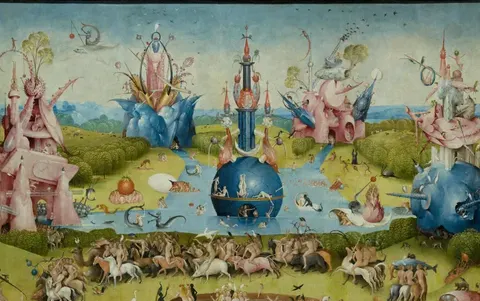
The broken fountain
Centre: the Garden · A blue globe with a crack, and a couple inside the hole
At the top of the panel, in the middle of the lake, stands a tall blue fountain on a cracked blue ball. People climb on it, lie on its ledge and swim around it. It is the sister of the pink fountain in Paradise, but this one is damaged: cracks run across the globe.
In Paradise an owl sat in the hole of the fountain. Here the hole holds a bearded man who touches a naked young woman while others watch. It is the only openly sexual act in the whole panel, and it sits exactly where the owl was.
Look closer: Zoom into the round hole at the bottom of the globe. Look closer in the viewer ›
The Prado: the central construction is "similar to the fountain of the Four Rivers in the Paradise panel, although here broken to symbolize its fragility and the ephemeral nature of the delights", and "the owl ... is replaced here by human figures in sexually explicit poses". De Tolnay called it the "Fountain of Adultery". The NTR documentary: "No longer lurking, evil (in the form of lust) has found its way to the very heart of the world."
Sources
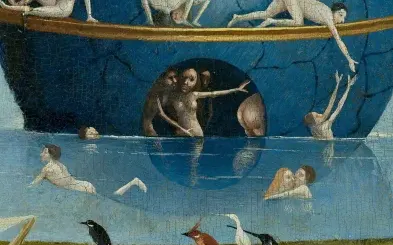
Inside the globe
Centre: the Garden · The one explicit scene of the garden
Through the round opening at the foot of the blue globe you look into a dark room. A man with a beard reaches towards a young woman; another person's bare backside hovers beside them. Everyone else in the garden flirts, feeds each other and plays. This is the one place where Bosch painted the act itself, and he hid it inside the building that stands for the whole world.
Wikipedia: "Visible through its circular window, there is a man holding his right hand close to his partner's genitals and the bare buttocks of yet another figure hovering in the vicinity." The NTR documentary speaks of a bearded man who "shamelessly touches the crotch of a naked young woman".
Sources
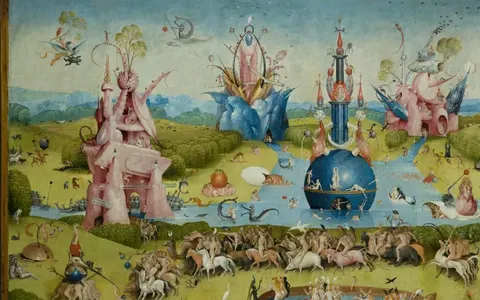
The pink tower
Centre: the Garden · A castle of flesh-coloured spires, with people inside
On the left of the lake stands a pink structure of spires, arches and spikes, part castle, part plant, part coral. People climb it and sit in its openings. Clear glass tubes stick out of its walls, and a crowd of strange grey figures sits in the water beside it, holding up red fruit.
Five of these constructions stand in the lake. The four outer ones alternate pink and blue, and the central one is the broken fountain. Nobody has ever built anything like them, and nobody knows exactly what they are.
The Prado counts "five fantastical architectural constructions in the water". Gibson compares them to the fountains and pavilions "of gold, coral, crystal and other precious materials" in medieval love gardens. De Tolnay called the four of them "castles of vanity". Falkenburg calls them "siege towers in disguise" that already point to the black mountains of Hell. De Bruyn suggests a medieval belief in a mirror-like temple with a fountain in the middle of Eden.
Sources
- Museo del Prado, collection entry P02823 (Pilar Silva Maroto, 2016)
- Walter S. Gibson, The Garden of Earthly Delights: the iconography of the central panel, NKJ 24 (1973)
- Wikipedia (Dutch): De tuin der lusten
- Eric De Bruyn, review of Reindert Falkenburg, The Land of Unlikeness (2011), Oud Holland 126 (2013)
- The Eclectic Light Company, Hieronymus Bosch: The Garden of Earthly Delights, part 1 (2016)
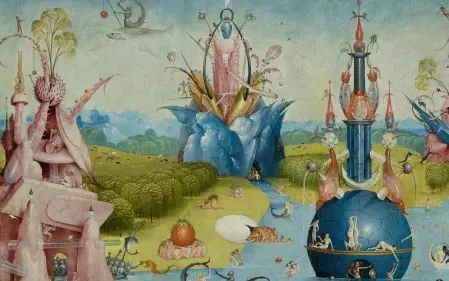
The blue rock
Centre: the Garden · A blue tower with a golden crown
The second construction is a blue rock with a golden, horn-shaped top, flanked by thorns. A group of bathers stands in a dark cave at its foot, and a river flows out of the cave into the lake. In front of it a giant strawberry rests on a heap of naked, pink-skinned people.
The Eclectic Light Company describes the four outer towers as "alternate red and blue in colour", with "various strange superstructures and ornaments". The NTR documentary notes the "gate-like openings at their base, through which people and animals are moving".
Sources
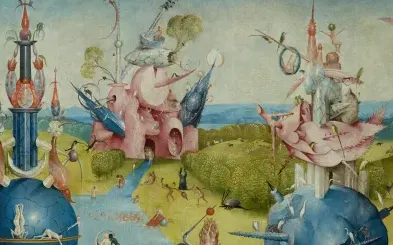
The pink tower on the right
Centre: the Garden · Round windows, a blue spike and people on the ledges
Right of the fountain stands another pink building with round openings, a blue spike and a knot of thin blue branches. People stand in its windows and sit at its foot. A black figure stands on the island before it, and swimmers float in the water around it.
Through the portholes of these towers you can sometimes see what the people inside are doing. Zoom in and look.
The Eclectic Light Company notes that the towers "form the stage for other activities"; only in the porthole of the central fountain does it see "almost explicit sexual activity". The NTR documentary describes "flesh-toned spires and pointed shapes" and asks whether they were "built to withstand a siege".
Sources
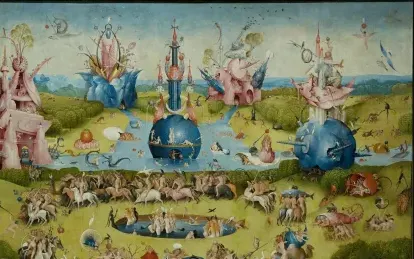
The blue globe with the tower
Centre: the Garden · A tall pink spire on a blue ball with a spike through it
On the far right of the lake a blue ball with holes in it carries a tall pink and white spire with green parrots. A long blue spike runs through the ball, and a thin tower with a tiny figure on top rises above the whole thing. Herons sit in its big opening, and people shelter in a cave under the ball.
Falkenburg, as De Bruyn reports, sees in many details of these towers "late-medieval siege machines and warfare". Laurinda Dixon (1981) saw alchemical apparatus in the garden's glass vessels and in the central blue fountain; the Jheronimus Bosch Art Center finds a complete alchemical programme "less probable".
Sources
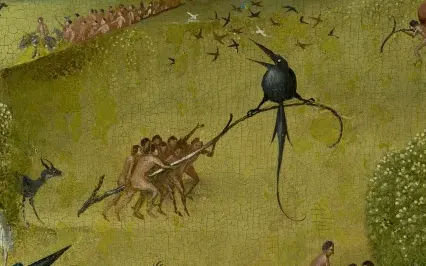
The bird on the branch
Centre: the Garden · Ten men carry a branch with a huge black bird at its tip
High on the meadow at the right edge, a tight bunch of about ten naked men holds a long pale branch, as if they were carrying a battering ram. At its tip, on a curling twig, sits a huge black bird with a long, open beak and two very long tail feathers that hang down like ribbons. Small birds fly around it.
Look closer: Look at the bird: beak open, tail like two ribbons. Look closer in the viewer ›
The bird has no clear species. A caption on Wikimedia Commons calls it a raven, but its beak is far too long for a raven and its tail ends in two long streamers, so it looks more like one of Bosch's invented birds. We found no art historian who explains this group.
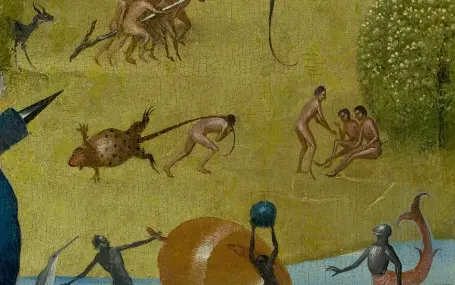
The man who drags a toad
Centre: the Garden · A spotted beast pulled along by its tail, and three men talking
Just below, a naked man walks bent forward with a long tail over his shoulder. At the other end of it a big brown animal with black spots and clawed feet slides along on its back: the body of a toad, the tail of a lizard. To the right three men sit and stand together by a bush, one of them leaning in with both hands out, as if he is telling the other two something.
Bax (1956), who described the panel corner by corner, notes that here "a man drags a toad-like" animal (our translation). He gives no meaning, and we found nothing on the three men beside him.
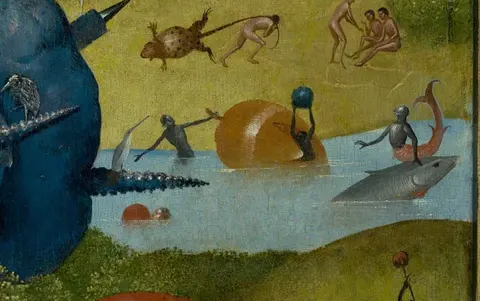
The big fruit and the sea knight
Centre: the Garden · A fruit towed through the water, a blue ball held high, a knight on a fish
In the water right of the blue globe, a black man wades along and tows a huge orange fruit by its stalk. Behind it a second black figure holds a blue ball high above his head with both hands. Further right a dark rider with a fish's tail sits on a big grey fish, one hand on its head. On the left a white heron watches, and lower down a swimmer pushes a red ball ahead of him.
Look closer: Find the sea knight with his fish tail, riding a fish at the edge of the panel. Look closer in the viewer ›
Bax (1956) describes the scene in a few lines: a large fruit floats "pulled along by a man", "another lifts a blue ball", "a third person, swimming, pushes a red ball ahead of him", and at the edge of the painting lies "a sea knight" on the head of a fish (our translations). He gives no reading. Black and white people share the whole garden; in 1517 De Beatis already noted "whites and blacks doing various activities and poses".
Sources
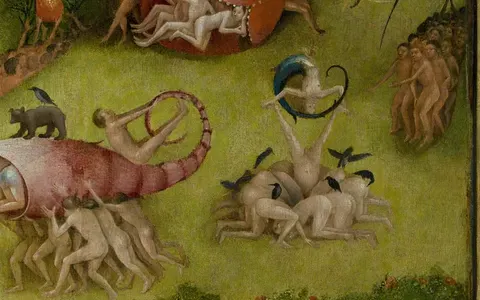
The ring of crows
Centre: the Garden · Kneeling people with crows on their backsides, and a siren on top
Right of the riders, a ring of naked people kneels with their heads bowed to the ground and their backsides in the air. Black crows sit on their backs. In the middle a man stands on his head with his legs spread wide, and on his feet balances a creature curled into a ring: a woman with a blue fish tail.
Look closer: Look at the siren balancing on the upturned feet. Look closer in the viewer ›
Bax (1956) describes "a group of eight persons who lie kneeling, with their heads bowed to the ground. Perhaps they are all men. Six crows sit on the backsides. One pecks at an anus." Behind them stands "a man on his head with his legs spread", and "on his feet a siren does a balancing act". The siren, he adds, appears in the Middle Ages and the sixteenth century as a symbol of female seduction. Elsewhere he lists the raven and the crow as signs of impurity, "perhaps also drunkenness". (Our translations from the Dutch.)
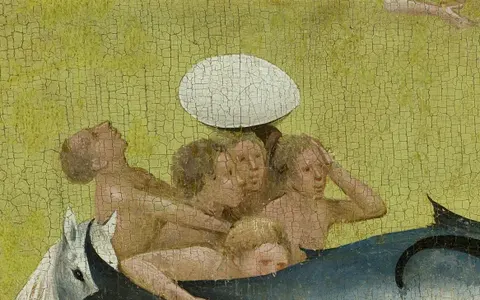
The egg at the centre
Centre: the Garden · A whole white egg, carried by one of the riders
In the cavalcade below the pool, a tight group of naked riders clings to a giant fish, and one of them carries a large white egg on his head. It is whole. Eggs are everywhere in this painting, usually cracked or hollowed out and used as houses; near the blue rock another big egg has split open and a crowd of tiny people pours out of it.
Eric De Bruyn noticed that this egg sits at the exact centre of the centre panel, just as the owl sits at the exact centre of the left wing, and that the Tree Man's body in the right wing is a broken eggshell.
De Bruyn: "in the exact center of the central panel we see an egg". Payne (2021) calls it "the only unhatched egg on this panel" and treats it as the hidden vanishing point of the composition, "a possible symbol of new beginnings"; that is his own reading. Dixon saw eggs as alchemical vessels.
Sources
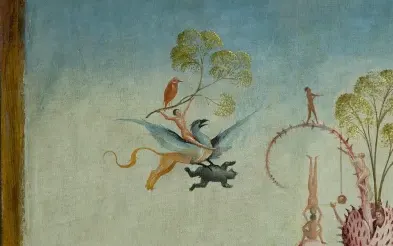
The griffin rider
Centre: the Garden · A man on a griffin carries a tree through the sky
In the sky at the top left a man rides a griffin, the lion-eagle of legend, and holds a branch with three forks like a lance. A bird sits on the branch. Across the sky he faces a knight with a fish's tail who flies on a winged fish. In its claws the griffin holds a small black animal.
The NTR documentary sees a joust: the griffin rider "takes on his opponent: a marine knight ... borne aloft by a winged fish". Fraenger read the bird on the branch as "a symbolic bird of death" and the rider as a "genius"; scholars today do not follow Fraenger. The Dutch Wikipedia says Bosch took the griffin from a print by Schongauer.
Sources
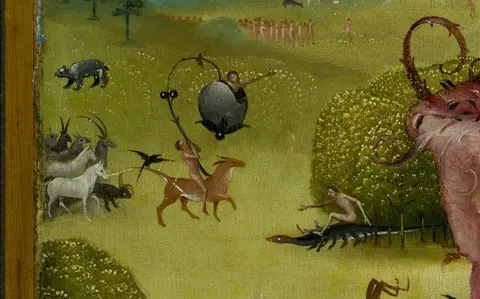
The rider with the big fruit
Centre: the Garden · A man inside a grey fruit points at the pink tower
High up at the left edge of the garden, a small procession of animals walks towards the wood. In front rides a naked man on a brown animal with backswept horns. He hugs a long branch with small black berries and one big grey fruit, and in the big fruit sits another man who stretches out his arm towards the pink tower. A black bird flaps just above the animal's tail.
Behind them come a white unicorn, a horse and a herd of horned animals, and higher up walks a bear on its own. To the right a man rides out of the wood on a dark, lizard-like creature with far too many legs.
Look closer: Look at the man inside the grey fruit: he points at the pink tower. Look closer in the viewer ›
Dirk Bax described this corner in 1956 without explaining it: a rider on a "cattle-like animal" carries "a branch from which hang two small black round fruits and one large one", and in the large one sits "a man who points with outstretched arm at the pink structure". The animals that follow are, for him, "two horses, a deer, an antelope, a mule and two imaginary animals", and behind them "stands a bear". The other rider sits on "a lizard-like animal with six legs". The Bosch Research and Conservation Project tags the bear and the unicorn in its photograph. No author we found gives this group a meaning. Gibson, writing about the riders round the pool of women, notes that riding was a medieval metaphor for the sexual act. (Bax wrote in Dutch; the translations are ours.)
Sources
- Dirk Bax, Beschrijving en poging tot verklaring van het Tuin der Onkuisheid-drieluik van Jeroen Bosch, KNAW Verhandelingen 63 (1956), pp. 26-69 (Google Books, search inside)
- Bosch Research and Conservation Project, tagged photograph of the Garden (tags Bear and Unicorn)
- Walter S. Gibson, The Garden of Earthly Delights: the iconography of the central panel, NKJ 24 (1973)
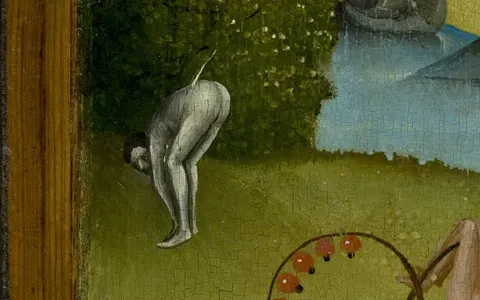
The man who shows his backside
Centre: the Garden · Bent double against the hedge at the left edge
Against a hedge at the left edge, a pale man bends over so far that his head hangs at his knees and his bare backside points at the sky. Something thin and white sticks out of it, like a stalk or a feather. He is not the only one: lower down in the garden another man has flowers growing from the same place.
Bax (1956) says this man "ostentatiously shows his backside" and quotes a line from Bredero's play Moortje (1615) about a man who "stuck out his behind as if he wanted to borrow" (our translation). In a footnote Bax reads the borrowing in an unchaste sense, as a hint at sodomy. Bredero wrote a century after Bosch, and the linguist J. W. Muller (1900) explained the saying more innocently: it was said of anyone standing bent over, and he guessed it came from the humble pose of a poor man buying bread on credit. Nobody we found explains the white stalk.
Sources
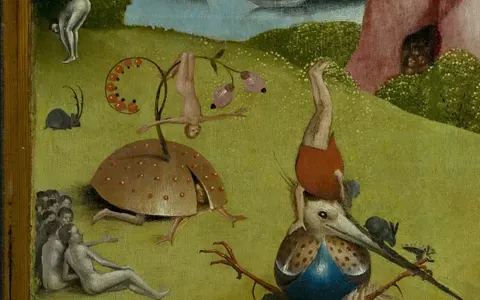
The man under the spotted shell
Centre: the Garden · A berry stem, a man hanging upside down, and the men who watch
Below the bending man, a man crawls under a big brown dome dotted with red spots. Only his arms and legs stick out, and his face peers through a slit. From the top of the dome grows a stem that curls into a ring of red berries and ends in two pink fruits. A second man hangs from it upside down, his legs hooked over the stem and his arms spread wide. In the corner a group of men sits and watches.
Beside the dome sits a small dark animal like a rabbit, with two long curved horns.
Look closer: Find the little rabbit with horns beside the shell. Look closer in the viewer ›
Bax (1956) describes the scene and leaves it at that: a man lies "under a plant-like, spherical object and looks out through a slit", a stem with "eight red and two violet berries" grows out of it, another man hangs from it "head down", and "a group of eight men sits watching the evolutions of the pair". The horned animal is, for him, "a little rabbit with long feelers on its head". He gives no meaning for the group, but elsewhere he writes that stems with berries near a hollow are, "like so many such plants in Bosch, a symbol of unchastity". (Our translations from the Dutch.)
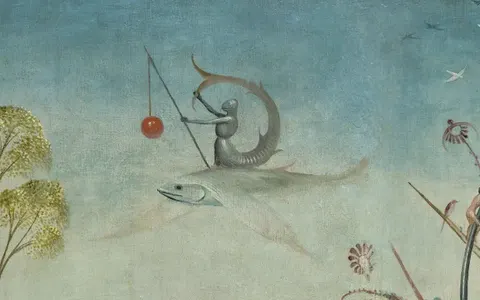
The knight on the flying fish
Centre: the Garden · A sea knight dangles a red ball from a stick as he flies
In the sky above the pink tower a big pale fish flies on long pink fins. On its back sits a grey rider with a helmet-like head and a fish's tail instead of legs; the tail arches up behind him and he holds its fin. In his other hand he has a long thin stick, and from its tip a red ball hangs on a thread, like bait on a fishing rod. To his left the man on the griffin rides towards him.
Bax (1956) calls him "a so-called sea knight" who holds a stick with a red ball on it and "sits on a winged fish", and for him the flying figures of this sky are "simply continuations of the erotic images" in the rest of the painting (our translations). Francisco Cruz (2007) sees "a kind of siren" carrying "a rod with a cherry hanging from it", and links sirens with seduction and death. The NTR documentary imagines a joust with the griffin rider and speaks of a lance with the fruit "speared on it", but it plainly hangs on a string; the Bosch Research and Conservation Project tags it "String with ball", a motif Bosch also painted elsewhere. Fraenger (1947) read the rider and his curled tail as a symbol of eternity on the way to heaven, a reading few follow today.
Sources
- Dirk Bax, Beschrijving en poging tot verklaring van het Tuin der Onkuisheid-drieluik van Jeroen Bosch, KNAW Verhandelingen 63 (1956), pp. 26-69 (Google Books, search inside)
- Francisco Cruz L., Lo grotesco en el jardín de las delicias, Analecta 2 (2007)
- NTR, Jheronimus Bosch: the Garden of Earthly Delights, interactive documentary (2016)
- Bosch Research and Conservation Project, tagged photograph of the Garden (tag String with ball)
- Wilhelm Fraenger, Hieronymus Bosch: Das tausendjährige Reich (1947), pp. 57 and 124 (archive.org)
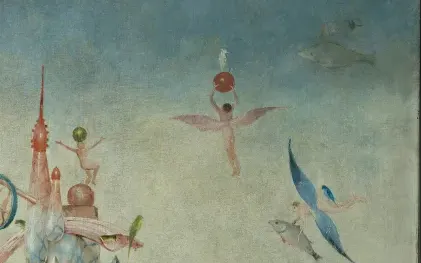
The flying youth with the fish
Centre: the Garden · Winged figures carry a berry and a fish through the air
At the top right, a winged figure holds a big red berry over his head, with a small white bird perched on it; below him a youth with long blue wings soars upwards with a fish in his hands and a small blue bird on his back. Higher up, a pale fish swims through the sky. Fish fly, birds swim, people grow wings: in this garden nothing stays in its element.
Wikipedia: "a winged youth soars upwards, carrying a fish in his hands and a falcon on his back". Gombrich thought these winged figures might echo the old story that giants were born of angels and women before the Flood.
Sources
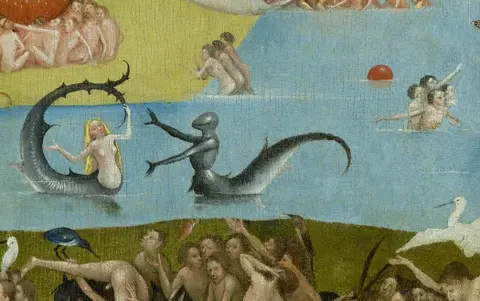
The mermaid and the knight
Centre: the Garden · A sea-knight in armour reaches for a mermaid
In the lake below the blue rock a mermaid with golden hair swims beside a dark knight in armour who also has a fish's tail. He seems to be trying to embrace her. Mermaids were the sirens of the Middle Ages: their song led men into lust.
Gibson: "Water was also the home of mermaids and sirens, whose songs were thought to lure men into lust and other fleshly sins." The NTR documentary finds "an ironic touch" in the armour, "considering that his behaviour is anything but chivalrous".
Sources
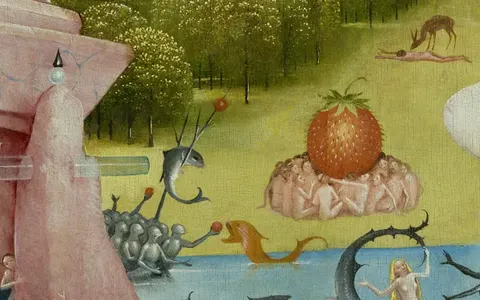
The strawberry on the meadow
Centre: the Garden · A ring of people sits around a giant strawberry
On the meadow above the lake a ring of naked people sits around a giant strawberry. Just to the left, at the water's edge, a crowd of grey-skinned figures holds up red fruit under a grey fish with branches for horns, and an orange fish swims past.
In Spain the painting was once called "del madroño", after the strawberry tree, whose red fruit looks much like this one. In 1605 the monk José de Sigüenza wrote that the whole work is about the "vain glory and brief taste of the strawberry, and its faint scent, which is barely noticed before it is gone".
Gombrich lists "the crowd in the background on the left surrounding an even larger strawberry" among the fruit scenes and explains them with a medieval idea that the earth was far more fertile before the Flood. Gibson (2003) adds that strawberries could also stand for "hypocrisy, deceit in general, and death concealed beneath a smiling appearance".
Sources
- E. H. Gombrich, Bosch's Garden of Earthly Delights: a progress report, JWCI 32 (1969)
- Jheronimus Bosch Art Center, review of Walter Gibson (2003) on the strawberries
- Wikipedia (Spanish): El jardín de las delicias
- Walter S. Gibson, The Garden of Earthly Delights: the iconography of the central panel, NKJ 24 (1973)
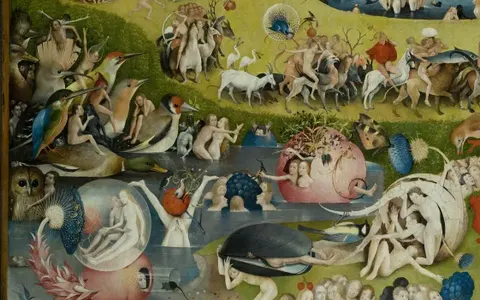
The giant birds
Centre: the Garden · A woodpecker, a hoopoe, a robin and a duck as big as houses
On the left of the garden stands a group of enormous birds: a green woodpecker, a hoopoe, a robin, a kingfisher, a goldfinch and a mallard. They are painted so exactly that you can name every species. Tiny people ride on them, sit between their feathers and take fruit from their beaks. The goldfinch feeds a man a blackberry.
In Dutch, the word for "bird", vogel, gave the verb vogelen, "to bird". Already in the late Middle Ages it also meant to have sex. A crowd of giant birds in a garden of love was a joke every Dutch viewer understood.
Look closer: The goldfinch holds out a blackberry to a man who leans back to bite it. Look closer in the viewer ›
The NTR documentary names the species and explains the double meaning of vogelen. The art historian Eddy de Jongh (1976) documented the same pun in seventeenth-century paintings and says it was in use in the late Middle Ages. De Tolnay read the birds as symbols of fornication and shame. Gombrich saw it more simply: people "accept food from the gigantic birds which must have grown to this size because of the abundance of the earth".
Sources
- NTR, Jheronimus Bosch: the Garden of Earthly Delights, interactive documentary (2016)
- Eddy de Jongh, Tot lering en vermaak (1976), on "vogelen" (DBNL)
- Wikipedia (Dutch): De tuin der lusten
- E. H. Gombrich, Bosch's Garden of Earthly Delights: a progress report, JWCI 32 (1969)
- Wikipedia: The Garden of Earthly Delights
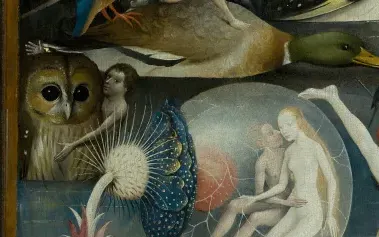
The owl at the left edge
Centre: the Garden · A big owl stares out while a man hugs it
At the left edge of the garden, just above the pond, a large tawny owl stares straight at you. A naked man has his arms around it, as if it were a lover. Its round eyes are the darkest things in this part of the picture.
There are two owls looking out of the centre panel, one at each edge. They watch the garden the way the owl in Paradise watches from the fountain.
The Prado: "Bosch particularly emphasizes two different types of owl that evoke evil. Staring straight out, they direct their disturbing gazes at the viewer at the two lateral edges of the panel." Payne (2021) calls this an owl "who has taken a human lover".
Sources
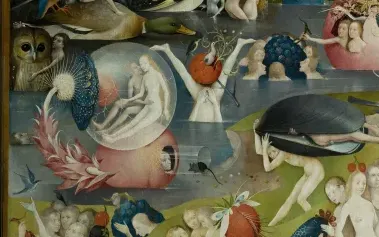
The couple in the glass bubble
Centre: the Garden · Two lovers sealed in a sphere that grows from a flower
On the pond at the left, a man and a woman sit inside a transparent ball. The ball grows like a fruit from a tall flower that rises out of a pink globe floating on the water. The man has one hand on the woman's belly and looks up at her; she rests a hand on his thigh. Look closely: thin cracks run across the glass.
Next to them a man inside a red fruit stares at a mouse that sits in a glass tube. The old Dutch proverb says: happiness and glass break fast.
Look closer: Find the mouse in the glass tube and the man in the red fruit who watches it. Look closer in the viewer ›
De Tolnay quoted the proverb Geluk en glas, zij breken ras for this couple. The NTR documentary points out the cracks and compares the bubble to the small boats with courting couples in late medieval books. Belting called it "an amniotic fluid bubble". Gibson notes that Pieter Bruegel copied this couple into his Allegory of Lust in 1557.
Sources
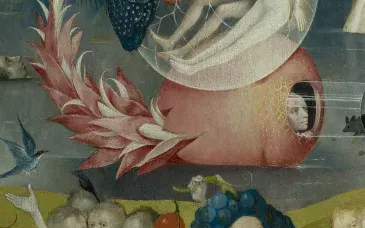
The pink flower and the glass tube
Centre: the Garden · A man in a tube, flowers like a flame
Under the bubble, a pink flower like a tongue of fire bends over the water, and a glass tube pokes out of a hole in the pink globe, where a man peers out from inside. Glass tubes appear all over this panel. They look like the test tubes and retorts of alchemists, and scholars have argued about them for a century.
Gombrich asked, "Was chemistry practised by the antediluvians? Actually it was", and cited the legend of the pillars built by the children of Seth before the Flood. Dixon (1981) built a whole alchemical reading on these tubes. Belting saw in them "perhaps a critical comment on the attempts of the alchemists to imitate God's nature". De Bruyn leaves the question open.
Sources
- E. H. Gombrich, Bosch's Garden of Earthly Delights: a progress report, JWCI 32 (1969)
- Jheronimus Bosch Art Center, review of Laurinda Dixon, Alchemical imagery in Bosch's Garden of Delights (1981)
- Jheronimus Bosch Art Center, review of Hans Belting, Garden of Earthly Delights (2002)
- Eric De Bruyn, review of Reindert Falkenburg, The Land of Unlikeness (2011), Oud Holland 126 (2013)
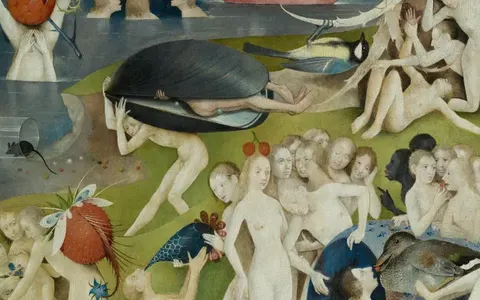
The couple in the mussel shell
Centre: the Garden · A man carries a closed shell with two people inside
A man bends under the weight of a huge dark blue mussel shell on his back. The shell is almost closed, but three legs stick out of it, and inside are two people who only have eyes for each other. Pearls roll out of the shell and fall to the ground. The carrier looks at you as he walks, as if he knows exactly what is going on behind him.
This is the first detail of the painting that anyone ever wrote down. In July 1517 the Italian traveller Antonio de Beatis saw the triptych in Brussels and noted "people crawling out of a shell".
The NTR documentary describes the scene and the carrier's "conspiratorial look". De Tolnay read the shell as a symbol of womanhood. Wikipedia gives De Beatis's words. Pearls were a symbol of purity; Payne reads the pearls falling out of the shell as telling us "exactly what the couple are up to inside".
Sources
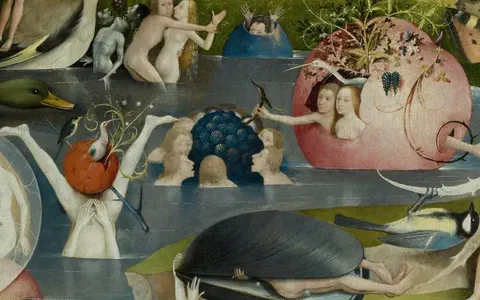
Heads in the pond
Centre: the Garden · Bathers around a giant grape and a hollow fruit
In the pond left of centre, a ring of bathers stands around a giant bunch of blue grapes. Beside them a figure has its head hidden under a red berry with a small bird on top. Two people look out of a hollow pink fruit with plants growing from it, and one reaches toward the grapes with a stick. A white heron pokes its beak out of the fruit.
Hollowed-out fruit, fruit peels and shells are everywhere in this garden, and people love to crawl inside them.
Gibson reports Bax's idea that these fruit peels play on the Middle Dutch word schel, which meant both a rind and a quarrel, and that "the fruit peels themselves signified something worthless". Gibson adds the fruit of Sodom from Josephus, "fair to behold, but when bitten into, revealed nothing but ashes and smoke".
Sources
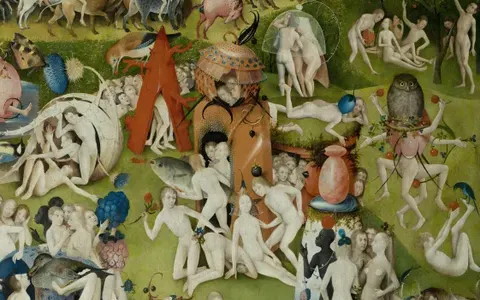
The red tent and the orange tower
Centre: the Garden · Men in a red tent beside an orange tower
Right of centre stands a tall red structure shaped like a tent, with branches like coral. Only men's legs show inside it, and more men crowd behind it. Next to it rises an orange tower with a domed cap spotted with blue flowers, and heads peer out from under its glass rim. Below, a crowd looks out of a hollow in the bank, and a man carries a large fish.
Payne (2021) notes that only men stand in and around the tent, some turning their backsides to each other, and reads this as a reference to homosexuality that no viewer of the time would have missed. De Bruyn writes that "quite a number of details in the central panel seem to refer to homosexuality" and that Falkenburg pays little attention to it. Gibson, after Bax, notes that the fish in the foreground are phallic symbols in old Dutch proverbs.
Sources
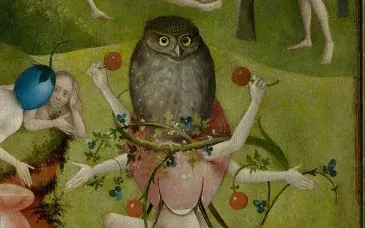
The owl on the dancers
Centre: the Garden · A small owl perches on a pink pod carried by two dancers
Near the right edge, a small owl perches on a pink pod. Two naked dancers carry it, their heads hidden inside, holding up cherries. Lower down, a man on his back with his legs in the air offers a cherry to a dark bird standing on his foot. The owl, as always with Bosch, looks straight at you.
Wikipedia describes "two cherry-adorned dancing figures who carry a surface on which an owl is perched" and a bird "about to eat from a cherry offered to it". The Prado counts this as the second of the two owls that watch the viewer from the edges of the panel.
Sources
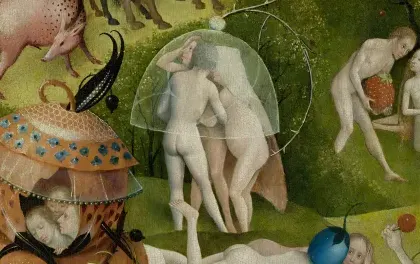
The couple under the glass dome
Centre: the Garden · Three people under a transparent bell
On the grass at the right, three people stand under a transparent dome, seen from behind. The man scratches his head; the woman on the right is clearly pregnant. Nearby a man lies face down with a giant blue grape for a head, and a second figure lies tucked beside him.
De Tolnay quoted the proverb about happiness and glass for this dome too. Dixon compared it to an alchemist's steam bath. The Eclectic Light Company notes the pregnancy. De Bruyn (2010) wrote about the man with a giant blue grape for a head: in Middle Dutch both "head" and "grape" could mean the tip of the penis.
Sources
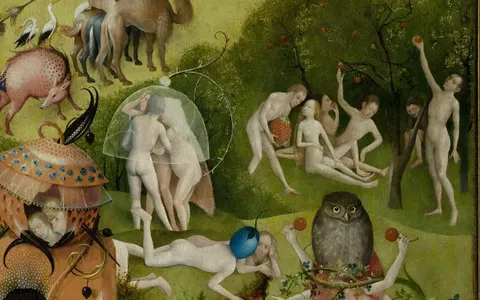
Picking the apples
Centre: the Garden · Fruit from the tree, and a man who leers
Under a tree at the right edge, a group of people pick and eat small red apples. Another man crouches behind the trunk. Below them a man offers a strawberry to a sitting woman and leers at her; she holds one hand on her belly. A tall man reaches up to pluck a fruit.
In the Dutch of Bosch's time, "to pluck fruit" was a polite way of saying "to have sex". And picking an apple from a tree is, of course, how the whole story of the Fall begins.
Gibson, reporting Bax: "to pluck fruit - or flowers - was a euphemism for the sexual act", said of this very group. The NTR documentary calls it "a direct reference to the fall of man" and wonders whether the woman with her hand on her stomach is pregnant.
Sources
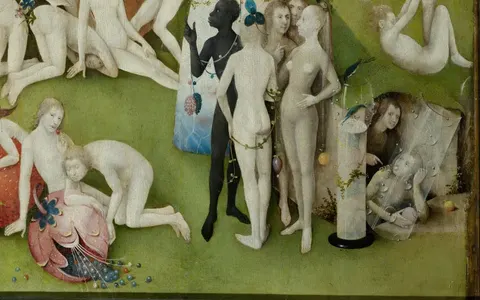
The man who points
Centre: the Garden · The only dressed man in the garden, in a cave, pointing at a woman
In the bottom right corner, half hidden in a cave, a dark-haired man in a dark garment looks straight at you and points at the woman lying below him. He is the only clothed person in the whole panel. The woman lies inside a half-cylinder of glass. Her body is covered in fine hair, her mouth is sealed, and she holds an apple.
Who are they? This corner has been argued over more than any other. The man has been called the patron, the painter himself, Noah, Saint John the Baptist, and Adam. The woman with the apple is most often called Eve.
Look closer: A second face looks out of the cave behind the pointing man. Look closer in the viewer ›
Fraenger (1947) saw the patron of the painting, with a face "reminding us of faces of famous men, especially of Machiavelli's". Bax (1956) saw Adam accusing Eve, with Noah behind him. Isabel Mateo Gómez (1963) suggested Saint John the Baptist. Gombrich asked, "Could he be Noah?" The Prado says the pair "are usually identified as Adam and Eve after the Expulsion from Paradise". Falkenburg says they are wild people, not Adam and Eve; De Bruyn answers with a medieval Dutch text, the Book of Sidrac, which says that Adam and Eve grew hairy after they were driven out, so Bax was right after all. Payne (2021) agrees they are Adam and Eve, and reads the gag over her mouth as a communion wafer.
Sources
- Wikipedia: The Garden of Earthly Delights
- Jheronimus Bosch Art Center, summary of Dirk Bax, Tuin der Onkuisheidsdrieluik (1956)
- E. H. Gombrich, Bosch's Garden of Earthly Delights: a progress report, JWCI 32 (1969)
- Museo del Prado, collection entry P02823 (Pilar Silva Maroto, 2016)
- Eric De Bruyn, review of Reindert Falkenburg, The Land of Unlikeness (2011), Oud Holland 126 (2013)
- James Payne, Great Art Explained: The Garden of Earthly Delights (video, 2021)
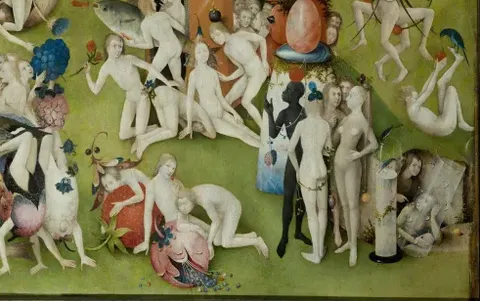
The hairy wild folk
Centre: the Garden · People covered in hair, and a black man among them
To the left of the cave stands a group of four: three pale people whose bodies are covered from head to foot in light brown hair, and one black man. The hairy woman on the right is covered everywhere except her breasts. A couple sits on the ground beside them.
Wild men and wild women lived in the forests of medieval stories. They were the opposite of civilised, courtly people, and they stood for raw desire.
Wikipedia: "scholars generally agree that these hirsute figures represent wild or primeval humanity but disagree on the symbolism". Patrik Reuterswärd saw "the noble savage", Peter Glum saw figures "intrinsically connected with whoredom and lust". The NTR documentary says they "embody lust and unbridled passion". Gibson uses Israhel van Meckenem's print of eight wild folk in a giant flower, but only as a parallel for Bosch's plant symbolism.
Sources
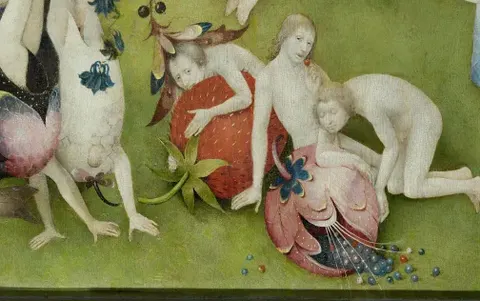
The giant strawberry
Centre: the Garden · A couple admires a strawberry bigger than a man
At the bottom of the garden a man lies across a strawberry as big as himself, his face pressed into it and a large blossom on his head. Beside him one figure sits eating a cherry, and another kneels over a pink fruit that spills a heap of small round seeds.
Strawberries, cherries, grapes and berries are the fruit of this garden, all soft fruits that taste wonderful and rot in days. In 1593 the Escorial recorded it as the painting "del madroño", the strawberry tree.
Sigüenza (1605) read the fruit as the "vain glory and brief taste of the strawberry". De Tolnay called the fruits "nothing but the godless symbols of sexual lust". The NTR documentary: "The strawberry represented temptation and mortality." Gombrich preferred the medieval idea that the soil before the Flood bore giant fruit and that people were vegetarians then. Gibson (2003) adds the strawberry as a symbol of hypocrisy and "death concealed beneath a smiling appearance".
Sources
- Walter S. Gibson, The Garden of Earthly Delights: the iconography of the central panel, NKJ 24 (1973)
- Wikipedia (Dutch): De tuin der lusten
- NTR, Jheronimus Bosch: the Garden of Earthly Delights, interactive documentary (2016)
- E. H. Gombrich, Bosch's Garden of Earthly Delights: a progress report, JWCI 32 (1969)
- Jheronimus Bosch Art Center, review of Walter Gibson (2003) on the strawberries
- Wikipedia: The Garden of Earthly Delights
- Patrimonio Nacional, guide to the Escorial exhibition (2016)
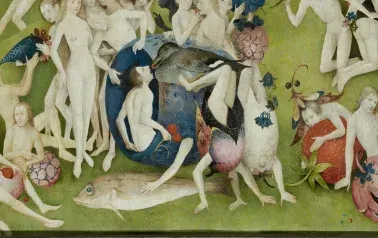
The man in the blue fruit
Centre: the Garden · A naked man peers out of a hollow blue globe
In the centre of the foreground a huge blue fruit with a speckled skin has been hollowed out, and a naked man sits in the opening, looking up at a big duck perched on top that feeds him a red berry. Behind the duck another figure dives head first into the fruit, legs in the air. Beside them a group of people kiss and hold cherries.
Wikipedia, after Belting: "All are surrounded by oversized fruit pods and eggshells." Gibson, after Bax: the hollow fruits into which the lovers have crept play on schel, the rind that also means a quarrel.
Sources
The fish on the grass
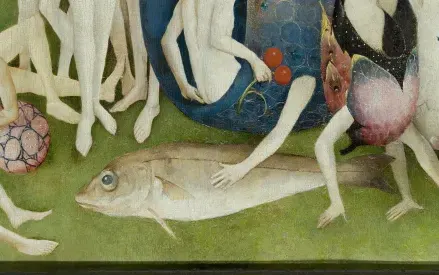
Centre: the Garden · A huge fish lies out of the water
At the bottom of the panel a large grey fish lies on the grass, its mouth shut and its eye wide. A hand rests on its back. Fish out of water, birds in the water, flying fish in the sky: the garden has turned the order of nature upside down.
Gibson reports Bax: "the fish which appear twice in the foreground occur as phallic symbols in Old Netherlandish proverbs". De Tolnay read the sea fish as "lust and fear". Payne (2021) sees in every fish out of its element a sign that "the world order is in chaos".
Sources
The dancers with the berries
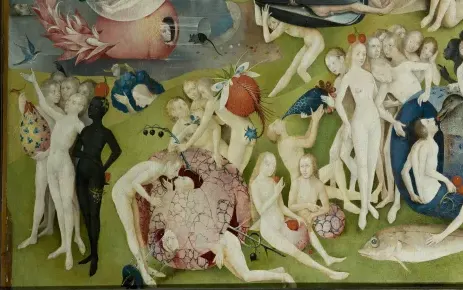
Centre: the Garden · Black and white figures, a man in a pink lattice fruit
In the bottom left corner a group of men and women stands close together: a black figure with a red fruit on its head beside a pale one, a figure with a bunch of blue berries, and someone who holds up a pale fruit painted with blue flowers. To their right a man leans into a pink fruit shaped like a lattice and kisses the person inside.
Black and white people share this garden. In 1517 De Beatis already noted "whites and blacks doing various activities and poses".
The NTR documentary says that in medieval Europe dark skin was linked with the exotic and with loose morals, but adds that Bosch "may also have wished to represent the diverse quality of God's creation". Gombrich connected the black figures to the medieval reading of the "daughters of man" as the tribe of Cain, and warned that this belief later served the defenders of slavery. De Bruyn asks why the black figures are absent from Hell.
Sources
- NTR, Jheronimus Bosch: the Garden of Earthly Delights, interactive documentary (2016)
- E. H. Gombrich, Bosch's Garden of Earthly Delights: a progress report, JWCI 32 (1969)
- Eric De Bruyn, review of Reindert Falkenburg, The Land of Unlikeness (2011), Oud Holland 126 (2013)
- Wikipedia: The Garden of Earthly Delights
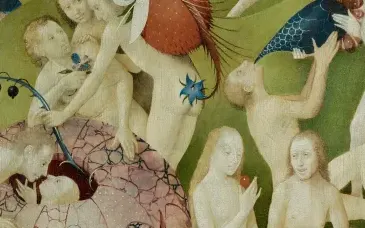
Flowers from a backside
Centre: the Garden · A man bends over, and flowers grow where they should not
Near the lattice fruit, a man bends over with his backside to the viewer, and a blue flower sticks out of it. Beside him another man seems to pick the flowers. Bosch was not afraid of a rude joke, and the Dutch language helped him.
De Bruyn, summarising Falkenburg: "the man who is plucking flowers from the anus of his companion", with the pun that a bunch of sweet-smelling flowers is a ruiker in Dutch, literally "a smeller". Falkenburg also reads the pairs of red berries on heads and in hands nearby as testicles.
Sources
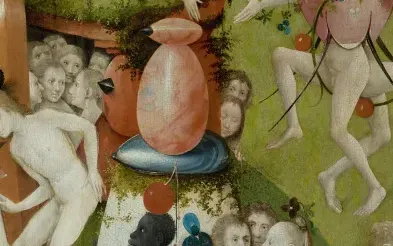
The pink egg on the blue shell
Centre: the Garden · A giant egg balanced on a blue shell, with faces around it
A large pink egg stands on a blue shell that rests on a mossy mound. Faces peer out from behind it. Eggs and shells are the houses of this garden. The egg is also what the Tree Man in Hell is made of, broken open.
De Bruyn notes that "the Tree-man's body in the center of the right interior panel is a broken eggshell". Dixon notes that in alchemy "the ovoid vessel in which all ingredients are combined and transmuted, is called 'egg'". A review of Gyselen (1974), on an egg-devil in a Saint Christopher by another painter, cites Bax's pun: door meant both yolk and fool.
Sources
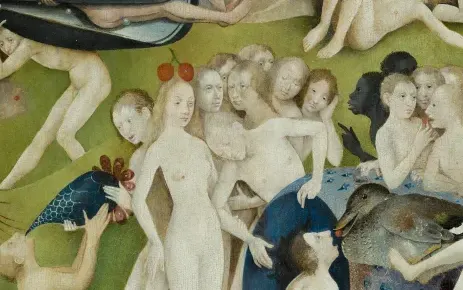
Cherries on her head
Centre: the Garden · A woman wears two cherries like a hat
Just right of the man with the mussel shell stands a crowd of pale women, pressed close together. The one in front wears two red cherries on her head, still joined by their stalk, and glances sideways. A figure leans in from the left to look at her. She is not the only one: in the pool of women further up, women carry cherry-like fruit on their heads, and at the right edge two dancers hold up cherries under the owl.
Look closer: Find the woman with two cherries on her head, just below the mussel shell. Look closer in the viewer ›
Wikipedia, after Gibson, captions this group: "The head of one female is adorned with two cherries", and reports Peter Glum's reading of the cherries as a symbol of pride, from the saying "Don't eat cherries with great lords, they'll throw the pits in your face." Vandenbroeck: "With Bosch cherries = unchastity, luxuria", and objects on a head say something about the wearer's character. The NTR documentary: "The cherry symbolised fertility and eroticism."
Sources

The right wing: Hell
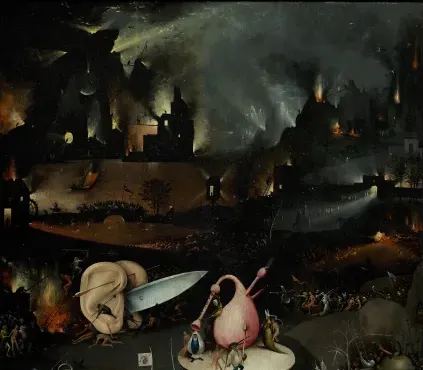
The burning city
Right wing: Hell · A city in flames against the night sky
Hell begins at the top of the right wing with a city on fire. Towers and walls stand black against the flames, explosions throw light through the gates and onto the water, and sparks and smoke fill the sky. A windmill smoulders. People climb ladders to escape and jump into the canal. The fire turns the water below red.
Bosch painted burning cities in several of his hells. When he was about thirteen, in 1463, a fire destroyed thousands of houses in his own town of 's-Hertogenbosch. Many writers think he never forgot it.
Look closer: Find the man climbing a ladder into a glowing round opening, and the boat with a red sail on the dark water. Look closer in the viewer ›
Gibson, quoted on Wikipedia: "their fiery reflection turning the water below into blood". The NTR documentary describes the ladders, the canal and the windmill, and says the fire "may well have conjured up childhood memories". Wikipedia (Hieronymus Bosch) gives the number of 4,000 houses in 1463, which the boy "presumably witnessed"; the Canon of Dutch History says more than four hundred wooden houses. Belting notes that Bosch describes hell "as a realistic world containing many elements from day-to-day human life".
Sources
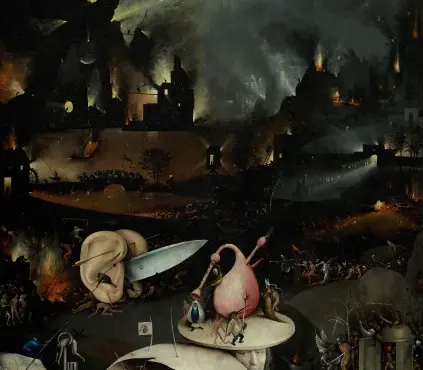
The army and the refugees
Right wing: Hell · Silhouettes with spears ride over a bridge into the city
Below the fire an army with banners and spears rides over a bridge into the open city gates. A horned demon leads it. Under the bridge, hundreds of small figures struggle in the water. On the roads, crowds flee towards the dark. Further down, a column of new arrivals is marched into hell like prisoners of war, and a long curved trumpet sounds.
The NTR documentary describes "black silhouettes on horseback galloping across a bridge while underneath hundreds of wretches are drowning", led by "a horned demon", and recalls the wars between Brabant and Guelders in which villages were burned. The musician Ian Pittaway (2021) notes the trumpet that marks the sinners' entry and connects it to the "last trumpet" of Saint Paul.
Sources
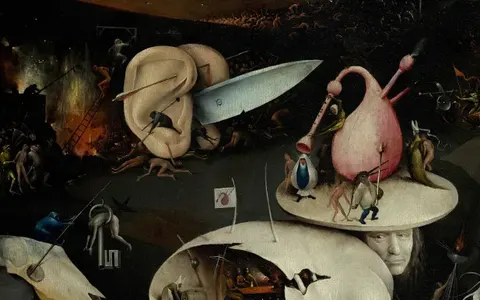
The ears and the knife
Right wing: Hell · Two giant ears, an arrow, and a blade with a mark
Two enormous human ears, pierced by an arrow, roll across the dark ground like a war machine. A long knife blade is wedged between them. Small people are crushed underneath. On the blade is a mark that looks like a letter: an M on its side, or a B.
The mark puzzled scholars for a long time. In 1995 and 1996 archaeologists digging at the Loeffplein in 's-Hertogenbosch found a batch of late medieval knives. One of them, a plain fifteenth-century table knife, has the same shape and the same M on its blade. The town was famous for its knives, which were sold from Spain to Scandinavia, and the cutlers stamped their own mark on the blade. A deed of 1538 in the town archive describes "a round M" as the mark of the cutler Anthonius Jonckers, also known as Van den Grave. So the M has nothing to do with Bosch's name. He most likely painted an ordinary knife from his own town, perhaps one that was lying around in his studio.
Look closer: Zoom in on the blade to see the mark. Look closer in the viewer ›
Sally Hickson (Smarthistory) reads the ears as "a powerful allusion to the deceptive lure of the senses". Pittaway says the sense of hearing is punished here, the ears of people who listened to idle songs. The NTR documentary notes that the shape also resembles a male sexual organ, and that cutting off ears was a real punishment for thieves. On the mark: the archaeologists Hans Janssen, Olaf Goubitz and Jaap Kottman published the excavated knife in 2001 (Adam McLean cites them), and Janssen called Bosch's giant knives "normal, fifteenth-century table knives" (2002). The Bossche Bladen (2003) calls it the only known knife with an M as its mark. Lucas van Dijck (2016) found the 1538 deed; he thinks the M stood for Jonckers' father Marcelius or his mother Maria, and notes that nobody knows whether the father already used it. Walter Bosing had earlier suggested "Mundus" or the Antichrist; Pittaway reads "B for Bosch", which the archive does not support.
Sources
- Sally Hickson, Bosch, The Garden of Earthly Delights, Smarthistory / Khan Academy
- Ian Pittaway, The symbolism of the Garden and the musicians' hell, Early Music Muse (2021)
- NTR, Jheronimus Bosch: the Garden of Earthly Delights, interactive documentary (2016)
- Adam McLean, The knife in Bosch's Garden of Earthly Delights
- Jheronimus Bosch Art Center, review of Hans Janssen (2002) on everyday objects in Bosch
- Bossche Bladen 5 (2003) nr. 3, Museumaanwinst: Het mes met de 'M'
- Jheronimus Bosch Art Center, review of Lucas van Dijck (2016), Het mes van de Tuin der Lusten
- Wikipedia: The Garden of Earthly Delights
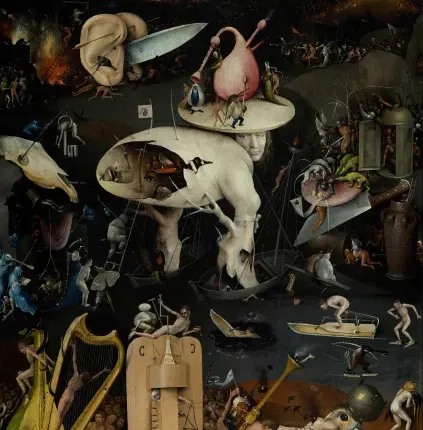
The Tree Man
Right wing: Hell · A hollow man with a tavern in his chest and boats for feet
In the middle of Hell stands its most famous creature. His body is a broken white eggshell. His legs are dead tree trunks whose branches pierce the shell, and the trunks stand in two small boats on the frozen water. His head carries a flat disc on which a giant pink bagpipe stands, with demons leading sinners around it. He turns his face towards you and looks past you with a small, tired smile.
Inside the shell is a tavern. A woman pours drink from a barrel and three naked men sit at a table on the back of a giant toad. A ladder leads up into the body; a hooded figure with an arrow in his backside climbs it. Bosch also drew the Tree Man on paper; the drawing is in the Albertina in Vienna.
Look closer: Look at the tiny flag on his back: it shows a bagpipe. Look closer in the viewer ›
Wikipedia, after Gibson, describes "his conspiratorial expression a mix of wistfulness and resignation". Belting proposed that the face is a self-portrait of Bosch; Hickson says "a lot of people believe this, but it's impossible to verify", and McLean does not see the likeness. Falkenburg calls the Tree Man "the embodiment of man's loss of divine likeness". The NTR documentary reads the tavern as the place where sloth and alcohol led the drinkers to hell. De Tolnay thought the drinkers were carnival-goers.
Sources
- Wikipedia: The Garden of Earthly Delights
- Sally Hickson, Bosch, The Garden of Earthly Delights, Smarthistory / Khan Academy
- Adam McLean, The portrait of Bosch
- Eric De Bruyn, review of Reindert Falkenburg, The Land of Unlikeness (2011), Oud Holland 126 (2013)
- NTR, Jheronimus Bosch: the Garden of Earthly Delights, interactive documentary (2016)
- Wikipedia (Dutch): De tuin der lusten
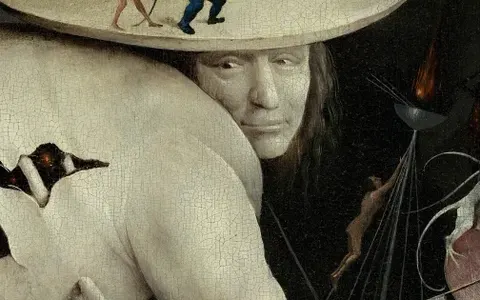
The face of the Tree Man
Right wing: Hell · Is this Bosch himself?
The face is pale and calm, with a straight nose, a thin mouth and long hair under the disc. It looks out with an ironic expression and a slightly sideways gaze. For that reason Hans Belting suggested in 2002 that this is Bosch himself, looking out of his own hell.
Nobody knows what Bosch looked like. The portraits we have were made after his death, so the idea cannot be proved or disproved.
Belting (via Wikipedia) cited "the expression of irony and the slightly sideways gaze" as "the signature of an artist who claimed a bizarre pictorial world for his own personal imagination". The NTR documentary explains that all known portraits of Bosch date from after he died. McLean (alchemywebsite) argues that the Arras portrait of around 1550 is "at best a reconstructed one".
Sources
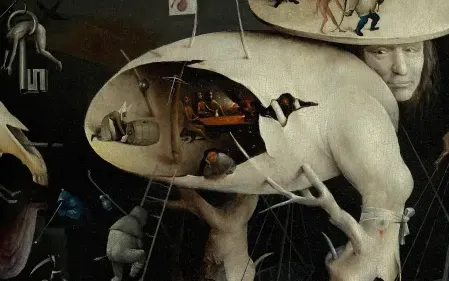
The tavern in the shell
Right wing: Hell · Drinkers at a table, sitting on a toad
Look into the broken shell: a dark room with a table, three naked drinkers, a woman tapping a barrel, a crossbow hanging from a branch. The men sit on a giant toad, the devil's animal. In Bosch's world the tavern was where people were led into sin.
The NTR documentary: "In the tavern inside the Tree Man's torso, a woman is pulling pints from a barrel ... A man is sitting on a giant toad, a symbol of the devil." Pittaway calls it "hell's tavern, in which the drinkers sit on a giant toad, another emblem of lust".
Sources
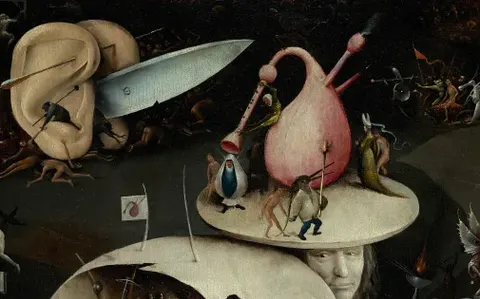
The bagpipe on the disc
Right wing: Hell · A pink bagpipe and a procession of the damned
On the flat disc that the Tree Man carries on his head stands a giant pink bagpipe. A demon with claws plays it. Three naked sinners, each with a clothed demon as partner, are led around it as in a dance, watched by a dark figure. One demon holds a burning torch against the bag.
A bagpipe looks like a scrotum and a penis, and in Bosch's time everyone knew that. Bosch painted it pink to make the point.
Wikipedia (Belting): the bagpipe is "often used as a dual sexual symbol". Pittaway: "Bosch added to the phallic symbolism by painting the bagpipe pink." The NTR documentary reads it instead as "the instrument of sloth and idleness". Pittaway also reports a pentimento: a painted-over toad with a lute on top of the bagpipe, visible in close-up.
Sources
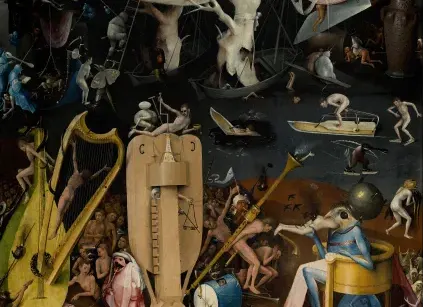
Hell frozen over
Right wing: Hell · Skaters on black ice, and one hole in it
Across the middle of the wing the water has frozen. A naked man balances on a giant skate that has grown into a boat, steers it by its straps, and heads for a hole in the ice where another man is drowning. Behind him a figure shivers. A bird-like demon with a bow and arrows skates in front. A second skate-boat has already gone through the ice at the hole, with only its point showing.
The skates are real. Bosch painted the wooden skates with iron blades and leather straps that people of his time wore. Archaeologists have found the same kind in the ground.
Look closer: Find the skater who heads straight for the hole in the ice. Look closer in the viewer ›
The NTR documentary links ice in hell to the medieval Vision of Tundale. The archaeologist Annemarieke Willemsen (2001) describes the skates and the enlarged skate used as a boat, and notes that "the objects Bosch has depicted here actually existed in his day". Belting calls the whole wing cold, with "frozen waterways".
Sources
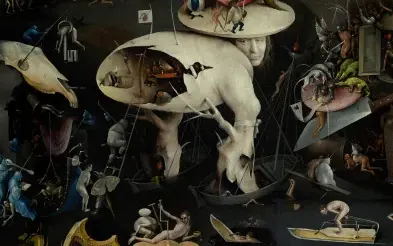
The horse skull and the key
Right wing: Hell · A skull as a roof, and a man hanging in a giant key
At the left edge of hell a horse's skull serves as the roof of a hut, with a crow beside it. From a pole in front of it hangs a giant key, and a man hangs limply through its ring. Under the skull hangs a bell with a man stuck inside it, and a small demon hangs on the rope to ring it.
A skull in a painting always means the same thing: remember that you will die. The key is harder. It may be Saint Peter's key, or the key to hell, or the key of a rich man who locked his doors against the poor.
The NTR documentary: the crow is "disguised as a grave digger" and the skull says "remember one day you will die"; on the key it offers both Saint Peter's key and "the key to hell itself". Pittaway quotes a text of 1480 about the rich man who "takes his key with him" everywhere, and sees the selfish rich man "hanged inside the key he used to protect himself from the poor".
Sources
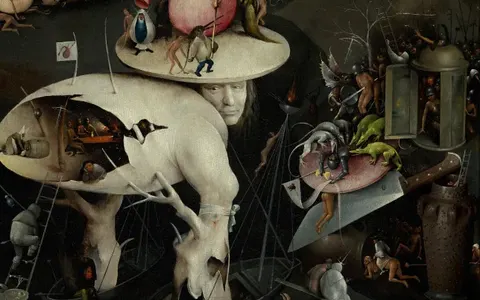
The lantern of the soldiers
Right wing: Hell · Helmeted men burn in a lantern
At the right edge, above the knight, stands a large iron lantern with a fire inside. Men in helmets stand in and around it; one is run through by the sword of a demon. Others are thrown into the flames.
Wikipedia (Gibson): "a group of victims above are thrown into a burning lantern". The NTR documentary reads the whole group with the knight below as a parody of the Christian liturgy. Brittany O'Dowd (2014) suggests that the naked soldiers who keep only their helmets sinned "under the guise of doing good".
Sources
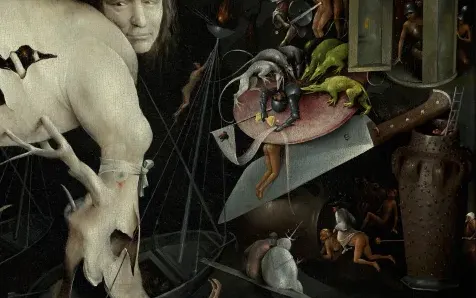
The knight eaten by beasts
Right wing: Hell · A knight in armour on a pale disc, torn by dog-like monsters
On a large pale pink disc to the right of the Tree Man lies a knight in armour, being torn apart by a pack of green dog-like monsters. In one hand he holds a golden chalice; the other holds the end of a banner with a toad on it. A wafer lies beside him. Under the disc a second giant knife, with the same mark, slices through a naked figure, and a demon drives a naked woman into a pitcher.
The NTR documentary reads chalice, wafer and the "large pale-red wafer that is being cut by a big knife" as "an infernal parody on a religious custom taken from Christian liturgy". Eric De Bruyn (2001, via the Dutch Wikipedia) compares it to the punishment of envy on Bosch's table of the Seven Deadly Sins, and reads the chalice as greed. Pittaway sees a "lusty armoured knight" punished for the toad on his flag and the golden goblet of his greed.
Sources
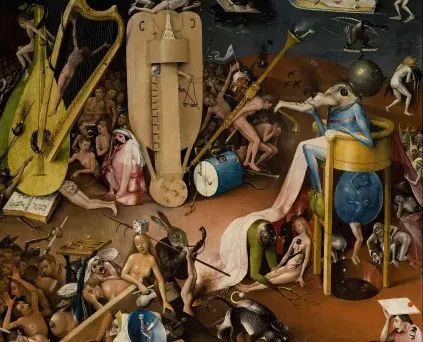
The Prince of Hell
Right wing: Hell · A bird-headed monster on a toilet chair eats the damned
On a tall chair that is also a toilet sits a huge blue creature with the head of a bird. It wears a cauldron as a crown and jugs on its feet. It is eating a man whole; black birds fly out of the man's backside. Through the seat of the chair the swallowed sinners drop in a glass bubble into a pit below. At the edge of the pit one man vomits and another, a miser, excretes gold coins.
The idea comes from a book Bosch could easily have read: the Vision of Tundale, an Irish vision of hell from the twelfth century, which was printed in 's-Hertogenbosch in 1484. In it a beast on a frozen lake swallows souls and then expels them "in the creature's excrement".
Look closer: Find the man excreting gold coins at the edge of the pit. Look closer in the viewer ›
Wikipedia (Belting, Gibson): "the panel's centerpiece", named "Prince of Hell" after the cauldron, "perhaps representing a debased crown"; Gibson compares it to the beast in Tundale that feeds on corrupt clergy. Pittaway quotes the Tundale passage and the 1484 Den Bosch edition. The NTR documentary notes that in Bosch's town the river was an open sewer, and that such a chair "would only be found in the homes of the city's wealthiest". Hickson calls the creature "a bird-like creature seated in a latrine chair, like a king on a throne".
Sources
- Wikipedia: The Garden of Earthly Delights
- Ian Pittaway, The symbolism of the Garden and the musicians' hell, Early Music Muse (2021)
- NTR, Jheronimus Bosch: the Garden of Earthly Delights, interactive documentary (2016)
- Sally Hickson, Bosch, The Garden of Earthly Delights, Smarthistory / Khan Academy
- Wikipedia: Visio Tnugdali
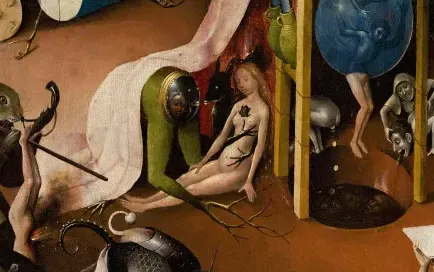
The woman and the mirror
Right wing: Hell · A toad on her chest, her face in a demon's backside
At the feet of the Prince of Hell sits a naked woman with long fair hair. Her eyes are closed. A dark demon holds her from behind, and a black toad sits on her chest. In front of her kneels a green creature with branches for legs, and on its backside is a round mirror in which her face appears.
Mothers in Flanders had a saying for daughters who spent too long at the mirror: "You are looking up the Devil's arse." Bosch painted the saying.
Pittaway reads her as a woman "whose sin was pride or vanity", quotes the Flemish saying, and explains the toad as a symbol of lust. The NTR documentary points to her resemblance to Eve in the left wing. Wikipedia: "At his feet, a female has her face reflected on the buttocks of a demon."
Sources
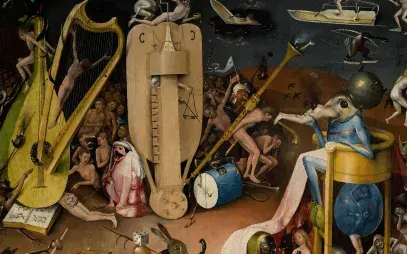
The harp and the lute
Right wing: Hell · A man crucified on the strings of a harp
At the left of the lower half stand two instruments the size of houses. A man is stretched on the strings of a giant harp, pierced through his body like a crucifixion. The harp grows out of the soundboard of a huge lute, and another man is tied to the neck of the lute by a fret while a snake-like creature attacks him. A demon has set a toad on fire beside him.
This part of the panel is called the Musicians' Hell. In Bosch's time, music outside church was suspect: it led to dancing, drinking and the sins of the flesh. Here the instruments have turned on the people who loved them.
Wikipedia: "others are crucified by harp and lute, in an allegory of music". Pittaway calls the harp "the most shocking" of the instruments turned to torture, "the strings threaded through his body at the neck, spine and anus", and reads the lute fret as the tie around the lutenist's waist. Walter Bosing suggested the scene may be a rebuke to travelling minstrels. The NTR documentary: "No longer sources of amusement and pleasure, these musical instruments have been turned into instruments of torture."
Sources
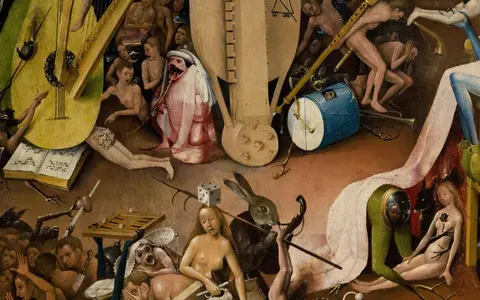
The music on the buttocks
Right wing: Hell · Notes painted on a sinner's backside, and a choir that sings them
Under the lute lies a man face down on a giant book of music. On his buttocks is painted a line of musical notes. A pink creature with a frog's head and a long tongue leans over him like a choirmaster, and behind them a choir of the damned sings with open mouths, with black rodent-like demons among them.
In February 2014 a student in Oklahoma, Amelia Hamrick, transcribed the notes on the buttocks and recorded them. "This is literally the 600-year-old butt song from hell," she wrote, and the post went around the world. She was not the first: a Spanish ensemble had recorded it in 1978, on an LP called "Codex Gluteo". And the music historian Ian Pittaway argues that the notes are only an imitation of notation, with no clef, so they cannot really be played.
Look closer: Zoom in on the notes on the man's backside. Look closer in the viewer ›
Wikipedia (Belting): "A choir sings from a score inscribed on a pair of buttocks." Lapham's Quarterly tells the Hamrick story. Pittaway (2021) lists the earlier transcriptions by Lenneberg (1961), Dixon (1981), Atrium Musicae (1978) and Vox Vulgaris (2003), and concludes that "since Bosch painted only the appearance of music, this 'butt music' was never intended to be read and played". The NTR documentary reports that Hamrick played it on her piano.
Sources
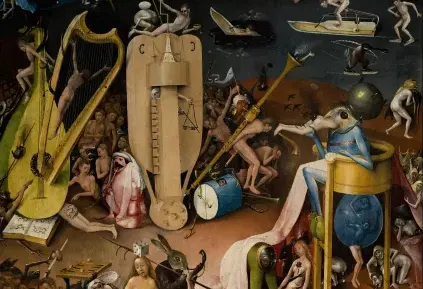
The hurdy-gurdy
Right wing: Hell · A blind beggar on top, a nun caught inside
Right of the harp stands a tall hurdy-gurdy, a string instrument played by turning a crank. A blind beggar with a bowl sits on top of it. A woman's arm reaches out of the key box, holding a triangle; she is a nun, caught inside the instrument. One more turn of the crank and the wheel will take her head. Beside the beggar a hunched man with a crutch balances an egg on his back.
The NTR documentary: "One more turn of the handle and the triangle-playing lady will lose her head." Pittaway identifies the blind beggar by his blackened eyes and begging bowl, the nun by her white veil, and notes that the hand holding the triangle beater belongs to a demon; he also says this is the earliest picture of the buzzing bridge of the hurdy-gurdy. Payne (2021) points to the metal badge on the bowl, a licence to beg.
Sources
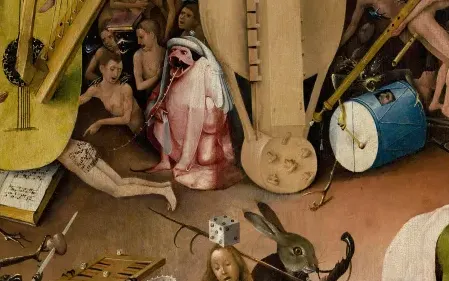
The choirmaster with the frog's head
Right wing: Hell · A pink monster leads the singing
The creature in the pink robe with the frog's head and the long tongue stands at the music book like a cantor. Its tongue reaches almost to the buttocks with the notes. Behind it the choir of the damned opens its mouths; one black demon wears a transparent book on its head.
Pittaway: the choir is "led by a cantor who is a hybrid with a frog's head and a man's body, so he can neither sing nor lead them", and most of the choir "cannot see the butt music". Payne (2021) describes "a demonic choir master whose tongue is like a scale of notes".
Sources
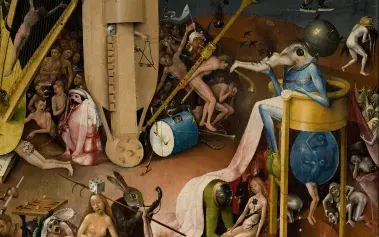
The flute, the drum and the trumpet
Right wing: Hell · A recorder in the wrong place, a man inside a drum
Right of the hurdy-gurdy a naked man carries a giant shawm, a loud wind instrument, on his back, while a recorder has been pushed into his backside. Next to him a demon beats a blue drum with a man trapped inside, screaming. Behind them a trumpeter blows so loudly that the people around him hold their ears. On his hood stands a small flag with a crescent moon.
Pittaway explains the shawm (a "bombard") and reads a Latin pun on flatus, breath and flatulence; he describes the drum "being beaten by a demon" that "can play only one note", and reads the crescent moon as "the emblem of lunacy". The NTR documentary: "inside a man is trapped crying out in fear." Payne (2021) sees in the man under the giant flute an echo of Christ carrying the cross, and reads the crescent as the flag of the Ottoman enemy; both are his own readings.
Sources
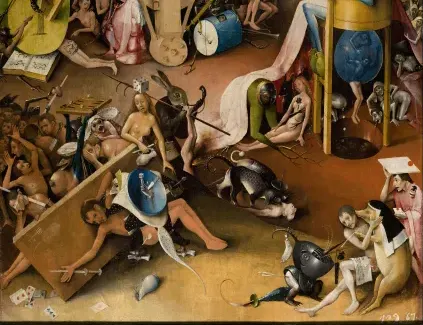
The gamblers
Right wing: Hell · An overturned table, cards, dice and knives
In the bottom left corner a gaming table has been turned over. Playing cards lie on the ground, dice roll, a demon holds up a backgammon board. A man is nailed to the table through his hand. Naked gamblers are attacked with knives and swords by demons in armour, and a tally is kept on the edge of the table.
A demon in wooden clogs wears a round shield on its back. On the shield a severed grey hand, pierced by a knife, makes the sign of blessing, with a die balanced on its fingertip. It echoes the blessing hand of God in the left wing, now cut off and used for gambling.
Look closer: Find the severed hand with the die on its finger. Look closer in the viewer ›
Willemsen (2001): cards, dice and board games "were stock symbols of iniquity in art and literature". The NTR documentary describes the tally on the table and the hand on the shield as "a devilish parody on the divine blessing". Wikipedia: "a group of naked persons around a toppled gambling table are being massacred with swords and knives". Payne (2021) reads the overturned table as a reference to Christ and the moneylenders.
Sources
- Annemarieke Willemsen, Playing with reality: games and toys in the oeuvre of Hieronymus Bosch (2001)
- NTR, Jheronimus Bosch: the Garden of Earthly Delights, interactive documentary (2016)
- Wikipedia: The Garden of Earthly Delights
- James Payne, Great Art Explained: The Garden of Earthly Delights (video, 2021)
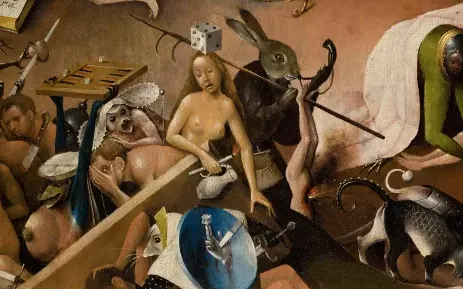
The woman with the die
Right wing: Hell · A candle, a jug and a die on her head
Behind the gaming table stands a naked woman with a die on her head. In one hand she holds a lit candle and a jug, and she looks down. Nearby a hunched man covers his eyes.
Payne (2021) reads the candle and jug as the signs of a prostitute, since Dutch prostitutes used candles to attract customers, and notes that the die on her head is a cheat's die whose opposite faces do not add up to seven. That is his reading; the scholarly sources we found describe the figure without explaining her.
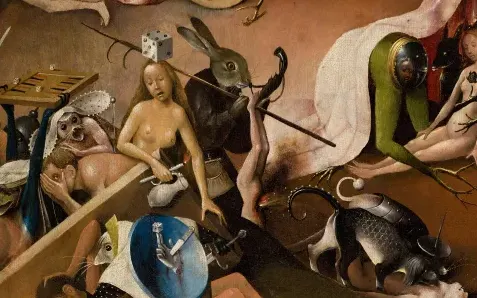
The hare with its catch
Right wing: Hell · A hare carries a bleeding man on a pole and sounds a horn
A large hare walks upright with a hunting horn, carrying a naked, bleeding person upside down on a pole, the way a hunter carries a hare. Its two hounds have caught another victim. The hunted has become the hunter.
Wikipedia (Gibson): "a rabbit carries an impaled and bleeding corpse". Payne (2021) reads it as "the hunted becomes hunter", the world turned upside down in hell, and recalls that hunting hares was forbidden to the lower classes.
Sources
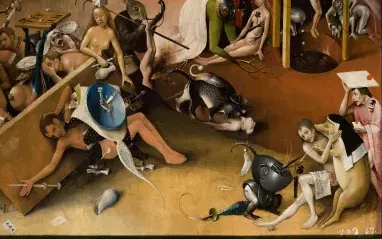
The pig in a nun's veil
Right wing: Hell · A pig persuades a man to sign a document
In the bottom right corner a pig wearing the black veil of a nun embraces a naked man and presses him to sign a document with red seals. A helmeted demon holds the inkpot in its mouth and offers a pen; a figure in a pale red robe holds more sealed papers. A black toad sits on the robed figure's shoulder. A sawn-off foot hangs from the thorny branch on the demon's helmet. The man looks at you, as if asking for help.
What is he signing? Some see a debt, some a pact with the devil, some an indulgence, the paper that promised forgiveness of sins for money. Bosch's own brotherhood sold indulgences, so he may not have meant it as criticism of the Church.
Wikipedia (Bosing): "The pig is shown trying to seduce the man to sign legal documents." The Dutch Wikipedia calls it an acknowledgement of debt. The NTR documentary suggests "a pact with the devil" and places the story of indulgences next to the scene, noting that Bosch's brotherhood "played a key role in the indulgences industry". Payne (2021) argues against the indulgence reading for the same reason. The sawn-off foot, says the NTR, recalls ergotism, "St. Anthony's fire", a disease that rotted limbs.
Sources
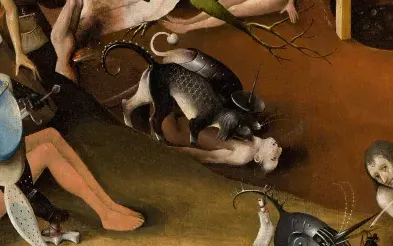
The hounds
Right wing: Hell · Armoured dogs eat a man on the ground
Between the gamblers and the pig, two dog-like beasts in armour have brought down a naked man and tear at him. They belong to the hare: its hounds have caught another victim. A fire burns in the ground beside them.
Wikipedia (Belting): the foreground shows "mutated animals feeding on human flesh". Payne (2021): the hare "has a pair of hounds, who have caught another victim".
Sources
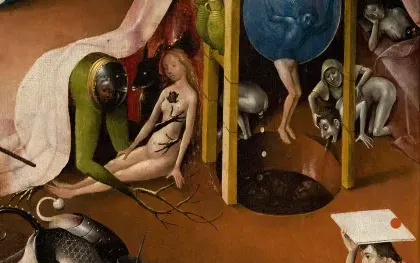
The pit
Right wing: Hell · Vomit, coins and faces under the water
Under the chair of the Prince of Hell opens a round pit full of dark water. Faces float just under the surface. At its edge a man vomits into it while a hooded figure holds his head. On the other side a crouching man excretes gold coins.
Hickson: "a wretched human is encouraged to vomit into a well in which other human faces swirl beneath the water". Pittaway: a glutton vomits and "a sinner, being punished for avarice, is excreting gold coins". The NTR documentary: "One rich 'stinker' is pooping coins."
Sources
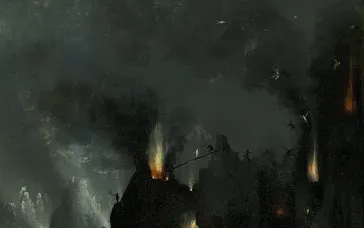
The fire on the mountain
Right wing: Hell · Flames, sparks and tiny figures high in the dark
In the top right corner flames burst from a dark mountain and sparks drift down like falling stars. If you zoom in on the peak you can make out tiny figures in the glow. James Payne points to two of them fighting, one dark and one light, and reads them as the lifelong fight between good and evil. That is his reading; it is a detail few people ever see.
Payne (2021): "At the apex of the volcano we can just make out two figures fighting."
Quaestiones
Is The Garden of Earthly Delights a warning or a celebration?
Most art historians since 1605 read it as a warning: Paradise, then a world given over to lust, then Hell. Wilhelm Fraenger (1947) and Hans Belting (2002) read the centre panel as a happy world without sin, and the painting looks happy enough to make that tempting. The Prado's own text calls it a false paradise that deceives the senses. The painting does not settle the question, which is probably why it was made.
Why is everyone naked?
Because the centre panel shows people living the way Adam and Eve lived before the Fall, without shame. There are no children and no old people in the garden, no work and no illness. In Hell the same people are still naked, but now they try to cover themselves.
What do the strawberries mean?
In 1605 José de Sigüenza wrote that the painting is about the "vain glory and brief taste of the strawberry", a pleasure gone almost before it is noticed. In Spain it was called the painting "del madroño", after the strawberry tree. Gibson adds that strawberries could also stand for hypocrisy and death hidden under a smiling face, and Gombrich that the fruit was giant because the earth was thought to be more fertile before the Flood.
Is the Tree Man a self-portrait of Bosch?
Hans Belting proposed it in 2002, and many people like the idea. Nobody can prove it: the portraits of Bosch that exist were all made after his death, so we do not know what he looked like. Belting's argument rests on the face itself: its ironic expression and its sideways glance out of the picture.
What is the letter on the knife?
It looks like an M on its side or a B, and it is a cutler's mark. In 1995 and 1996 archaeologists in 's-Hertogenbosch dug up a fifteenth-century table knife with the same M, and a deed of 1538 names the town cutler who used it: Anthonius Jonckers, also known as Van den Grave. Bosch's town was famous for its knives, so he most likely painted one from home. Older readings saw "Mundus" (the world), the Antichrist or "B for Bosch" in it.
What is the "butt music"?
A line of musical notes painted on the buttocks of a man who lies under the giant lute in Hell. Amelia Hamrick transcribed and recorded it in 2014; a Spanish ensemble had done so in 1978. The music historian Ian Pittaway argues that the notes are fake notation without a clef and were never meant to be played.
Who paid for the painting?
A member of the Nassau family in Brussels: Engelbert II, who died in 1504, according to the Prado, or his nephew Henry III according to the Bosch Research and Conservation Project. It was first described in their palace in 1517. It was almost certainly not made for a church.
Was Bosch on drugs when he painted it?
No. Bosch was a respected citizen and a sworn brother of a religious confraternity, and his monsters come from manuscripts, prints, bestiaries and the gargoyles of his own town's church. The idea comes from ergot, a fungus in bread that caused hallucinations and the loss of limbs; the sawn-off foot in Hell recalls that disease, but nothing connects it to the painter.
Where can I see the real painting?
In the Museo del Prado in Madrid, room 056A, where it has hung since the 1930s. It belongs to Patrimonio Nacional, the Spanish royal collections, and is on permanent loan to the museum.
May I use the photograph on this page?
Yes. The photograph was made by the Prado with Google in 2009 and the stitched 30,000-pixel version is on Wikimedia Commons in the public domain, because Bosch died in 1516. The texts on this page are ours; the scholars' words are quoted with their names.
How many owls are there?
We can point at four that the books also mention: in the Fountain of Life, at the left and right edges of the garden, and the owl-faced Prince of Hell. Writers count differently; the NTR documentary says people once called the owl "the Bosch bird". The owl hunt on this page uses the four.
What is a triptych?
A picture in three parts on hinges, so that the two outer wings can fold over the middle. Churches kept the wings closed on ordinary days. Bosch painted the outside of this one in grey, the world on the third day of Creation, and saved the colour for the inside.
Sources and credits
The photograph is The Garden of Earthly Delights by Bosch High Resolution.jpg on Wikimedia Commons, 30,000 by 17,078 pixels, stitched from the gigapixel photographs that the Museo del Prado made with Google Earth in January 2009, in the public domain. The closed wings are the Museo Nacional del Prado's own photograph of the exterior, 2,362 by 2,511 pixels, as served by the Prado's online viewer (photograph © Museo Nacional del Prado). We cut the photograph into 2,107 tiles; your browser loads only the part you look at.

Every scene card lists the pages it was written from. The main ones: the Prado's collection entry for P02823 by Pilar Silva Maroto (2016); the English, Dutch and Spanish Wikipedia articles; the NTR interactive documentary Jheronimus Bosch, the Garden of Earthly Delights (2016, Pieter van Huystee and Q42); E. H. Gombrich, "Bosch's Garden of Earthly Delights: a progress report" (1969); Walter S. Gibson, "The iconography of the central panel" (1973); the reviews of Belting, Bax, Dixon, Gombrich, Gibson and Vandenbroeck on the site of the Jheronimus Bosch Art Center; Eric De Bruyn's and Lynn Jacobs's reviews of Reindert Falkenburg's The Land of Unlikeness (2011); Ian Pittaway's three articles on the music of the Garden at Early Music Muse (2021); Annemarieke Willemsen on the skates and the games (2001); Sally Hickson's essay for Smarthistory; Adam McLean on the knife and the portrait; and James Payne's video The Garden of Earthly Delights for Great Art Explained (2021), which gave this page its shape. Where a reading is Payne's own, the card says so.
The viewer and the texts are ours. The frame around the painting was modelled and rendered in Blender after the real frame of the triptych. Nothing on this page is affiliated with the Museo del Prado or Patrimonio Nacional. If you find a mistake, write to me.