The Two-Headed Boy: an Ode to Jeff Mangum
A tall jar of old, golden spirit stands on a shelf by candlelight. Inside floats a small boy with two heads, asleep, the faces leaning together. Strike a match, tap on the glass and wait: sometimes something taps back. Hold the brass ear trumpet to the jar to hear what he hears, shake the jar and watch the flakes rise, or play the singing saw that leans against the wall. The jar is my ode to Jeff Mangum and the song "Two-Headed Boy" by Neutral Milk Hotel; the history on the pages below it is real. Free, no account, and nothing leaves your browser.
No. V A boy with two heads in spirit of wine. Glass jar tied over with bladder, crowned after Ruysch. The boy is invented, after a song; the jar and everything about it is real history.

Tap the glass with a click or a touch, or with the space bar and the arrow keys. Hold L or the Listen button to listen through the ear trumpet. S shakes the jar, W takes up the singing saw, M switches the sound, F fills the screen, Escape puts a slip back.
The candle is out
A card propped against the jar
No. V. A boy with two heads, in spirit of wine. He was asleep when the candle went out.
Strike a match to light the candle. Then tap on the glass, and wait.
The shelf is being dusted
With sound. Headphones help. Every sound is also written down.
This shelf needs JavaScript and Web Audio. The picture shows what you would see; the pages below still tell the whole story.
The jar is still being set up on the shelf, so for now this is only a picture of it. Everything on the pages below is already there. Come back soon to tap the glass.
A jar for Jeff Mangum
In the Aeroplane Over the Sea is one of the records I keep coming back to, and "Two-Headed Boy" is the song on it I find the most beautiful: Jeff Mangum alone with an acoustic guitar, singing to a boy in a jar. A cabinet of curiosities without a jar of spirit is missing something, so this cabinet got a jar, and the jar got the boy from the song.
He is invented. The museums that keep real children in jars ask their visitors not to photograph them, out of respect for the dead, and I would not put one on a website. This boy was built and lit on a computer and dressed in a linen shirt with lace collars, the way the Amsterdam anatomist Frederik Ruysch dressed his specimens three hundred years ago so that they would look asleep. Everything else on the shelf comes out of the song, and everything on these pages about jars, spirit and two heads comes from the sources at the bottom.
Here is the song, from the official Bandcamp page of the band's label:
Official player from Merge Records on Bandcamp. Buying the record there pays the band and the label. Also on Merge Records and the band's own site.
At the shelf
Strike the match on the card, or click the box of matches, and the candle catches. Then tap the glass. Above the spirit it rings high and long; below it the spirit weighs on the glass and the knock comes out lower and duller, and rings run through the gold. Wait after you tap. Sometimes nothing comes back. Sometimes, after a silence, he taps back from inside, from the side of the head that answers, in the rhythm you tapped. Not the first time, though.
Hammer on the glass and the spirit clouds and he turns away for a while. After three answers the candle gutters and he knocks from somewhere in the dark jar: left or right, high or low, front or back. Tap where you hear him. Headphones help here. Once a visit, if you leave him alone for a minute, he taps by himself.
Hold the brass ear trumpet to the glass (or hold the Listen button, or the L key) to hear what he hears. Drag the jar from side to side, press Shake, or on a phone shake the phone itself, and white flakes lift from the bottom in two slow spirals. The singing saw leans on the wall behind the candle: take it up and play it by holding down on the picture, higher up for higher notes. The leaded window shows the moon as it is tonight. The jar remembers, in your own browser and nowhere else, the side you tapped last.
Every sound is written underneath the picture as it happens and every tap shows as a ring of light, so the conversation also works with the sound off. With a keyboard: the space bar taps the middle of the glass, the arrow keys tap left, right, high and low, L listens, S shakes, W takes up the saw, M switches the sound and F fills the screen.
What "Two-Headed Boy" is about
Neutral Milk Hotel's "Two-Headed Boy" is the fourth song on In the Aeroplane Over the Sea, released by Merge Records on 10 February 1998. Jeff Mangum sings it alone with an acoustic guitar. He never explained it. In the one interview in which he mentions it, with Mike McGonigal in Puncture in the spring of 1998, he said only that each section of the song "came out at a different time". What it is about comes from its listeners. Mark Richardson (Pitchfork, 2005) heard "a mutant child trapped in a jar of formaldehyde"; Steve Tignor (Puncture, 1998) a two-headed boy listening to his radio, in a song really about "communication at its most desperate"; Kim Cooper, in her book on the album (2005), a freak of nature in a jar, "somehow animate", building a radio for the woman who waits outside it. Scott Spillane of the band told Cooper it took him six or seven years to realise the boy "was tapping on a jar in a darkened lab somewhere".
From the song to the shelf
The things on this shelf come from images in the song: a boy "floating in glass", the tapping on the jar, a radio catching signals in the dark, his Sunday shoes, "the needle that sings in your heart". Here they are things you can touch. What is not on the shelf stays in the song; the jar of formaldehyde, for instance, is the critics' word, and a jar in a cabinet of around 1650 would hold spirit, because formalin only came in 1893.
The record
The album was recorded from July to September 1997 at Pet Sounds Studio in Denver, in Jim McIntyre's house, a former fish market that looked like an abandoned building, with Robert Schneider producing. "Two-Headed Boy" is track 4 (4:26); "Two-Headed Boy Pt. Two" closes the album (5:13). Merge says Mangum wrote the song in New York's West Village in October 1996. Some details of the sessions could have come from this cabinet. A papier-mâché human head stood on the mixing desk as a kind of totem (Kim Cooper). The liner notes credit Mangum with, among other things, shortwave radio and tape, and Julian Koster with the singing saw and the accordion. The cover is Chris Bilheimer's reworking of an old European postcard of bathers; the flying gramophone inside the sleeve was drawn by Brian Dewan.
Anne Frank
In the same interview Mangum said: "A lot of the songs on this record are about Anne Frank." He had read her diary just before recording his first album and "spent about three days crying", and for a long time he dreamed of having a time machine to save her. He did not say this song was one of them; Kim Cooper reads her into it. Anne Frank hid with her family in the annex at Prinsengracht 263 in Amsterdam from July 1942, was arrested there on 4 August 1944 and died in Bergen-Belsen in February 1945, at fifteen. Her diary was published in 1947 as Het Achterhuis. The Anne Frank House tells her story.
Afterwards
The band toured through 1998 and then stopped, and Mangum withdrew for years. They came back for reunion tours from 2013 to 2015. The record found its listeners slowly: number 4 in Pitchfork's list of the best albums of the 1990s (2003), the sixth best-selling vinyl album in the United States in 2008, number 376 in Rolling Stone's 500 greatest albums of all time (2020). The box set The Collected Works of Neutral Milk Hotel (Merge, 2023) was nominated for a Grammy for its packaging.
Where to listen
On Bandcamp (sold by Merge), on Merge's own site, on the band's site walkingwallofwords.com, and on Spotify and Apple Music.
Op sterk water: how a jar keeps a body
Dutch has a phrase for it: op sterk water, in strong water. Sterk water first meant nitric acid and later spirits; the great dictionary of the Dutch language (WNT, 1936) says the words now live almost only in op sterk water, for things kept from decay in alcohol, and Naturalis in Leiden still keeps most of its reptiles and amphibians in jars "op sterk water". English says in spirit, a wet collection, fluid-preserved.
The first recorded jar is from 4 June 1662, when William Croone showed the Royal Society in London two puppy embryos he had kept for eight days "in spirit of wine in a glass-vial sealed hermetically". Robert Boyle followed. In January 1664 he brought a linnet and a little snake kept four months in spirit of wine, in glasses that were sealed with wax and put in the society's repository, and in 1666 he published the method in the Philosophical Transactions. By the end of the century collectors drowned whatever they could catch. The London apothecary James Petiver told travellers to send small animals in "Rack, Rum, Brandy; or any other Spirits".
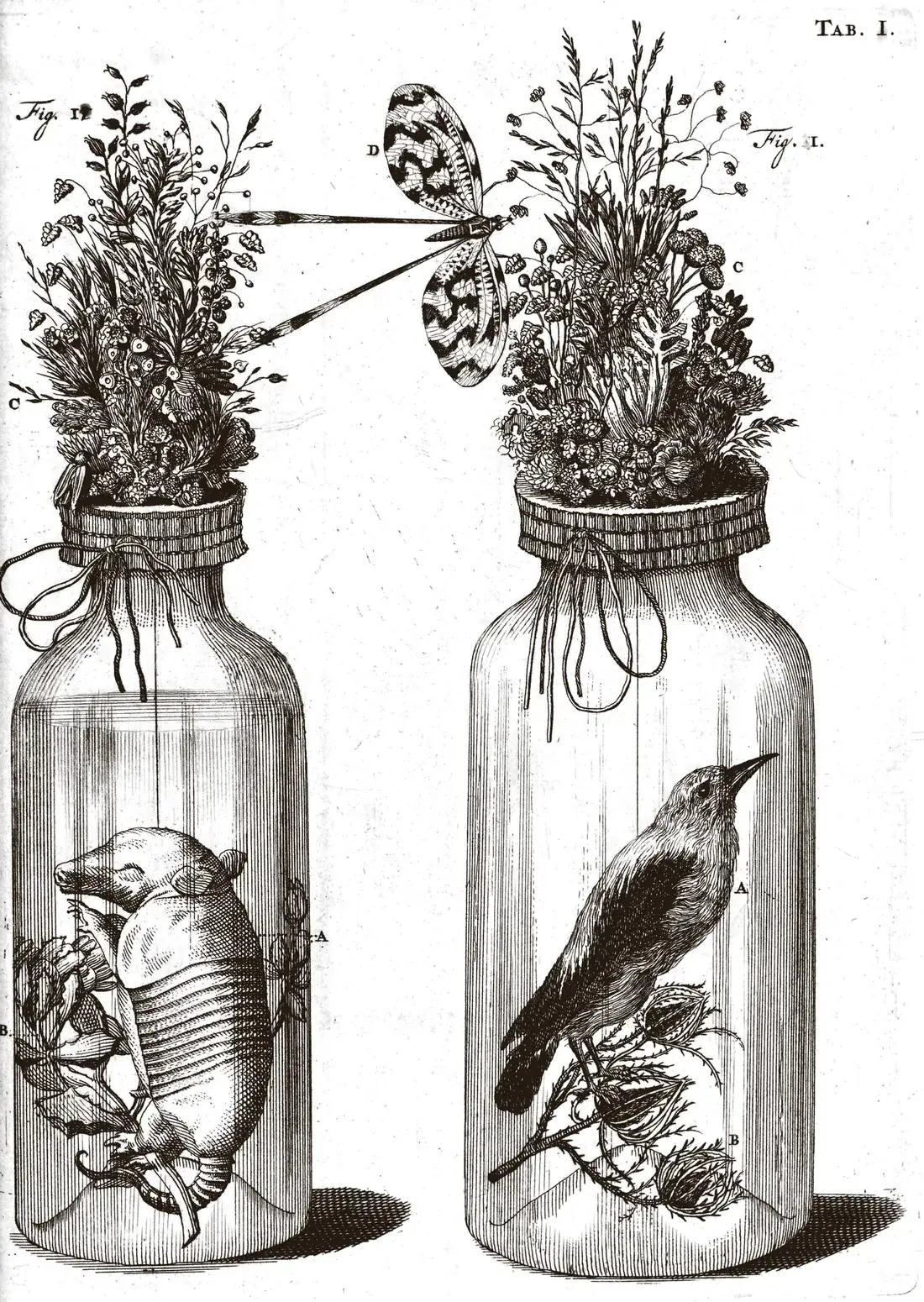
In Amsterdam the anatomist Frederik Ruysch (1638-1731) made it an art. His spirit was clear and spiced with pepper, and he kept the recipe secret. He wrote that his little bodies, kept for twenty years, were "so neatly preserved that they seem to sleep rather than be dead". He dressed the cut edges in lace so that the sight would not be unpleasant to the eye, nor evoke fear or disgust; his daughter Rachel, later a famous flower painter, made collars, cuffs and caps for them. He crowned the lids with dried plants, shells and seahorses, which is where the crown on this jar comes from. Peter the Great bought his collection in 1717 for 30,000 guilders, and 916 of his preparations survive in the Kunstkamera in St Petersburg. The story that the sailors drank the spirit on the way to Russia is a legend from the nineteenth century.
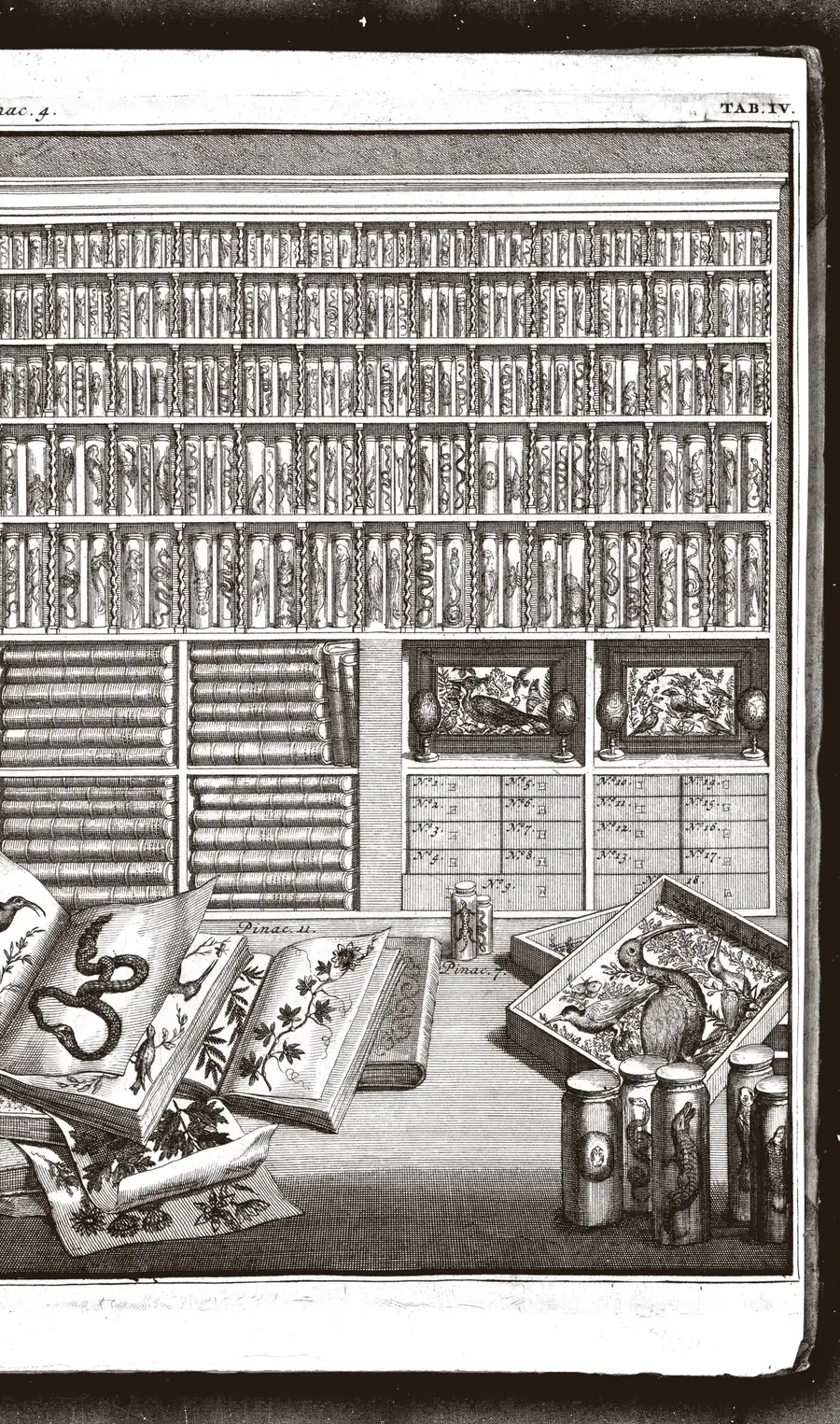
A jar had to be shut tight, or the spirit crept away. The Dutch way was a cork or a plate of slate, a pig's or sheep's bladder over it, varnish, and wax on top; Albertus Seba's jars had red wax. In 1836 John Cross of Worcester published a whole booklet on closing them: bladder, a thin sheet of lead, bladder again, black paint and coach varnish. Screw lids came with John Mason's jar in 1858.
In 1893 Ferdinand Blum, a doctor in Frankfurt, noticed that formaldehyde had hardened the skin of his own fingers, and that a mouse left in it overnight felt like a spirit preparation. Since then specimens are usually fixed in formalin and kept in 70 percent ethanol. At Museum Vrolik in Amsterdam the sterk water was alcohol of about 60 percent at first, and formalin came at the end of the nineteenth century.
Old jars turn yellow because fats seep out of the specimen into the spirit and oxidise, pale yellow at first, later orange; the Museum für Naturkunde in Berlin calls its jars amber, and a ray that was once dark is now pale. Jars also get weaker. Ethanol evaporates faster than water, so every jar has to be checked and topped up. The Natural History Museum in London keeps its spirit collection on 27 kilometres of shelves in the Darwin Centre, and the Berlin museum has more than 320,000 jars holding about a million animals.
And the sound. Tap a glass above the liquid and it rings high and long; tap it below and the liquid weighs on the wall, so the note is lower and dies sooner. Liquid lowers the pitch of a struck glass (Jundt and colleagues, Journal of the Acoustical Society of America, 2006, on wine glasses). A bottle you blow across does the opposite, because there the air rings. The glass on this shelf follows the same rule.
Two heads
The word on the label is Latin: biceps means two-headed, and the muscle is named after its two heads. Livy, listing the omens of a plague year in the 170s BC, writes that in the territory of Veii "biceps natus puer", a two-headed boy was born.
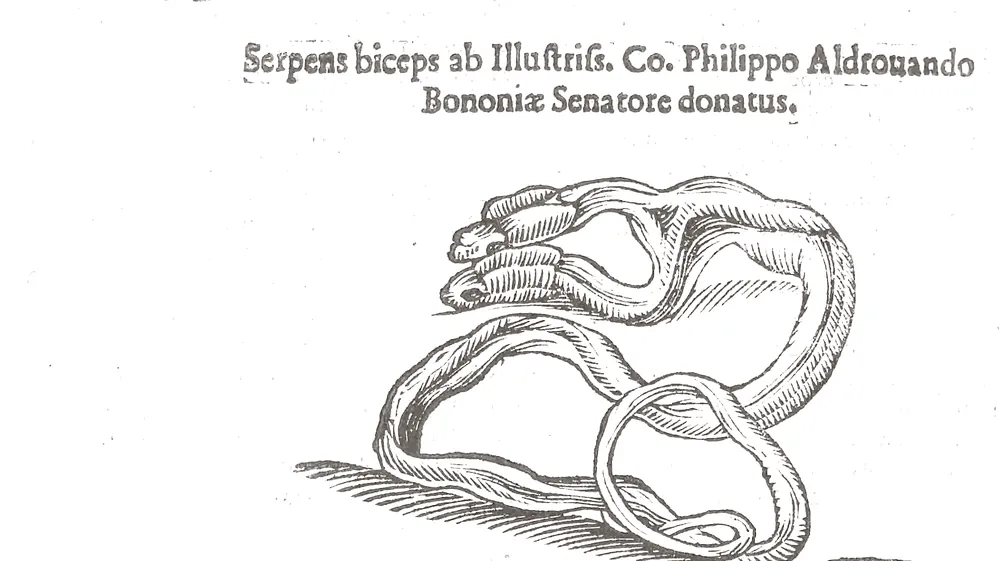
Two-headed snakes are real. Van Wallach of Harvard's Museum of Comparative Zoology counted more than a thousand documented cases, in at least 170 species. Most are stillborn or live for hours or days; a few have lived for years in captivity. The amphisbaena of Pliny and Lucan, with a head at each end, never existed; the real ones have both heads at the same end. Ulisse Aldrovandi pictured one in Bologna in 1640, "very carefully dried", a gift to the public museum, which is the snake in the second jar here.
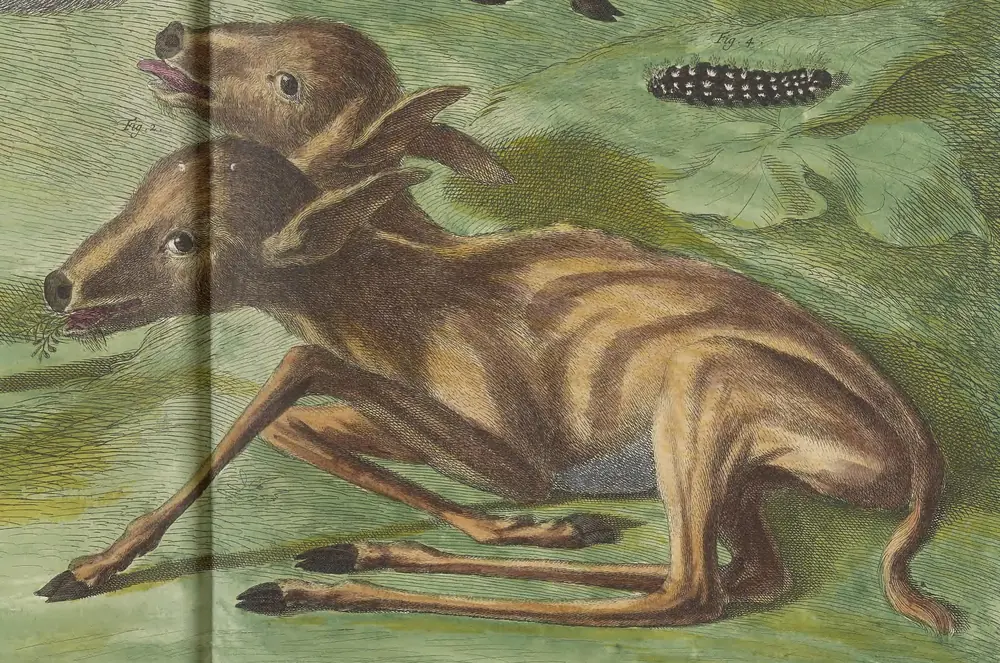
For centuries such births were read as wonders and warnings. Ambroise Paré's Des monstres et prodiges (1573) and Fortunio Liceti's De monstris (1616) collected them. Paré opened a two-headed child born in Paris in 1546 and found one heart, "so one may say it was only one child". This page does not show their woodcuts. In Russia, Peter the Great's decree of 13 February 1718 paid 100 roubles for a living human "monster" and 10 for a dead one, fined anyone who hid one ten times the reward, and ordered the dead put in spirits and closed tightly. The decree says two infants with two heads each had already been handed in, and that such births are not the devil's work. The Kunstkamera, the museum Peter founded, cleared its great anatomy hall in 2025; its director said it should no longer be a hall of freaks.
The two-headed boy of Bengal
There was a real two-headed boy. He was born in May 1783 near Burdwan in Bengal, to poor parents. The midwife, terrified, threw him on the fire, and one eye and ear were burnt. His second head sat upside down on top of the first, crown to crown. His parents carried him about the streets of Calcutta as a curiosity, to be seen for money. When he was about four his mother went to fetch water and came back to find him dead from the bite of a cobra. He was buried near the Rupnarayan river and dug up again, and his double skull went to John Hunter's collection in London, where the Royal College of Surgeons still keeps it. The surgeon Everard Home described him in the Philosophical Transactions in 1790.
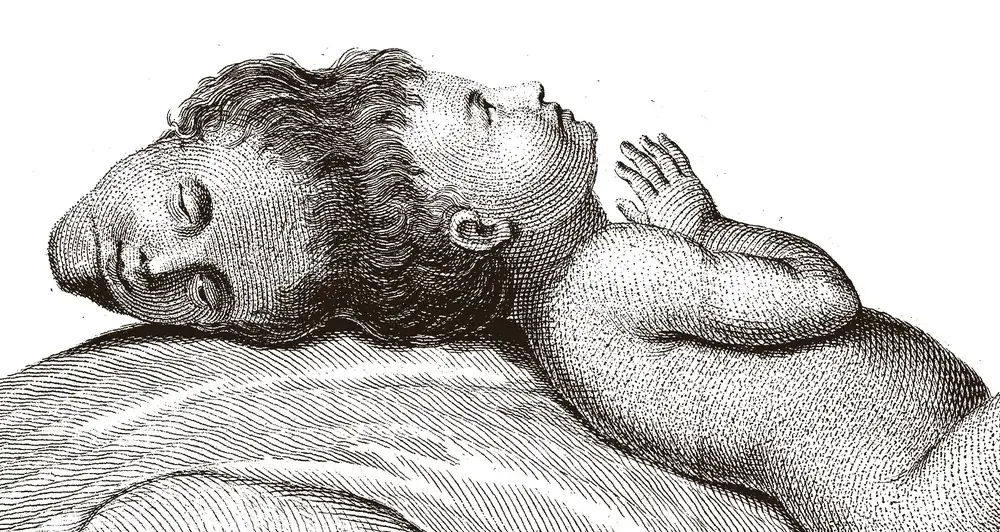
Conjoined twins are people, and the ones whose bodies ended up in collections rarely had a say in it. Museum Vrolik in Amsterdam, which keeps 840 preparations with congenital anomalies, does not allow photographs out of respect for the dead, and says it often does not know whether they or their families ever agreed. The new ICOM Code of Ethics for museums, adopted on 25 June 2026, asks museums to "uphold the inherent dignity of human remains". That is why the boy on the shelf is invented.
The needle that sings
Through the ear trumpet you hear a slow tick. It is a gramophone needle in the locked groove at the end of a 78: one click a turn, 78 turns a minute. The 78 became the norm in the 1920s, and in practice records turned at 78.26 on the 60-cycle mains of America and 77.92 on the 50-cycle mains of Europe. Either way the tick falls inside the 60 to 100 beats a minute of a resting adult heart (British Heart Foundation), which is why it sounds like one.
Under the tick there is radio. Radio operators have fought fading since the 1920s with two aerials set a little apart, because one of them usually hears the signal while the other loses it; Harold Beverage and H. O. Peterson of RCA called it diversity reception in 1931. A boy with two heads is a diversity receiver. If you have found stations on the Alicorn Wireless next door, he picks those up through the wall.
The singing saw
Julian Koster played the singing saw on In the Aeroplane Over the Sea; you can hear it on the title track. A saw sings when you bend the blade into an S and draw a bow along its back. The note lives on the line where the bend turns over, a sweet spot that physicists at Harvard explained in 2022. I have a music saw and a bow at home and play it now and then. The one on this shelf is made of sine waves: take it up, hold down on the picture to draw the bow and move up and down to bend the blade. What you play you can keep as a 24-bit WAV and use in your own music, no need to ask.
Questions
What is "Two-Headed Boy" by Neutral Milk Hotel about?
Jeff Mangum never explained it. In his one interview about it (Puncture, 1998) he said only that each section "came out at a different time". Critics hear a boy in a jar listening to a radio: Mark Richardson (Pitchfork, 2005) a child "trapped in a jar of formaldehyde", Steve Tignor (Puncture, 1998) a song about "communication at its most desperate", Kim Cooper (2005) a boy in a jar building a radio for the woman outside it.
Is "Two-Headed Boy" about Anne Frank?
Not by Mangum's own account. In 1998 he said that "a lot of the songs on this record are about Anne Frank", after he had read her diary and "spent about three days crying", but he did not name this song. Some critics, Kim Cooper among them, read her into it.
When was In the Aeroplane Over the Sea released, and where was it recorded?
Merge Records released it on 10 February 1998. It was recorded from July to September 1997 at Pet Sounds Studio in Denver, with Robert Schneider producing. "Two-Headed Boy" is track 4 and "Two-Headed Boy Pt. Two" closes the album.
Who played the singing saw on the record?
Julian Koster, who is also credited with the accordion. The liner notes do not say on which songs; you can hear the saw on the title track.
What does "op sterk water" mean, and what is a wet specimen?
It is Dutch for "in strong water": kept in alcohol. A wet specimen is an animal or a body part kept in fluid, in English also called fluid-preserved or in spirit. Today specimens are usually fixed in formalin and kept in 70 percent ethanol.
How long have animals been kept in jars of spirit?
Since at least 4 June 1662, when William Croone showed the Royal Society two puppy embryos kept "in spirit of wine in a glass-vial sealed hermetically". Robert Boyle published the method in 1666.
Why are old specimen jars yellow?
Fats seep out of the specimen into the spirit and oxidise, turning it pale yellow and later orange. The Museum für Naturkunde in Berlin calls its jars amber.
Are two-headed animals real?
Yes. In snakes alone more than a thousand cases are documented, in at least 170 species (Van Wallach, 2008). Most die young; a few have lived for years in captivity. The real ones have both heads at the same end.
Is the boy in the jar real?
No. He is invented, after the song, and built and lit on a computer. Real children in jars are kept in medical museums that ask visitors not to photograph them, out of respect; this page does not show any.
Can I hear the song here?
Yes: the official Bandcamp player from Merge Records is in the first section of this page, opened on "Two-Headed Boy". The album is also on Merge's site, the band's site walkingwallofwords.com, Spotify and Apple Music.
Does it work on a phone, and is it free?
Yes and yes. Tap the glass with a finger, hold the Listen button for the ear trumpet, and shake the phone itself once you allow motion. No account, nothing to pay. Your browser keeps the side you tapped last and your sound setting, and nothing else; Google Analytics counts what people do here, never anything about what you play or tap.
Sources
Every fact on this page was checked against these, on 7 October 2026:
- The song: Mike McGonigal, "Dropping in at the Neutral Milk Hotel", Puncture, Spring 1998 (archived copy) and Steve Tignor's review; Mark Richardson, Pitchfork, 2005; Kim Cooper, Neutral Milk Hotel's In the Aeroplane Over the Sea (33⅓, Continuum, 2005); Merge Records, 2023; the liner notes via Discogs.
- Anne Frank: the Anne Frank House.
- Spirit and jars: Thomas Birch, The History of the Royal Society, vol. 1 (1756) on Croone and Boyle; Boyle, Philosophical Transactions 1 (1666); F. J. Cole on Ruysch (1921); Kosenko, Steinicke and Kielstein (2022) and Boer, Radziun and Oostra (2017) on Ruysch's jars; Kathryn James on Petiver, Historical Journal (2022); John E. Simmons, Fluid Preservation (2014); John Cross (1836); Ferdinand Blum (1893); Museum Vrolik; Museum für Naturkunde Berlin; the WNT, sterk (II); Jundt et al., JASA 119 (2006).
- Two heads: Livy 41.21 (The Latin Library); Van Wallach in the Bulletin of the Maryland Herpetological Society (2008); Aldrovandi, Serpentum, et draconum historiae (1640); Paré, Deux livres de chirurgie (1573); Peter the Great's decree, PSZ no. 3159; Seba, Thesaurus vol. 1 (1734); Everard Home, An account of a child with a double head (1790) and the Royal College of Surgeons catalogue; Museum Vrolik on photography; the ICOM Code of Ethics (2026).
- Sound: Yale University Library and Peter Copeland, Manual of Analogue Sound Restoration Techniques (British Library, 2008), on 78 rpm; the British Heart Foundation on resting heart rate; Beverage and Peterson, Proceedings of the IRE (April 1931); Harvard SEAS, The physics of a singing saw (2022).
Credits and the rest of the cabinet
Built by Lloyd Stellar, electro producer and software developer from Hilversum. The shelf, the jars and the boy were modelled and rendered in Blender with the Cycles renderer; the boy started as a figure from MakeHuman, whose models are free (CC0). The flame, the moon, the flakes and the rings of light are drawn in your browser, and every sound is synthesised there with Web Audio; the far voices on the radio are S.A.M. (Software Automatic Mouth, 1982) in Christian Schiffler's SamJs. Plates: Ruysch (1710, Wellcome Collection), Vincent (1715, via Wikimedia Commons), Aldrovandi (1640, Biodiversity Heritage Library), Seba (1734, Smithsonian Libraries) and Home (1790, Royal Society, via the Internet Archive), all public domain. Type: IM Fell English by Igino Marini and EB Garamond, both under the SIL Open Font License.
An homage. This page is not affiliated with Jeff Mangum, Neutral Milk Hotel or Merge Records, and it reproduces no recording or lyrics of theirs beyond a few words.
More in Lloyd's Wunderkammer, the whole cabinet: the Alicorn Wireless, a ghost radio whose stations this boy can hear, the Brazen Head, Lloyd's Scriptorium and The Book Nobody Can Read. For my own music: Bandcamp and Spotify.
Finis