News archive
Everything that was ever announced on the home page, newest first: tools, games, releases and articles. The three newest items also stay on the home page.
All news
New Release: the Corporate Electro EP on CD, 40 copies with two bonus tracks
The Corporate Electro EP is out on CD. There are 40 of them, and each one has two bonus tracks that will never be released anywhere but on this disc. It costs €12.50 on Bandcamp.

The CD comes in a jewel case with an 8 page booklet. The front is the same fake 1989 car phone advert as the download, so on paper it still costs $125.00 including a free suit and telephone. The real price is €12.50, without the suit.
The six tracks of the EP stay a free download on Bandcamp, as before. The bonus tracks, Doomscrolling and Time is, Time was, Time is past, are only on the CD and will not turn up as a download later. The samples in Time is, Time was, Time is past come from the Brazen Head in my Wunderkammer.
Order it on Bandcamp, or look at the CD on my releases page first.
New Tool: Syd Vocoder, a free vocoder VST3 with the sound of the Nord Micro Modular
New under Plugins: Syd Vocoder, a free vocoder VST3 for Windows, Mac and Linux. For years every vocoder voice in my tracks has come out of an old Clavia Nord Micro Modular. Now that sound is a plugin with the synth built in: hold a chord, sing, and the synth speaks your words.
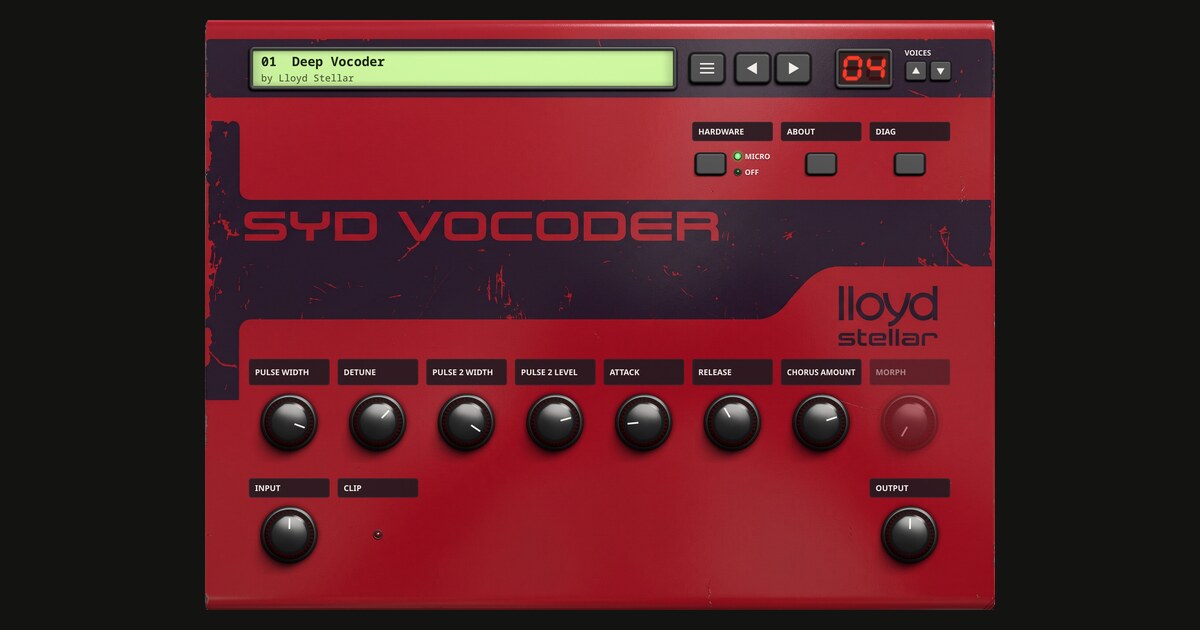
The Micro Modular is a virtual analog modular synth from the late 1990s. You can patch almost anything on it, but I only use mine for its vocoder, because to my ears no other vocoder sounds this good. I spent a long time rebuilding it as exactly as I could, without reusing any of Clavia's code: the same 16 bands and the same fixed-point arithmetic, small flaws included. A switch called HARDWARE adds a model of the Micro's own input and output converters.
Then I converted the vocoder patches from my Micro Modular into 21 presets: patches I downloaded from the internet long ago and my own. Each one has seven knobs and a Morph knob, like a Nord with a patch loaded.
There is a three-minute sound demo on the Syd Vocoder page, along with the downloads, the setup for Ableton Live, the install steps and the manual.
New Release: the new More Lasers, now for Windows and Mac
Lloyd's Lasers is retired, and it lives on in a new version of More Lasers. That leaves one free laser and zap synth instead of two plugins, and for the first time it runs on a Mac: a VST3 for Windows and Mac, an Audio Unit for Logic Pro and GarageBand, and a standalone version that needs no DAW at all.
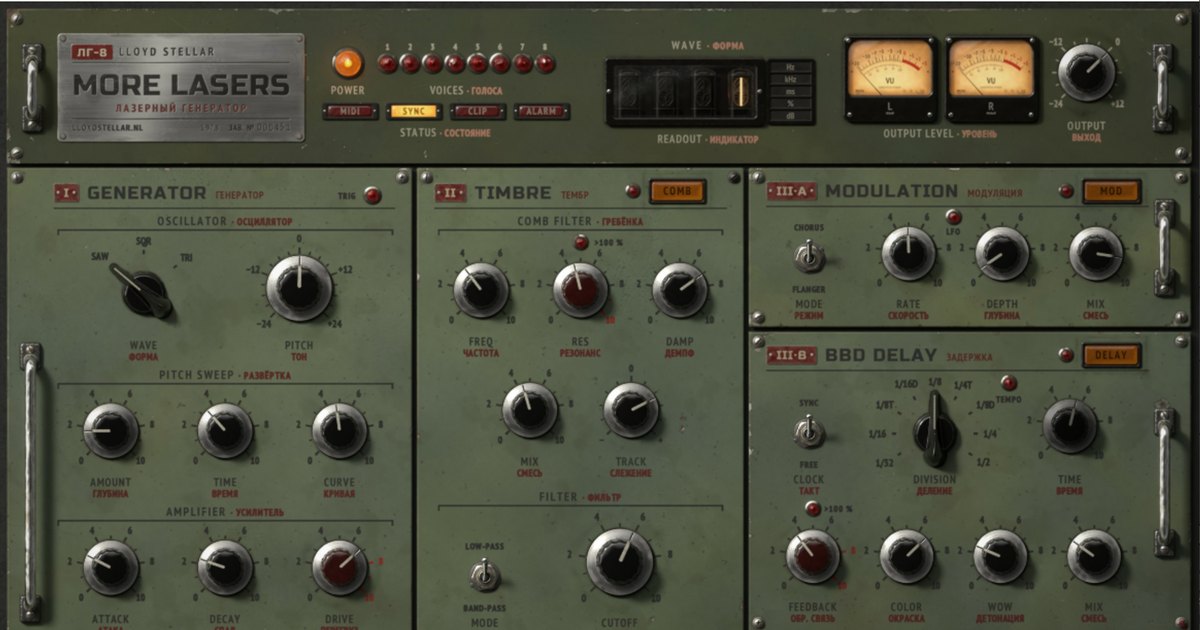
The new version got a new face: the control desk of a Cold War nuclear power station, in olive-green steel with heavy black knobs, red warning lamps, a Nixie tube readout and two VU meters. Every label is in English with the Russian one underneath.
The generator now has a saw, square or triangle wave, a zap section and a sub oscillator one or two octaves down. After the comb filter comes a low-pass or band-pass filter, and the effects are a chorus or flanger, a BBD delay and an alien reverb.
The Mac version is a universal build for Apple Silicon and Intel, for macOS 10.13 or later. It is not notarised by Apple, so the install steps include two lines for Terminal. The downloads and the steps for both systems are on the More Lasers page, and old links to Lloyd's Lasers take you there too.
New Tool: Lloyd's Robot Vocal, a robot voice VST3 that raps on the beat
New under Tools: Lloyd's Robot Vocal, a VST3 for Windows and Mac. Type your lyrics, pick a rap flow and one of 49 retro computer voices, and the plug-in raps them with every syllable on the beat of your song. It makes the MIDI clip for you as well: one note per line, drag it into Live, press play.
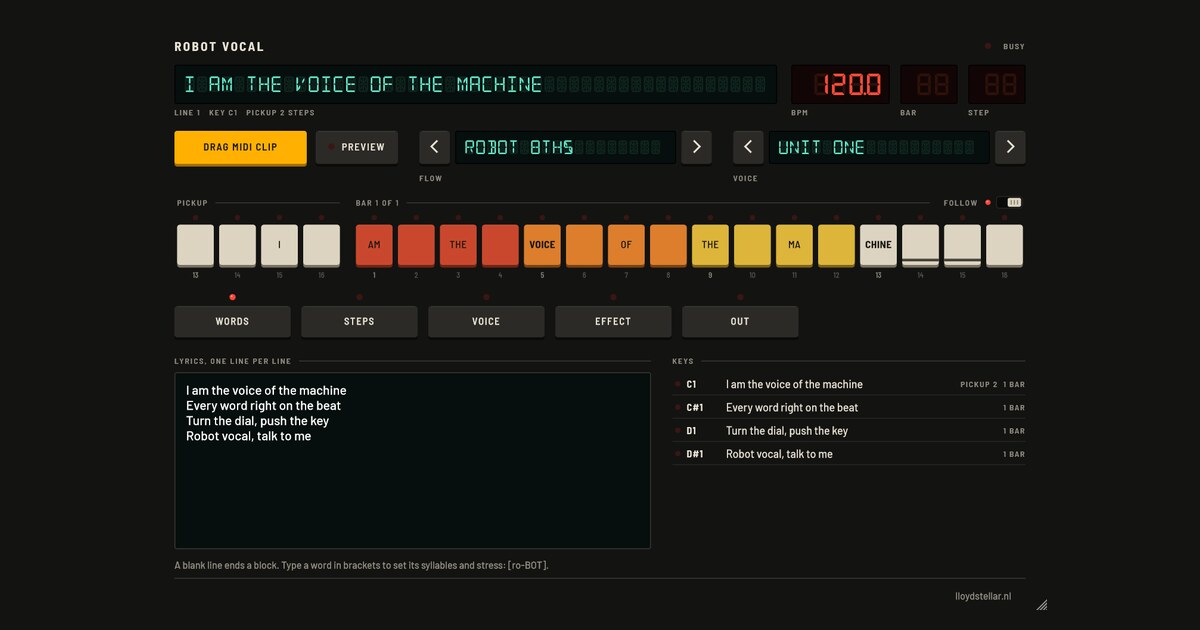
I am crazy about retro computer robot voices, and getting a robot vocal exactly on the beat was always a hassle. This plug-in does that part by itself. You choose from 17 rap flows, from robot 8ths and the electro 3+3+2 bounce to boom bap and half-time trap. Every flow has a BPM range where it works best, and it sounds better when your song sits somewhere inside it.
The voices come from old speech chips, early home computers, talking computers of the mid 80s and eSpeak NG, with vocoders, talkboxes and delays to put on top. I built it for myself and I will use it a lot, but other producers might like it too, so it is free.
On your phone, Robot Vocal is an Android app on Google Play that saves WAVs and can send the vocal straight to Ableton Live with App2Live.
The downloads for Windows and Mac, the install steps and the manual are on the Lloyd's Robot Vocal page.
New Tool: Lloyd's App2Live sends sounds from apps straight into Ableton Live
New under Tools: Lloyd's App2Live, a Max for Live device for Ableton Live 12.4. Make a beat or a loop in an app on your phone or in your browser, press Send to Live, click Import in Live, and every sound lands on its own audio track, named and warped to the tempo of the app.
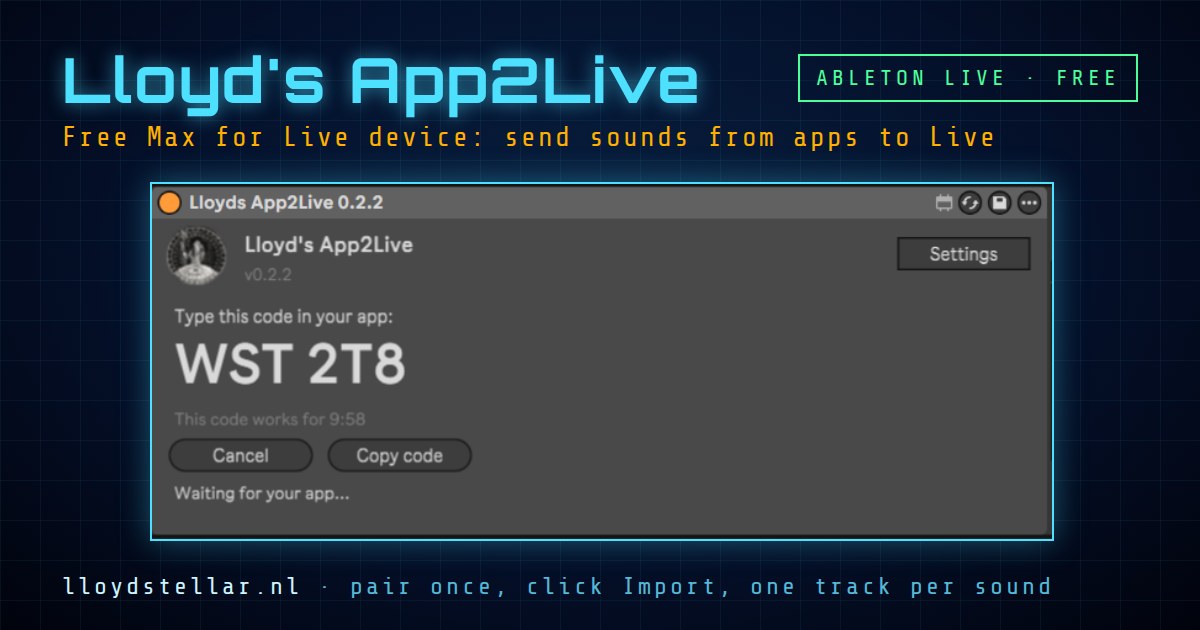
The first app that can send to it is my own online TR-808. Make a beat in the browser, click Send to Live under the stem export, and every drum arrives in Live as a four-bar loop on its own track. It works from a phone too: the sounds wait on the server for up to 24 hours, until you click Import. Your Set is never touched before that click, and LA2L never changes its tempo.
The device is open source. If you build web or Android apps yourself, the developer kit and the documentation are on GitHub, so your app can get a Send to Live button as well.
The download, the install steps and the screenshots are on the Lloyd's App2Live page.
New Tool: Lloyd's Sample Maker turns a jam into a sample pack
New under Tools: Lloyd's Sample Maker, a Max for Live device for Ableton Live 12. Put it on a track, press Record, jam for a while on your synths and drum machines, press Record again, and it cuts the take into one shots or loops. Listen, press Save or Skip, and every saved sound lands in your sample pack folder as a 24-bit WAV with a clean name and a number.
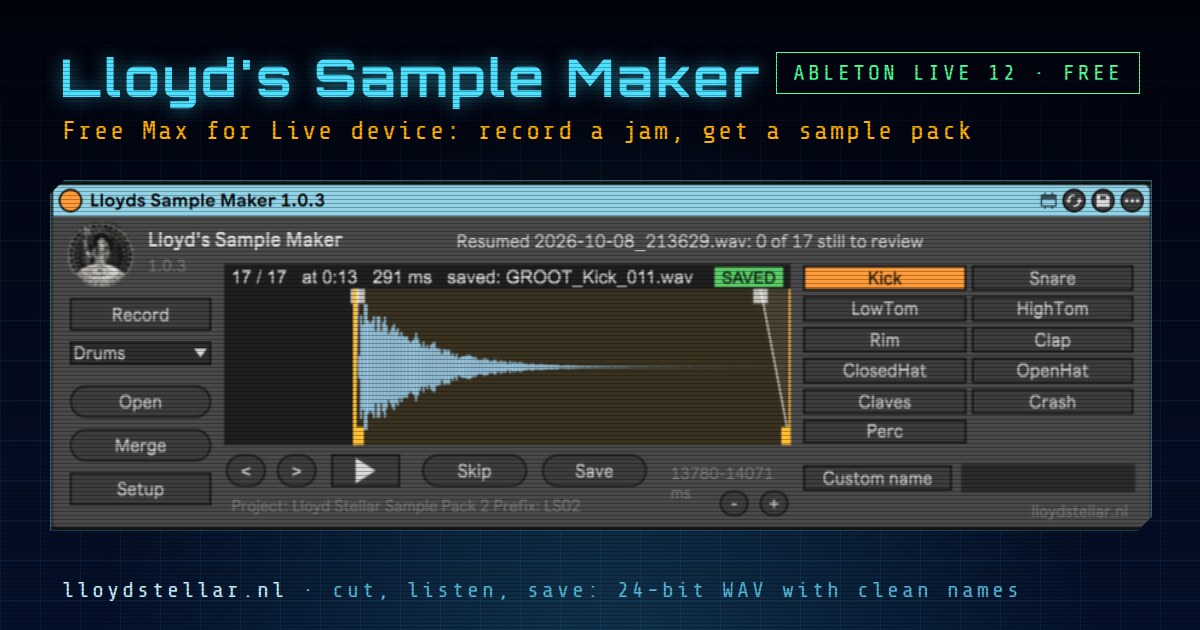
I made it for myself, because making sample packs was always a chore: record, export, trim, name, number, move the file to the right folder, keep a list of what was done. Now the device does that while I play. It is built around my own way of working, so you have to like my way. If you do, it is yours for free, with a six-page manual.
Six sound types (Drums, Synth, FX, Vocal, Drum loop, Synth loop), note detection for synth one shots, loops in whole bars at Live's tempo with the BPM in the file name, and a memory that survives switching Live Sets, so one pack can come from many tracks. You need Live 12 Suite, or Live 12 Standard with Max for Live, on Windows or Mac.
Download it from the Lloyd's Sample Maker page, or read the manual first.
New Game: The Alicorn Wireless, voices in the static
New in Lloyd's Wunderkammer: The Alicorn Wireless. Every old cabinet of curiosities had a unicorn horn, and nearly all of them were narwhal tusks. This one is wound with copper wire and wired to a valve radio with one big knob. Turn it and search the hiss for the signals people have heard in radio noise since 1876: lightning that whistles, a star that ticks, spies reading out numbers, the Wow! signal, and the voices some listeners believed came from the dead.
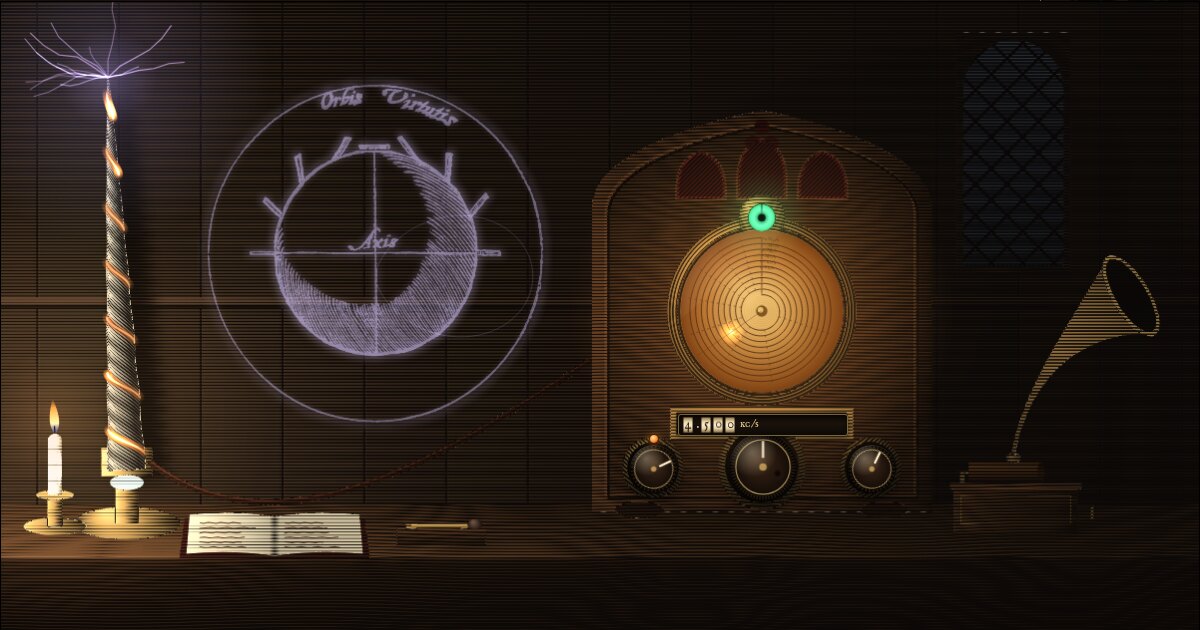
There are twenty-eight stations on the dial, each at the frequency where its story happened and each with its source: Friedrich Jürgenson at 1485 kilocycles, the Lincolnshire Poacher, Sputnik, Jupiter, the first pulsar, the hydrogen line. Some keep hours. The dawn chorus only sings in the early morning, the Sun only by day, and Jupiter only when its moon Io is in the right place, all worked out from your own clock. The Wow! signal comes once, and never again.
Below the last turn of the dial there is no radio at all, only five wax cylinders from 1888 to 1890, among them Florence Nightingale asking to be remembered by her voice. My own station is on the dial too, at 826 kilocycles: Hilversum. Whatever you hear can be saved as a 24-bit WAV to use in your own tracks.
Tune in at The Alicorn Wireless, under Curiosa in the menu.
New Game: The Brazen Head, a talking oracle from 1594
Next to the Scriptorium in Lloyd's Wunderkammer now stands a head of brass: The Brazen Head. It is the scene from Robert Greene's play of 1594: Friar Bacon has watched his talking head for sixty days and has fallen asleep, and you are his servant Miles, with a bell. Ask a question, keep watch, and ring the moment the head speaks. Miss it three times and you will see why the play is remembered.
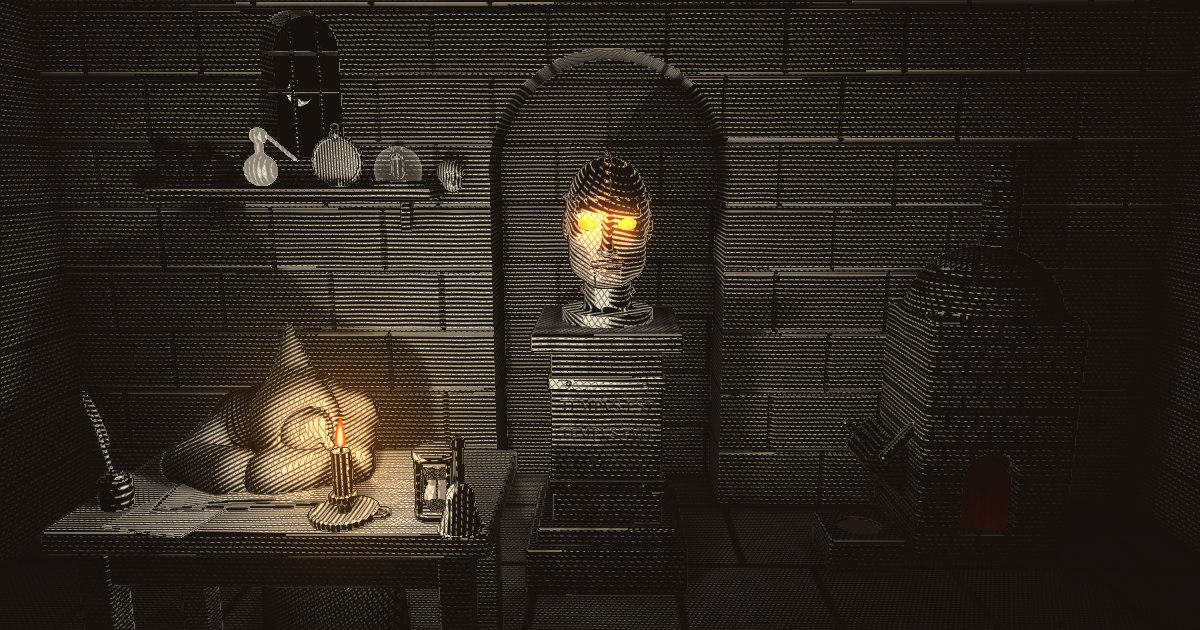
The vault is drawn by your graphics card as an engraving, line by line, and the shadows move when the draught catches the candle. Only the flame and the eyes of the head have colour. The head speaks with the voice of S.A.M., the speech program from 1982 that the terminal's vocoder command also uses, pushed through resonators that open and close with its jaw. Every answer is a quotation from an old book: Nostradamus in the English of 1672, Mother Shipton, the proverbs John Heywood collected in 1546, the spirits of John Dee, and after midnight Reginald Scot's Discoverie of Witchcraft.
Wake the friar in time and a drawer slides out of the pedestal. The head becomes a vocoder with twenty bands and three carriers that you play with the mouse, a finger or a computer keyboard laid out like a tracker, and you can save a take as a 24-bit WAV to use in your own tracks. A broken head stays broken until you work the bellows and cast a new one, and every new head carries one more seam.
You find The Brazen Head in the Curiosa menu.
New Tool: Lloyd's Scriptorium writes in forgotten alphabets
A new corner on the site, and a new desk in it: Lloyd's Scriptorium. Type a sentence and a quill writes it out in iron gall ink in one of nine historical scripts: the Theban "witches' alphabet" of 1518, the three angelic alphabets Agrippa printed in 1533, the secret letters of Hildegard von Bingen, the Enochian of John Dee, runes, ogham, and a Voynichese that nobody can read.
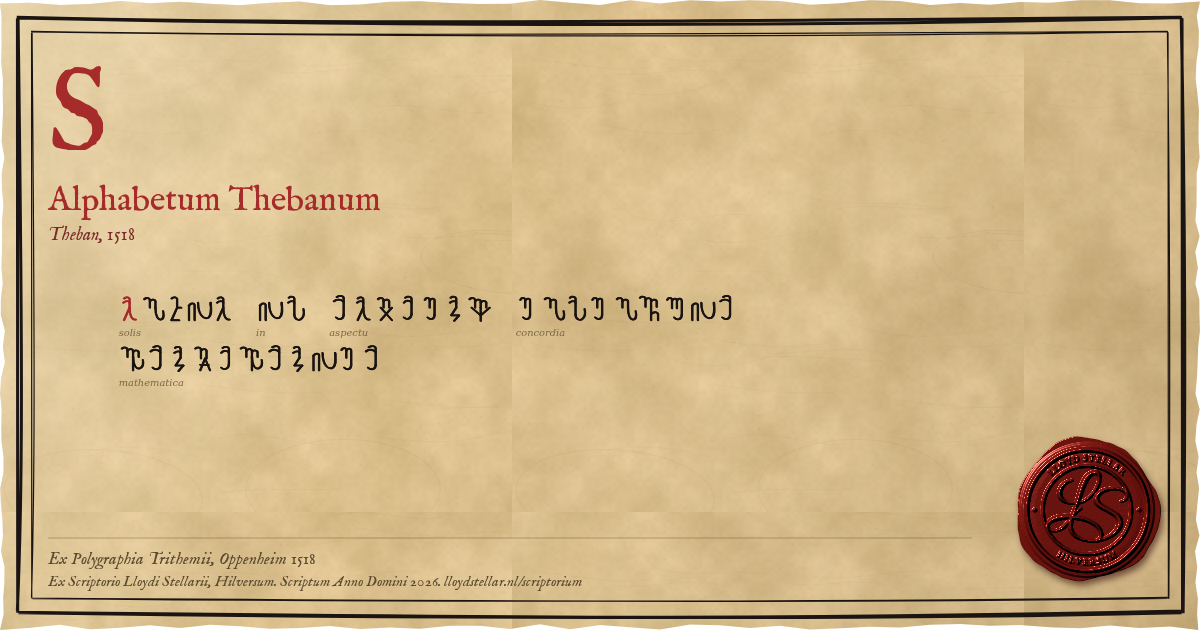
The desk has four tabs. Transcribe writes your words in one of the nine scripts, with the Latin under each word and a tilde over any sign the script does not have. Sigil takes a wish, strikes out the vowels and the repeated letters the way Austin Osman Spare described it around 1913, and traces what is left in one line over a letter wheel, the method of the Golden Dawn's Rose Cross: arcs along a ring, straight lines between rings. Square turns a name into numbers with Agrippa's Latin table and draws the line those numbers make over one of his seven planetary magic squares, Saturn to the Moon. Cipher enciphers a message on Alberti's disc of 1467, the tabula recta of Trithemius or the Vigenère square, and folds it into a sealed letter: a link with a wax seal that the receiver breaks to read the message. The letter lives in the link, there is no database.
Everything on the page is documented history, down to the library that keeps the original plate, and none of it is presented as working magic. I do not believe in any of it; I like the look of it, and the Bosch-era mood of the whole thing fits the music. Three exports: the full folio as a PNG, the ink alone as an SVG for a sleeve or a shirt, and a banner for a post. The wax seal is on by default and can be switched off.
Lloyd's Scriptorium is in the Curiosa menu, next to the Voynich investigation.
New Tool: the Bowie Lyrics Cutter, cut-up lyrics on a workbench
A new tool in the box: the Bowie Lyrics Cutter. It does what David Bowie did on a hotel floor in 1974: cut text into strips, shuffle them and glue a lyric together from the pieces. Poems from the public domain, your own notes or a PDF, all cut up on screen.
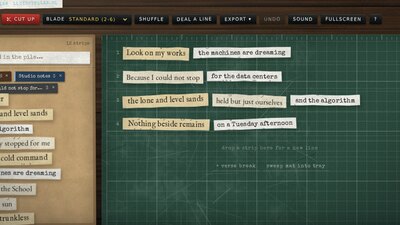
You put up to five texts on the bench: a poem from PoetryDB (Shakespeare, Dickinson, Poe, Blake, Whitman and about a hundred more poets, with 232 poems built in for when the database is down), something you type yourself, or a TXT, PDF or DOCX file that is read inside your browser. Press Cut up and the scissors slice everything into phrases of two to five words, cut between noun groups, verb groups and prepositions, so you get "under the moonlight" and "eats a lot of pie" instead of loose words or whole sentences. Every strip is a piece of paper with the right typeface for where it came from: old book type for the poems, a typewriter for your own notes, with a sliver of the neighbouring lines showing at the cut edge.
Then you dig. Search the pile for a word, shuffle it, or deal a random line onto the mat. Drag a strip between two others and they shift aside; drop it below the last line for a new one. When the lyric is there, export it as text, as a picture of the mat, or save the whole project as JSON to pick up later. It works on a phone too, held sideways, with a fullscreen mode.
The Bowie Lyrics Cutter page also tells the story of the technique, from Tristan Tzara's Dada recipe through Burroughs and Gysin to Bowie's Verbasizer.
New Game: 2048 Override, where you fuse signals to overload the AI
Game number five: 2048 Override. It is the year 2048, the AI NEXUS-9 owns every network, and you fight it from a hacked CRT terminal with the rules of 2048: slide data signals, fuse equal ones, build a 2048-bit pulse and take the local core down. The best scores go into a worldwide hall of fame.
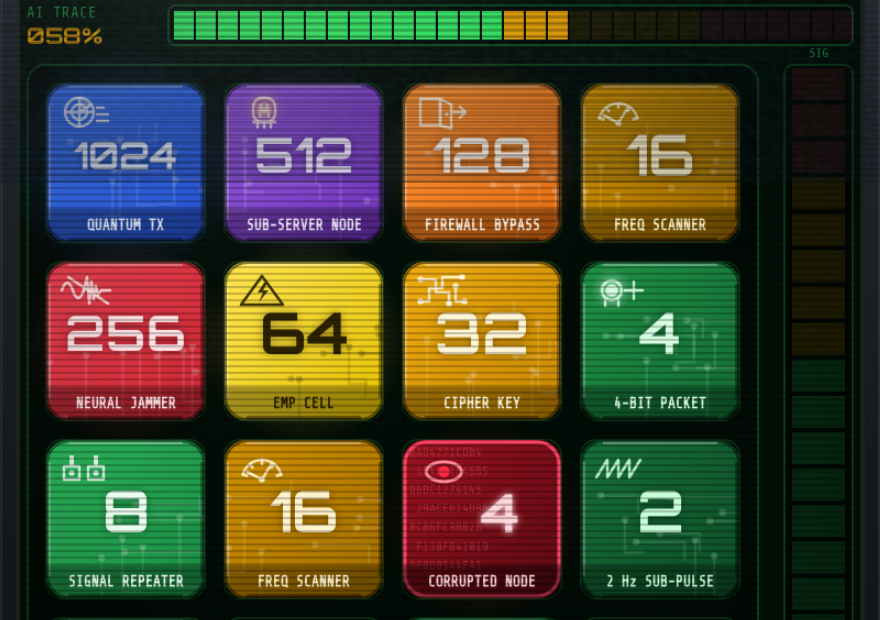
The sliding and fusing are exactly Gabriele Cirulli's 2048 from 2014. The room you play it in is new: a military CRT with scanlines and a curved glass, a VU meter that kicks on every move, a signal ladder, a system log and an AI Trace bar. Every value is a piece of resistance hardware, from a 2 Hz sub-pulse and a blinking 4-bit packet up to an EMP cell, a neural jammer, a vacuum-tube sub-server and a quantum transmitter with a sweeping radar. Fusions spark and send out a frequency ring. Moves without a fusion raise the trace; at 100% NEXUS-9 seals a cell for five turns. From tile 32 onward red Corrupted Nodes spawn that only an equal signal or a neighbouring 64 EMP Cell can remove.
The sound is synthesized live in the browser: a whoosh per slide, a spark per fusion that climbs in pitch with the tile value, and an electro loop underneath that picks up tempo and extra parts as your highest tile grows. Make 2048 and the screen strobes, the terminal speaks through the S.A.M. speech synth, and you can push on into Global Purge mode towards 4096 and 8192. Your best tile earns you phosphor colours for the terminal, six decrypted lore files and, at 2048, a transmission with my Corporate Electro EP.
2048 Override works with keyboard, swipes and touch buttons, and has a fullscreen mode for phones. The code is based on the open-source 2048 by Gabriele Cirulli (MIT licence).
New Game: Patch Bay, stacking synth modules in a Eurorack case
There is a fourth game in the arcade: Patch Bay. The classic seven falling shapes, except here you are a sound engineer whose runaway master clock keeps shipping synth modules into a Eurorack case. Mount them, close signal paths, and keep the magic smoke inside.
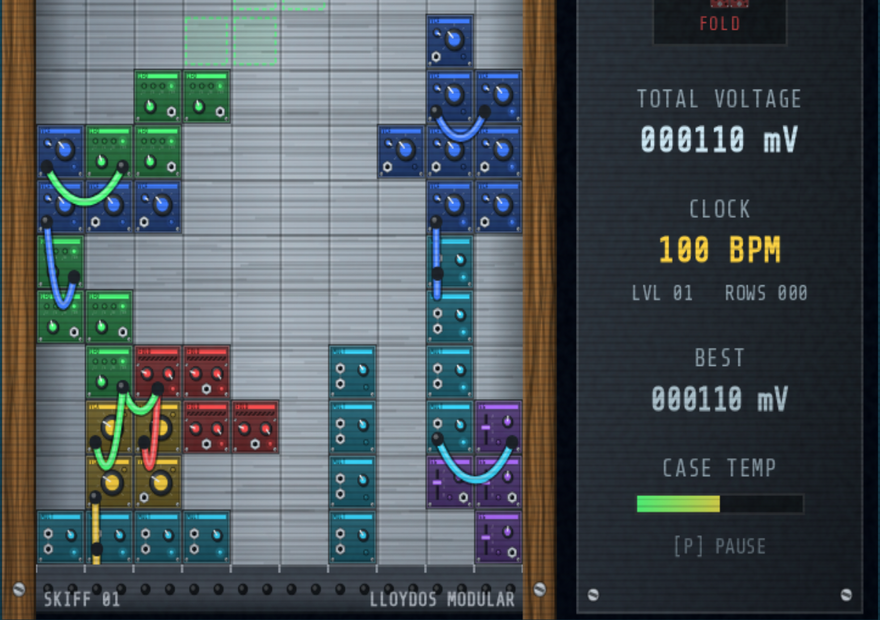
The rules are the ones Alexey Pajitnov wrote down in 1984: ten columns, twenty rows, seven shapes. Here the well is a Eurorack skiff with brushed aluminium, wooden cheeks and rails with screw holes, and the seven shapes are modules: a MULT, a quad VCA, an envelope, a VCO, a ladder filter, a clock divider and a wavefolder, each with its own panel, knob, jack and blinking LED. Every module you mount gets patched to its neighbours with a cable, so a full case turns into cable spaghetti. Your score is Total Voltage in millivolts, the speed is the master clock in BPM, there is a Buffer to park a module and a Pending Shipments queue of the next three.
The sound is effects only, so your own records can keep playing: each module type answers a landing with its own click, sweep or wobble, a drone thickens as the case fills, a voltage pulse runs through a closed row, a Master Patch of four rows triggers a strobe and a bass drop, and when the rack overflows you get a short circuit, a feedback squeal and a cloud of magic smoke. Voltage adds up across games and opens the Rack Customizer: black anodised, brass or neon cases, neon or braided cables, and soundbanks that route the row clears through the 808 samples of this site's drum machine, an acid 303 or West Coast FM blips. There are also three achievements for the real patchers.
Play Patch Bay in the arcade. The code is based on Jake Gordon's open-source JavaScript Tetris (MIT licence).
New Release: the Corporate Electro EP
My new EP Corporate Electro is out now on Bandcamp. Six tracks, a little over 31 minutes, and it is free. Pay what you want if you want to, or take it for nothing.

The artwork is a magazine advert that never existed. A man in a suit sits in a convertible with a car phone the size of a brick against his ear, and the offer next to him is $125.00 including a free suit and telephone. The small print warns that good looking hair and the convertible are not included, and that the deal runs until December 21, 1989. Call 555 and the rest of the number if you want to try.
The track titles are in the same mood: Do You Like Me Now?, Destroy Data Centers, Cherry Vanilla, Ban The Algorithm, Slingshot and Ruinerwold. Electro, self released, no label involved this time.
You can play the whole thing below or head to Bandcamp to download it in whatever format you prefer. Following me there is the easiest way to hear about the next one.
New Article: I gave the Voynich manuscript a lie detector test
I put the Voynich manuscript through a full statistical interrogation: entropy tests, word correlation curves, and a ghost writer program that produces convincing Voynichese. The strangest result: inside the words the text has the texture of a real language, syllable by syllable, while between the words it carries almost no information at all.
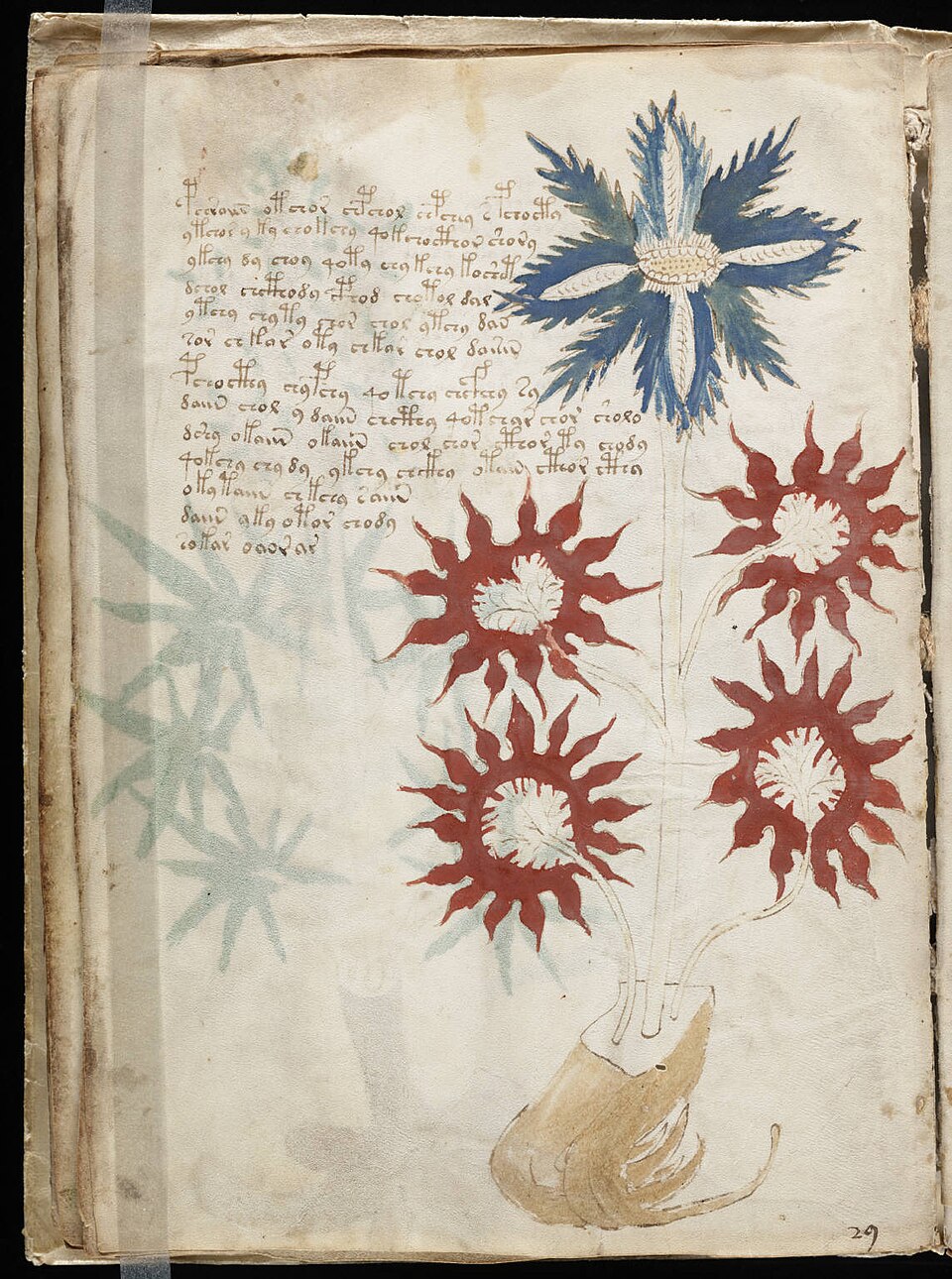
The Voynich manuscript is a 600-year-old book written in an alphabet that exists nowhere else, full of plants no botanist can identify. The best codebreakers of the twentieth century failed to crack it. Instead of trying to translate it, I measured it, comparing its statistical fingerprint against Latin, Middle English, Hebrew, Arabic and medieval Italian.
The short version: the words refuse to talk to each other the way words in every real language do, the text echoes what was visible on the page while it was written, and the building blocks are syllable-sized and lean Romance without matching any language I could test. There is also one kind of cipher that survives all of it, and I explain in the article why my own strongest result is no argument against it.
The long version, with manuscript images, the charts and the technical paper: The Book Nobody Can Read.
New Album: Music for Liminal Spaces by Warriors of Kagh
Music for Liminal Spaces is the new album from Warriors of Kagh, my ambient side project next to Lloyd Stellar. Eight tracks, and you can listen to them and download them for free on Bandcamp.
.jpg)
The music is made for liminal spaces: empty, in-between places that seem stuck between the past and the present. The eight pieces are instrumental, somewhere between dark ambient and liminal music.
It is about the uneasy nostalgia you feel for places that now only exist in memory, about being alone, and about the things that are left behind.
Released June 19, 2026, and produced by me. Besides Bandcamp, you find it on Spotify, Apple Music and the other streaming services.
New Release: More Lasers, a free VST3 laser & zap generator for Windows
My new VST3 plugin Lloyd Stellar: More Lasers does one thing: electro lasers and zaps. It is a sound generator with a pitch sweep at its core, a resonant comb filter that can overdrive, and built-in chorus, delay and reverb.
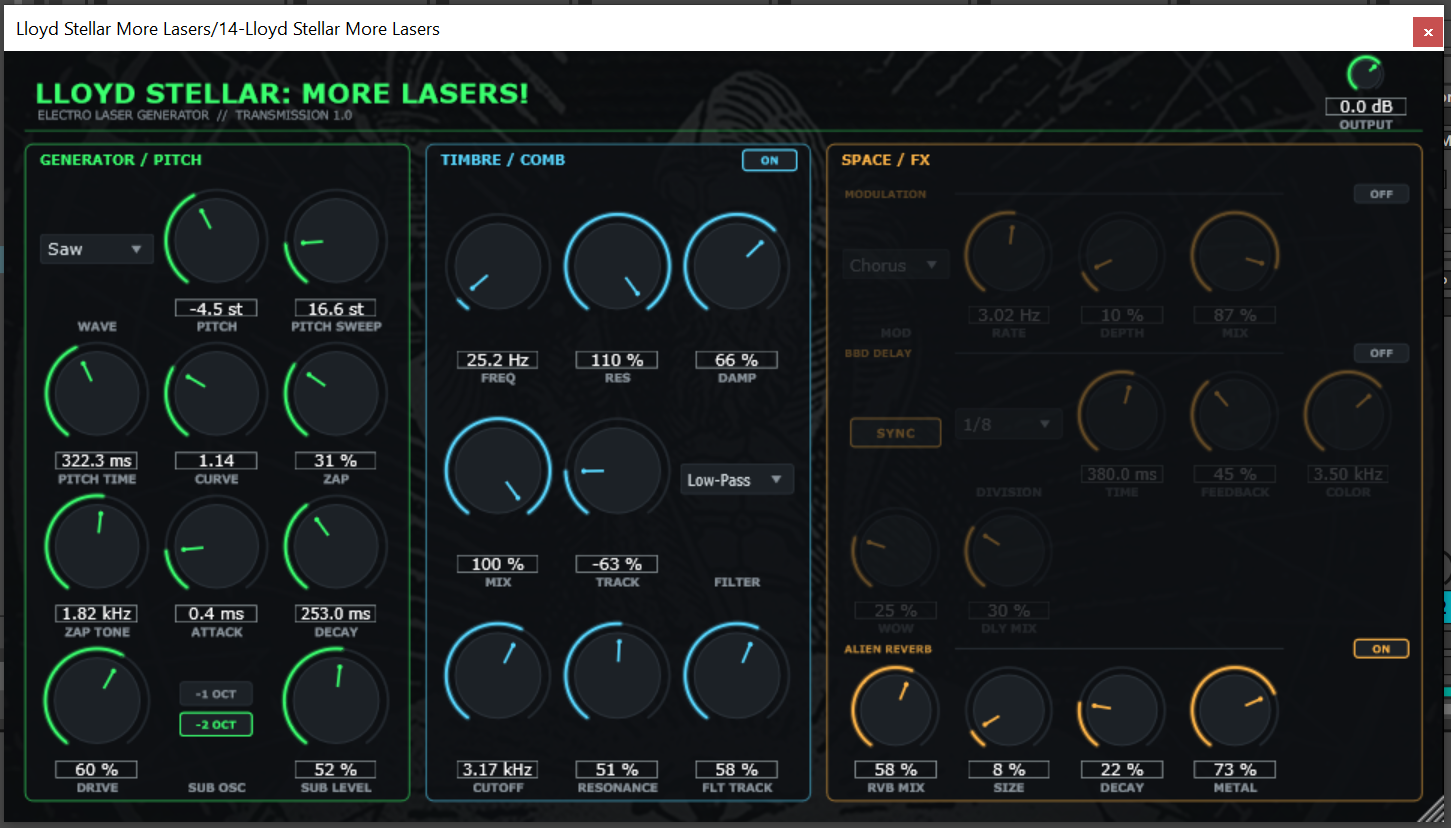
The generator sets the pitch sweep, its curve and its timing, which is most of what makes a laser sound like a laser. A sub oscillator and output drive add weight and grit. From there the sound runs through a resonant comb filter with damping and key tracking that can be pushed into harsh, metallic overdrive, followed by a low-pass filter with resonance.
The effects panel adds a chorus, a bucket-brigade style delay with tempo sync and wow, and a space reverb with a metallic character control. With those on, a plain zap cuts through a mix.
More Lasers is available for Windows only. I build and test everything on Windows and do not own any Apple hardware, so there is no macOS version for now. The download and the full feature list are on the More Lasers page.
Update, October 26, 2026: the new More Lasers runs on Windows and Mac, and it replaces Lloyd's Lasers. See the news item of that day.
New Release: Lloyd's Online Commodore 64, loaded with music software
New on the site: Lloyd's Online Commodore 64, an emulated Commodore 64 that I filled with music programs and other software about music.

The music programs include SID-Wizard, The Music Shop and Music Machine. Each one has a keyboard reference at the bottom of the page, so you know which keys do what.
There are also C64 games made by Legowelt (Danny Wolfers) and a few C64 demos with music in them. You pick a program from the dropdown menu and it loads.
The C64 was my first home computer. My father bought it when I was about 6 years old, and it still brings back good memories. You can try it at Lloyd's Online Commodore 64.