The Alicorn Wireless: Voices in the Static
A narwhal tusk, sold for centuries as the horn of a unicorn, wound with copper wire and wired to a valve radio. Turn the big knob and search the hiss for the signals people have heard in radio noise since 1876: lightning that whistles, a star that ticks, spies reading out numbers, a signal from Sagittarius that lasted 72 seconds, and the voices some listeners believed came from the dead. Every station sits at the frequency where its story happened. Below the last one there is no radio at all, only five wax cylinders from 1888 to 1890. Free, no account, and nothing leaves your browser.
No. IV Narwhal tusk, sold as the horn of a unicorn, wound with copper wire. Valve receiver in a walnut case. The tusk is drawn; the stations are real.

Arrow keys tune finely, Shift with an arrow tunes faster, Page Up and Page Down jump a whole turn of the dial.
The receiver is cold
A card tied to the tusk
Twenty-eight stations are on this dial and five wax cylinders below it. Some only speak at dawn, some only by day, and one only once.
Switch on and turn the big knob. Turn it slowly and it tunes finely. A whistle that falls in pitch means you are getting close; when it disappears and the green eye closes, you are there.
The plate is being engraved
With sound. Headphones help. Every voice is also written down.
This receiver needs JavaScript and Web Audio. The picture shows what you would see; everything below still applies.
How to tune
Switch on with the knob on the left. The valves need a few seconds; then the hiss arrives and the little green eye above the dial opens. The big knob in the middle moves a glowing bead along the dial, which is a spiral of ten turns: one cycle per second in the centre, ten thousand million at the rim, every turn ten times higher than the one inside it. The knob on the right jumps a whole turn at once.
Spin the big knob and let go, and it coasts on its flywheel. Turn it slowly and the slow-motion drive takes over, so the bead creeps. Near a station with a carrier you hear a whistle, the beat between the radio and the station; it falls in pitch as you get closer and disappears when you are exactly on it. Voices slide from chipmunk to human as they come into tune. Natural sounds have no carrier: they swell out of the hiss as the bead passes. When a station is locked, the green eye closes, light runs up the copper on the tusk and something draws itself in the dark above it. A slip tells you what you found and where it comes from.
Everything you hear is written underneath, and the eye works with the sound off. On a keyboard, the arrow keys tune finely, Shift with an arrow faster, Page Up and Page Down jump a turn, the space bar works the telegraph key and F fills the screen.
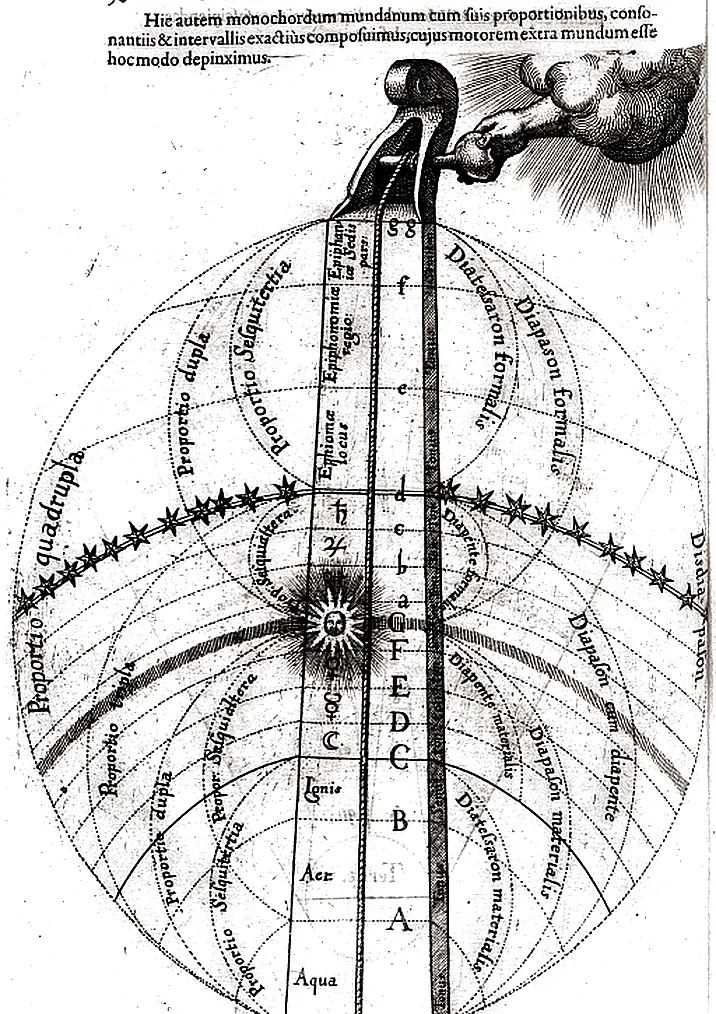
Why a narwhal tusk
Almost every cabinet of curiosities had a unicorn horn, and nearly all of them were narwhal tusks from the Arctic, traded as alicorn. They were believed to detect poison; at a royal table a piece of alicorn was said to sweat or change colour near a poisoned dish. Elizabeth I owned one valued at 10,000 pounds, and from 1671 to 1840 the kings of Denmark were crowned on a chair made of narwhal tusks, which still stands at Rosenborg Castle.
In 1638 the Danish physician Ole Worm showed that the unicorn's horn was the tooth of the narwhal. His own museum, the Museum Wormianum of 1655, is the engraving on the walls of this room. The tusk grows in a left-handed spiral, and in 2014 Martin Nweeia's team found it is a sensory organ with millions of nerve endings that react to the water around it. So the alicorn was a detector after all.
Lay a copper wire in its groove and you have a helix, the helical antenna that John Kraus worked out at Ohio State in the late 1940s and that went on to carry satellite radio. Kraus later designed Big Ear, the telescope that caught the Wow! signal. A left-handed helix answers to radio waves that turn to the left and ignores the ones that turn to the right. The narwhal's tusk spirals to the left.
What is on the dial
Every station is a real story, at the frequency where it was heard. Where history gives no frequency, I chose one and the station's slip says so. All the sounds are made in your browser after the descriptions in the sources; nothing is a sample of someone else's recording, except the cylinders at the end.
The Earth sings
In 1876 Thomas Watson, Alexander Graham Bell's assistant, listened at night to a long iron test line over Boston and heard snaps and chirps like birds. British radio operators in the First World War, listening in on enemy field telephones, heard tones that fell over a few seconds, almost like a person whistling or an incoming grenade
, and called them whistlers. In 1953 Owen Storey showed they are lightning: the crack of a strike runs out along the Earth's magnetic field to the other hemisphere and back and arrives as a falling whistle. Around dawn there is the dawn chorus, rising chirps like birds. Lightning strikes about 44 times a second somewhere on Earth, and in 1952 Winfried Otto Schumann worked out that the gap between the ground and the ionosphere rings like a bell because of it, at about 7.83 cycles per second. That one is on the dial too, far below hearing; the slip lets you hear its overtones five octaves up.
Tesla, Marconi and the first listeners
In the summer of 1899 Nikola Tesla heard regular signals at Colorado Springs that he could not place, with such a clear suggestion of number and order
that he thought of another planet. Later writers have suggested Marconi's experiments, or radio from Jupiter and its moon Io. On 12 December 1901 Marconi heard three dots, the letter S, on Signal Hill in Newfoundland, with a wire held up by a kite. He never measured the frequency, so the Marconi station sits at two places: at 366 metres, the wavelength given at the time, and near 3.5 MHz, where later analysis puts the signal that crossed the ocean.
Voices of the dead
On 12 June 1959 the Swedish painter and film maker Friedrich Jürgenson recorded birdsong and heard voices on the tape, among them, he wrote, his late mother. He went on to record from the radio between stations; 1485 kHz is still called the Jürgenson frequency. Konstantīns Raudive made over 100,000 such recordings. In 1980 William O'Neil built the Spiricom, and in 1982 George Meek told a press conference in Washington it allowed conversations with the dead; nobody has repeated it. Thomas Edison told a magazine in 1920 he was working on an apparatus for the dead, and in 1926 called it a joke. Between 1960 and 1964 two Italian brothers released recordings they said were Soviet cosmonauts dying in space; the space historian Sven Grahn calls it part of the mythology of the Space Age
.
Echoes
At the end of the summer of 1927, Jørgen Hals near Oslo heard PCJJ, the Philips shortwave station at Eindhoven, and three seconds later its echo. Carl Størmer and Balthasar van der Pol of Philips tested it the next year and logged echoes of several seconds. Nobody is sure what causes them. On this radio the telegraph key sends your own Morse, and sometimes it comes back.
The sky
Karl Jansky found the hiss of the Milky Way at 20.5 MHz in 1932, peaking every 23 hours and 56 minutes. In February 1942 British radars were jammed so badly that the Germans were blamed; J. S. Hey showed the jammer was the Sun. In 1951 Ewen and Purcell at Harvard, and six weeks later Lex Muller at Kootwijk with a converted German radar dish, caught the 21 centimetre line of hydrogen that Hendrik van de Hulst had predicted in occupied Leiden in 1944. Jupiter roars at 22.2 MHz when its moon Io is in the right place. Sputnik beeped on 20.005 and 40.002 MHz. Penzias and Wilson could not get rid of a hiss at Holmdel in 1964, sent away the pigeons and swept out their droppings, and found the afterglow of the Big Bang. In 1967 Jocelyn Bell found the first pulsar at 81.5 MHz. On 15 August 1977 Big Ear recorded the Wow! signal at 1420.4556 MHz for 72 seconds, and it never came back.
Spies and machines
From the 1970s until 2008 a station played a few bars of the folk song The Lincolnshire Poacher on shortwave and then a woman's voice read out five-figure groups. Since about 1982 a station on 4625 kHz has sent a short buzz about 25 times a minute. From 1976 to 1989 the Soviet radar Duga hammered across shortwave with a tapping of ten a second that listeners called the Russian Woodpecker. Electronic music never quite got over these sounds; Kraftwerk's Radio-Activity (1975) has a track called Antenna and another called Radio Stars.
The Dutch part
Three of these stories happened in the Netherlands: the Philips station PCJJ whose echoes were heard in Oslo, the hydrogen line predicted in Leiden and caught at Kootwijk, and the dish at Dwingeloo, which in 1956 was for a year the largest radio telescope in the world. And on the station dials of the 1930s, among Droitwich and Luxembourg, stood the name of the town I come from: Hilversum. It is on this dial as well, and that one is my station.
Why we hear voices in noise
Hearing a voice in noise is what brains do. Diana Deutsch's phantom words are a few syllables repeated from two loudspeakers, in which listeners hear words that are not there, and different people hear different ones. In 1981 Robert Remez and colleagues replaced speech with three whistling tones; most people hear whistles until they are told it is speech. In 2005 Matt Davis and colleagues showed the same with noise-vocoded speech, a voice rebuilt from a few bands of hiss: it is unintelligible until you know what it says, and then it pops out and you cannot stop hearing it.
The station at 1890 kHz is exactly that. It is a sentence spoken in 1890, rebuilt from bands of hiss, with more bands the closer you tune. The slip lets you read the words and listen again. The sweep switch on the medium wave works like the spirit boxes ghost hunters use: it chops the band into syllables, and the slip shows you every fragment it played. The psychologist James Alcock put it in one sentence: Electronic Voice Phenomena are the products of hope and expectation; the claims wither away under the light of scientific scrutiny.
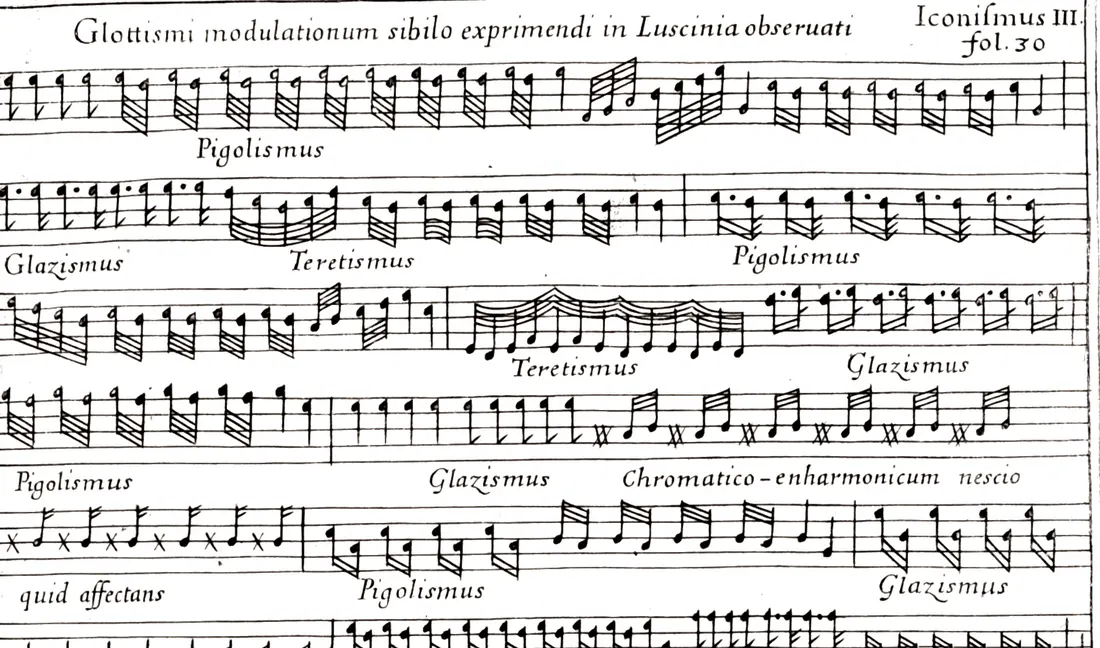
Five wax cylinders
Below the last turn of the dial the band switch clicks into GRAM, the old setting for playing records through a radio. In 1888 Edison's agent in London, Colonel George Gouraud, took a phonograph to the Handel Festival at the Crystal Palace and recorded a chorus of 4,000 voices from the press box. In April 1889 he recorded Robert Browning at a dinner party; Browning forgot his own poem. He died that December, and when the cylinder was played on the anniversary of his death it was said to be the first time anyone's voice had been heard from beyond the grave
.
In the summer of 1890 Gouraud recorded Alfred Tennyson, Florence Nightingale and the trumpeter Landfrey, a bugler of the Light Brigade at Balaclava, for a fund for the destitute veterans of the Light Brigade. Nightingale chose her words for the purpose: When I am no longer even a memory, just a name, I hope my voice may perpetuate the great work of my life.
These five are the only voices from the dead on this radio. They needed no medium; wax kept them.
Sources
Every slip on the dial names its source. The main ones:
- Natural radio: Whistler (radio), the dawn chorus, Schumann resonances, Thomas A. Watson.
- Tesla, Talking with the Planets (Collier's Weekly, 1901); Marconi at Signal Hill and Poldhu.
- Voices of the dead: Electronic voice phenomenon, Carl Michael von Hausswolff on Jürgenson in Cabinet, the Judica-Cordiglia brothers.
- Echoes: Sverre Holm on long delayed echoes.
- The sky: the hydrogen line, Lex Muller, J. S. Hey, PSR B1919+21, the Wow! signal, the pigeons at Holmdel, perytons.
- Spies: UVB-76, the Lincolnshire Poacher, Duga.
- The ear: Diana Deutsch's phantom words, Matt Davis on noise-vocoded speech.
- The tusk: Ole Worm, the tusk as a sensory organ, the helical antenna.
- The cylinders: Nightingale, Tennyson, Browning, Handel (all Wikimedia Commons, public domain) and Landfrey (Project Gutenberg, from the Edison National Historic Site).
Questions
Is this a real spirit box?
No. Nothing on this radio comes from the dead or from space. Every station is made in your browser after its documented history, except five wax cylinders from 1888 to 1890, which are real recordings in the public domain. The sweep switch works the way spirit boxes work, and the slip shows you how it fools the ear.
Does it pick up real radio signals?
No. A browser cannot receive radio. The tusk and the receiver are drawings; the stations are reconstructions of real signals at the frequencies where they were heard, with the sources on each slip.
Why does the Wow! signal only happen once?
Because the real one did. Big Ear recorded it for 72 seconds on 15 August 1977 and nobody has heard it again. Here it comes once per browser, if you wait for it; the logbook keeps the printout.
Why is a station silent?
Some keep hours. The dawn chorus comes in the early morning, the Sun only by day, the hiss of the galaxy follows the stars, and Jupiter only roars when its moon Io is in the right place. All of it follows the clock of your own computer or phone; nothing asks where you are.
What is the Jürgenson frequency?
1485 kHz on medium wave. Friedrich Jürgenson, who started recording what he believed were voices of the dead in 1959, later recorded from the radio between stations around 1445 to 1500 kHz, and 1485 kHz is still called the Jürgenson frequency.
What does a pulsar sound like?
Like a slow, steady tick. The first pulsar, found by Jocelyn Bell in 1967 at 81.5 MHz, pulses every 1.3373 seconds. On this radio every pulse also draws one line of the stacked plot that later became the cover of Joy Division's Unknown Pleasures.
Can I use the recordings in my own music?
Yes, without asking. Record on wax saves 30 seconds of whatever you hear as a 24-bit WAV. All sounds except the five cylinders are made in the browser, and the cylinders are in the public domain. Credit is welcome but not required; it is in the file.
Why do I hear nothing?
Sound starts when you switch the radio on, because browsers only allow sound after a click. Check the sound button at the top of the receiver, and on an iPhone the silent switch, which also silences web pages.
Is anything stored or sent?
The logbook is kept in your own browser and nowhere else. Google Analytics counts which stations people find, never anything you type.
Credits and the rest of the cabinet
Built by Lloyd Stellar, electro producer and software developer from Hilversum. The receiver, the tusk and the candle are drawn in code and engraved line by line in your browser; the sounds are synthesised with Web Audio. The voices are S.A.M. (Software Automatic Mouth, Don't Ask Software, 1982) in Christian Schiffler's JavaScript port SamJs. The plates that appear in the dark are by William Gilbert (1600), Robert Fludd (1617), Christoph Scheiner (1630) and Athanasius Kircher (1650), and the title woodcut of Robert Greene's play (1630), all public domain via Wikimedia Commons. Type: IM Fell English by Igino Marini and EB Garamond, both under the SIL Open Font License.
More in Lloyd's Wunderkammer, the whole cabinet: The Brazen Head, a talking oracle of brass that can also be found somewhere on this dial, Lloyd's Scriptorium for forgotten alphabets, and The Book Nobody Can Read. The online TR-808 broadcasts here as well. For the sound of all this: my music is on Bandcamp and Spotify.
Finis